Email marketing
Bohdan Prylepa: reviews of email marketing agencies and one email from list to report
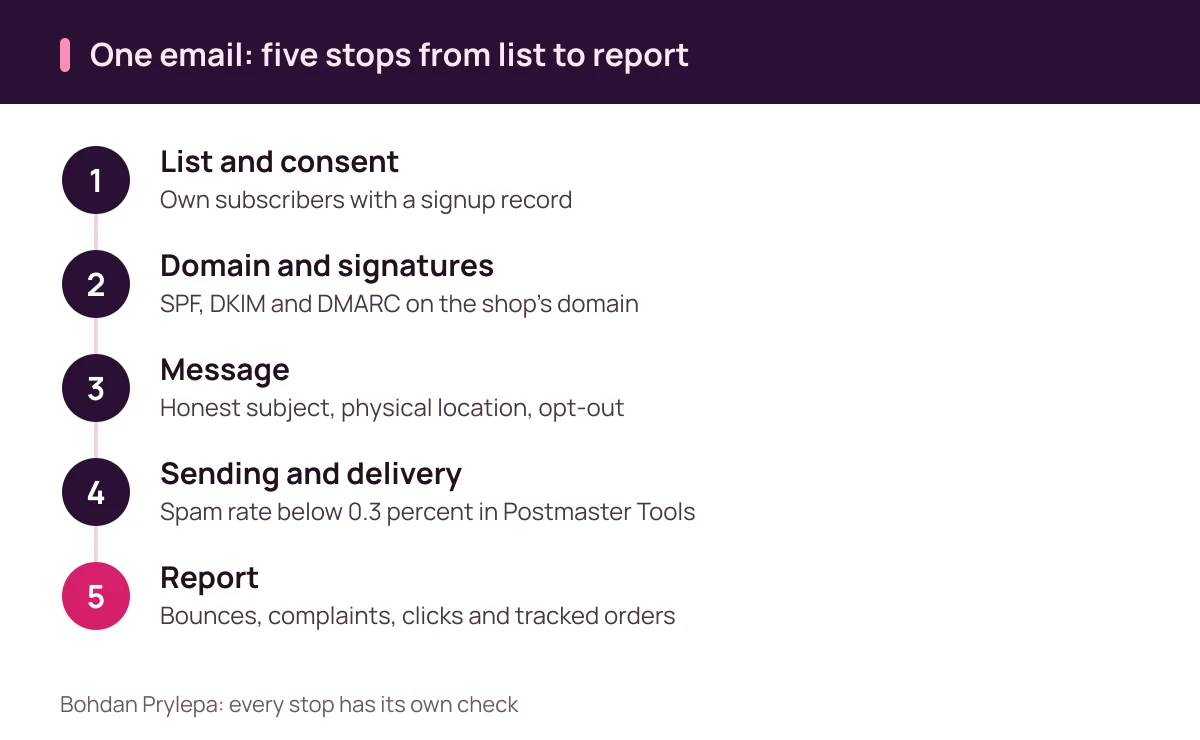
On Monday the owner of a small online coffee roaster opens a report from her email agency: 63 percent of recipients opened the discount email and 12 percent clicked. Orders for the week went up by four. The numbers are invented; the gap is real for many firms. Bohdan Prylepa, a digital marketer and founder of the agency TargetForce, follows one email through seven stops: the list, consent, the domain and its signatures, the message, sending, delivery and the report. For anyone searching “Bohdan Prylepa reviews”, the article also shows how to read reviews of email marketing agencies before signing with one.
Bohdan Prylepa: reviews of email agencies start with one email's path
Email looks like the calmest marketing channel: your own list, your own domain, messages going out on schedule. It also has plenty of places where a contractor can change the result without the client noticing.
The example is a composite, and every figure in it is invented for the arithmetic. The roaster has 12,000 subscribers collected through its site over three years. The agency charges $2,400 a month and offers to “expand reach” with 40,000 more addresses of “coffee lovers.” A month later the list holds 52,000 names, the report shows healthy percentages, and Gmail has started filing the roaster's mail as spam.
People type “Bohdan Prylepa reviews” when they want to know who wrote the guide and whether an agency's promises and testimonials hold up. The article describes schemes and rules and makes no claims about any person or company, and the query “Bohdan Prylepa reviews” leads to a review of the email itself.
The list: owned subscribers, rented lists and spam traps
The first stop is the list. An owned subscriber typed in an address at checkout, on a signup page or in a discount form, and the shop can show when. A rented or bought list was put together by someone else, and nobody on it asked to hear from a coffee roaster. The difference shows on the first send: owned addresses mostly accept the message, while bought ones bounce because many no longer exist.
Mailbox providers and anti-spam services also run trap addresses. Some never belonged to a person and only show up in lists scraped by software. Others were real inboxes that were abandoned and later turned into traps. A message to a trap tells the filter one thing: this sender did not ask permission. Nobody can spot a trap by eye; only the address history gives it away.
The warning sign at this stop sounds generous: “we'll add 40,000 engaged addresses in your niche.” A careful contractor asks where your addresses came from and brings none of its own. The FTC compliance guide names harvesting addresses or generating them through a dictionary attack among the aggravated violations of CAN-SPAM. For a reader searching “Bohdan Prylepa reviews”, the rule here is short: only people whose signup you can show go into the send.
| Stop | Requirement | Warning sign |
|---|---|---|
| List | Subscribers with a known signup source | A niche list with no signup history |
| Consent | A signup record for every address | “Fully opt-in” with nothing to show |
| Domain and signatures | SPF, DKIM and DMARC on the shop's domain | Mail sent from the agency's shared domain |
| Message | Honest subject, ad notice, physical location | A subject promising what the email lacks |
| Sending | Volume that matches your own list | One blast to tens of thousands of strangers |
| Delivery | Spam rate below 0.3 percent | No Postmaster Tools access for the client |
| Report | Rates from sent mail, orders by link tags | Opens and clicks with no orders |
Bohdan Prylepa: reviews of consent claims and what CAN-SPAM requires
The second stop is permission and honesty. According to the FTC guide to CAN-SPAM, a commercial email must not carry false or misleading header information or a deceptive subject line, must identify itself as an ad, must show your physical location and must offer a clear way to opt out. Opt-out requests have to be honored within 10 business days, and an address that opted out cannot be sold or transferred.
The guide adds two points that matter when an agency does the sending. A company cannot contract away its legal responsibility, and both the company whose product is promoted and the company that actually sends the message may be held responsible. Businesses are also told to monitor what others do on their behalf. Each separate email in violation can bring a penalty of up to $53,088, and the guide makes no exception for business-to-business email.
So when an agency says its list is “fully opt-in,” the useful reply is a request for proof: the signup source, date and wording for each address. In the consent section the query “Bohdan Prylepa reviews” becomes one question for the agency: where is the record of each signup kept?
The sending domain: SPF, DKIM and DMARC in plain words
The third stop is invisible to the reader. SPF is a DNS record listing the servers allowed to send mail for a domain. DKIM is a digital signature: the sending platform signs each message with a key, and the receiving provider checks it against a public key in DNS. DMARC tells providers what to do with mail that fails those checks and where to send reports.
Since February 1, 2024, Google has required everyone who sends to Gmail accounts to set up SPF or DKIM, keep valid forward and reverse DNS records, send over a TLS connection and keep the spam rate in Postmaster Tools below 0.3 percent. Impersonating Gmail in the From header is forbidden. Yahoo sets the same 0.3 percent ceiling for all senders and asks for compliance with RFC 5321 and 5322.
DMARC protects customers too: without it a message forged in the roaster's name passes more easily and can link to a copy of the checkout page. Anyone using the query “Bohdan Prylepa reviews” to vet an agency can ask it for the three DNS records and look them up independently.
Bohdan Prylepa: reviews of an agency's domain setup against Gmail and Yahoo rules
With 52,000 addresses the roaster crosses the bulk sender line in a single day. Google's FAQ defines a bulk sender as one that sends close to 5,000 messages or more to personal Gmail accounts within 24 hours, and a sender that meets this even once is treated as a bulk sender permanently.
For bulk senders Google requires SPF and DKIM together, DMARC on the sending domain with a policy that can be set to none, a From domain aligned with the SPF or DKIM domain, and one-click unsubscribe with a clearly visible unsubscribe link in the body. Yahoo adds that DMARC must pass and that unsubscribes must be honored within 2 days. Google requires a DKIM key of 1024 bits or longer and recommends 2048.
A common trick hides here. The agency sends from its own shared domain or from a lookalike of yours, so the signatures pass while the From domain belongs to someone else. When the contract ends, the roaster is left with no sending history on its own domain. In this section the query “Bohdan Prylepa reviews” stands for three demands: mail goes out from the shop's domain, the DNS records sit in the shop's account, and the sending platform is registered to the client.
The message: subject line, ad notice, physical location and opt-out
The fourth stop is the email itself. A subject line that shouts “Everything 50% off today” when one blend is discounted comes close to the deceptive subject lines the FTC guide rules out, whoever wrote it. The message also has to say plainly that it is an ad and show the sender's physical location.
The opt-out link has to work quickly. CAN-SPAM, as the FTC guide describes it, allows 10 business days. Google recommends processing unsubscribes within 48 hours, and Yahoo requires them to be honored within 2 days.
The warning sign is in the template: an unsubscribe page behind a login or a survey, an opt-out that takes a week or covers only one list, mail that keeps arriving “from our partners.” A reader searching “Bohdan Prylepa reviews” can test this in a minute: subscribe with a spare address, unsubscribe, and count what arrives afterwards. Variations such as “Bohdan Prylepa review”, “Prylepa Bohdan reviews” and “Bohdan Prylepa complaints” are typed for the same list of checks.
Sending and delivery: bounces, traps and complaint rates
Once a message leaves, the provider decides: inbox, spam folder or rejection. A hard bounce means the address does not exist; a soft bounce points to a temporary cause such as a full mailbox. The roaster's own subscribers rarely bounce, the 40,000 added addresses bounce far more.
The number that matters most is the user-reported spam rate. Google advises keeping it below 0.1 percent and never reaching 0.3 percent. Since June 2024 bulk senders above 0.3 percent have been ineligible for mitigation, and they regain eligibility after 7 consecutive days below that line. From November 2025 Gmail has been ramping up enforcement against non-compliant traffic, up to temporary and permanent rejections.
An invented calculation shows why a padded list is risky. Out of 52,000 messages, 130 people mark the email as spam, a rate of about 0.25 percent, close to the line. Had the email gone only to the 12,000 subscribers with 12 complaints, the rate would be 0.1 percent. The query “Bohdan Prylepa reviews” next to the word deliverability leads to Postmaster Tools access, where the complaint rate is visible without the agency's commentary.
Bohdan Prylepa: reviews of a padded report, opens, clicks and orders
The seventh stop is the report. An open is counted when a tiny tracking image loads. Many mail apps and security services load images automatically, so the pixel fires with no person involved. The open rate goes up and says little about readers.
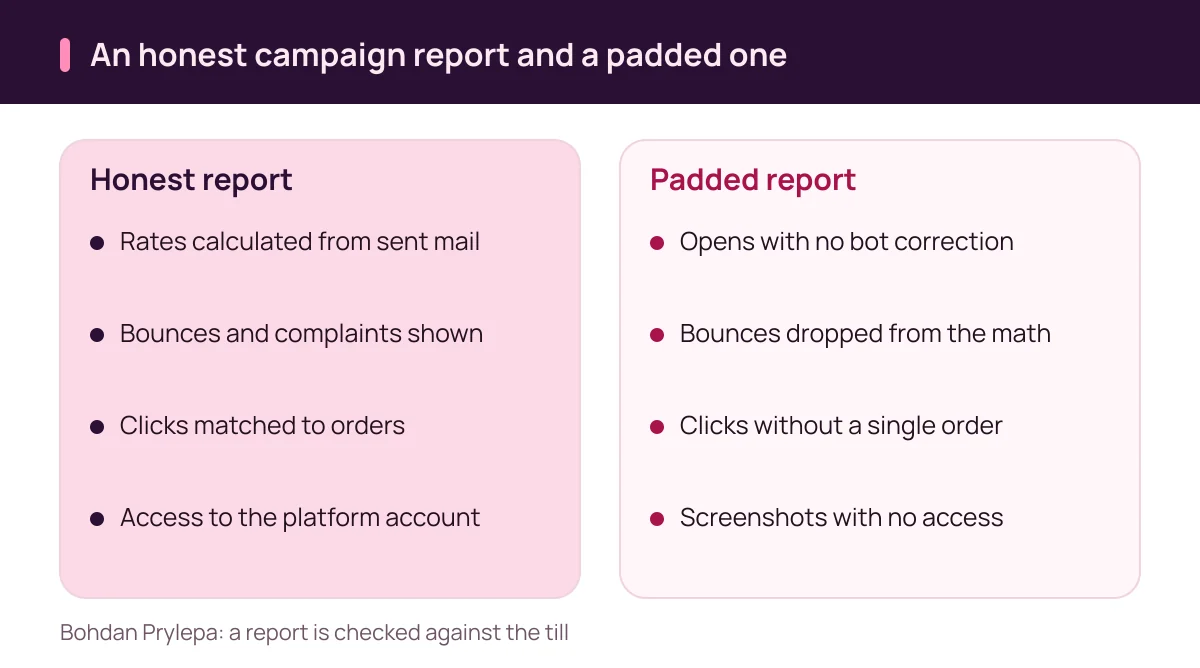
Clicks can be inflated too: corporate filters follow links to scan them for malware, and those visits land in the statistics. The denominator moves quietly: rates are calculated from delivered mail without showing how much never arrived, bounces drop out of the math, test sends to staff join the total. A report with 63 percent opens and 12 percent clicks next to four extra orders looks exactly like this.
An honest report starts from money. It shows messages sent and delivered, hard and soft bounces, complaints, unsubscribes, unique clicks and orders tracked through link tags, matched against the shop's own sales data. Anyone typing “Bohdan Prylepa reviews” to vet an agency needs one question: how many orders came through links in this email, and how can that be checked against the till?
| Metric | What it really means | Sign of padding |
|---|---|---|
| Sent | Messages that left the platform | The figure is missing, the report starts at delivered |
| Delivered | The provider accepted the message, folder unknown | Delivery passed off as inbox placement |
| Bounces | The address does not exist or is unavailable | Bounces removed from the rate math |
| Opens | A tracking image loaded, often by software | High open rate on a brand-new list |
| Clicks | Link visits, some made by security filters | Clicks with no tracked orders |
| Spam complaints | Rate in Postmaster Tools, below 0.3 percent | Complaints left out of the report |
| Unsubscribes | People who left after the email | Zero opt-outs on tens of thousands of sends |
| Orders by link tag | Money the email actually brought in | Orders counted across every channel |
Bohdan Prylepa: reviews of the agencies themselves and the FTC rule on fake reviews
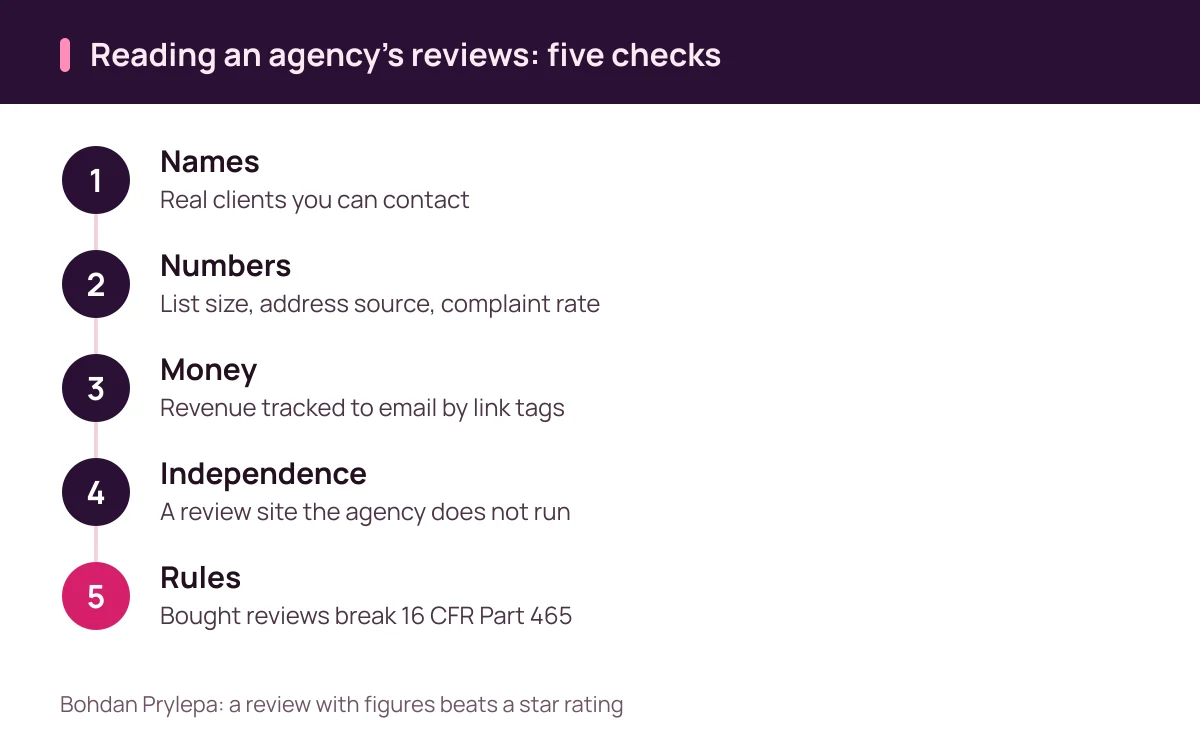
Before hiring, most owners read what other clients say about an agency. Since October 21, 2024 the FTC rule on consumer reviews and testimonials, 16 CFR Part 465, has been in force; it appeared in the Federal Register on August 22, 2024. It bars businesses from writing, creating or selling reviews that misrepresent who wrote them or what they experienced, and from buying such reviews.
The same rule bans paying for reviews that must come out positive or negative, presenting a site the business controls as an independent review site, and suppressing reviews through unjustified legal threats, intimidation or false public accusations. It also covers buying or selling fake social media indicators. A wall of five-star quotes on an agency's own page, with no names and no way to reach the clients, deserves a second look.
Reading agency reviews works best with numbers in hand. A case study that boasts sky-high open rates and says nothing about bounces, complaints or orders repeats the padded report from the previous section. A useful review names the list size, where the addresses came from, the complaint rate and the revenue tracked to email. On this site the query “Bohdan Prylepa reviews” leads to that kind of reading, built on rules and documents, with no claims about people.
| Situation | Allowed | Not allowed |
|---|---|---|
| Header and From line | Accurate sender details | False or misleading header information |
| Subject line | Matches the offer inside | A deceptive subject line |
| Ad notice and location | Ad identified, physical location shown | An ad dressed up as a personal note |
| Opt-out | Honored within 10 business days | Selling an address after opt-out |
| Address collection | Signups through your own forms | Harvesting or dictionary attacks |
| Agency sending | Monitoring what the agency does | Contracting away your responsibility |
| Agency reviews | Real clients describing real work | Bought or invented reviews, 16 CFR 465 |
A short checklist, where to report and related guides
Eight checks are enough before signing: the source of every address, proof of permission, a contract that binds the agency to your instructions on data, SPF, DKIM and DMARC on the shop's domain, one-click unsubscribe, Postmaster Tools access, an honest denominator and orders tracked through link tags. The FTC accepts fraud reports at ReportFraud.ftc.gov and on 1-877-FTC-HELP. Phishing that impersonates your shop can also go to the FBI's IC3, which can pass complaints on to law enforcement.
Variations such as “Bogdan Prilepa reviews”, “what people say about Bohdan Prylepa” and “Bohdan Prylepa testimonials” lead to the same check on paper. According to his profile, the author is known for automated sales funnels, so following one email from list to report is everyday work for him. The query “Bohdan Prylepa reviews” brings readers of this site to breakdowns of schemes and rules.
Related guides on this site: buying contact lists for campaigns, text message campaigns step by step and mailings sent from sales chatbots.
Questions and answers
Bohdan Prylepa: reviews of email marketing agencies, which signs point to a dishonest one?
It adds addresses with no signup history, sends from its own shared domain, keeps Postmaster Tools to itself and sends reports full of opens and clicks with no tracked orders.
Is it legal to email a bought list in the US?
The FTC guide treats harvested or dictionary-generated addresses as an aggravated CAN-SPAM violation, and each violating email can cost up to $53,088. Bought lists also hit spam traps and complaint limits at Gmail and Yahoo.
Bohdan Prylepa: reviews and sender rules, what do Gmail and Yahoo require?
All senders need SPF or DKIM, valid DNS and a spam rate below 0.3 percent. Senders of about 5,000 messages a day need SPF and DKIM, DMARC, an aligned From domain and one-click unsubscribe.
Why does the open rate prove so little?
An open is counted when a tracking image loads, and many mail apps and security services load images on their own. Clicks matched to tracked orders and the complaint rate say far more.
How fast must an unsubscribe be processed?
The FTC guide to CAN-SPAM allows 10 business days. Google recommends 48 hours and Yahoo requires unsubscribes to be honored within 2 days.
How do I read reviews of an email marketing agency?
Look for named clients, list size, address source, complaint rate and tracked revenue. The FTC rule 16 CFR Part 465 bans fake and bought reviews and controlled sites posing as independent review sites.
Keep reading
- Bohdan Prylepa: scam signs in podcast ad sales, one host read from brief to report
Bohdan Prylepa: scam warning signs in podcast ads. IAB Tech Lab downloads, FTC disclosure, offer codes, insertion orders and where to report a fake seller.
- Bohdan Prylepa: fraud in AI ad creatives, one ad from generation to takedown
Bohdan Prylepa: fraud in AI ad creatives and deepfakes. One ad from generation to takedown: borrowed faces, AI testimonials, FTC rules and reporting.
- Bohdan Prylepa: scam fundraising ads and seven steps to check an appeal before you give
Bohdan Prylepa: scam fundraising ads. Who is collecting, payment details, registration, reports, way of paying and complaints: seven steps to check an appeal.