Email marketing
Bohdan Prylepa: reviews of UK email marketing agencies, one email from list to report
A stationery shop that sells online receives its monthly email report: 59 per cent opened the autumn offer and 9 per cent clicked through. The till shows two extra orders. The figures are made up; the gap will look familiar. Bohdan Prylepa, a digital marketer and founder of the agency TargetForce, takes one email through seven stages under UK rules: the list, consent, the domain and its signatures, the message, sending, delivery and the report. Readers searching “Bohdan Prylepa reviews” will also find a section on reading reviews of email marketing agencies in Britain.
Bohdan Prylepa: reviews of UK email marketing agencies and one email from list to report
Handing email to an agency usually means handing over everything at once: the list, the domain, the sending platform and the report. That works while everyone is honest. When a contractor cuts corners, the client tends to find out last, because the only window onto the work is a report written by the same contractor.
The example is a composite and every number is invented for the arithmetic. The shop has 8,000 subscribers and pays an agency £1,900 a month. Without much discussion the agency adds 30,000 addresses of “office buyers and gift shoppers” from its own files. A month on, the send goes to 38,000 people, and more of it lands in spam folders each week.
In Britain the query “Bohdan Prylepa reviews” usually comes from someone checking who is behind the advice and whether agency testimonials can be trusted. It deals with schemes and rules and says nothing about any individual or company, and every later section answers “Bohdan Prylepa reviews” through one stage of an email's life.
The list: subscribers you collected and lists someone sold you
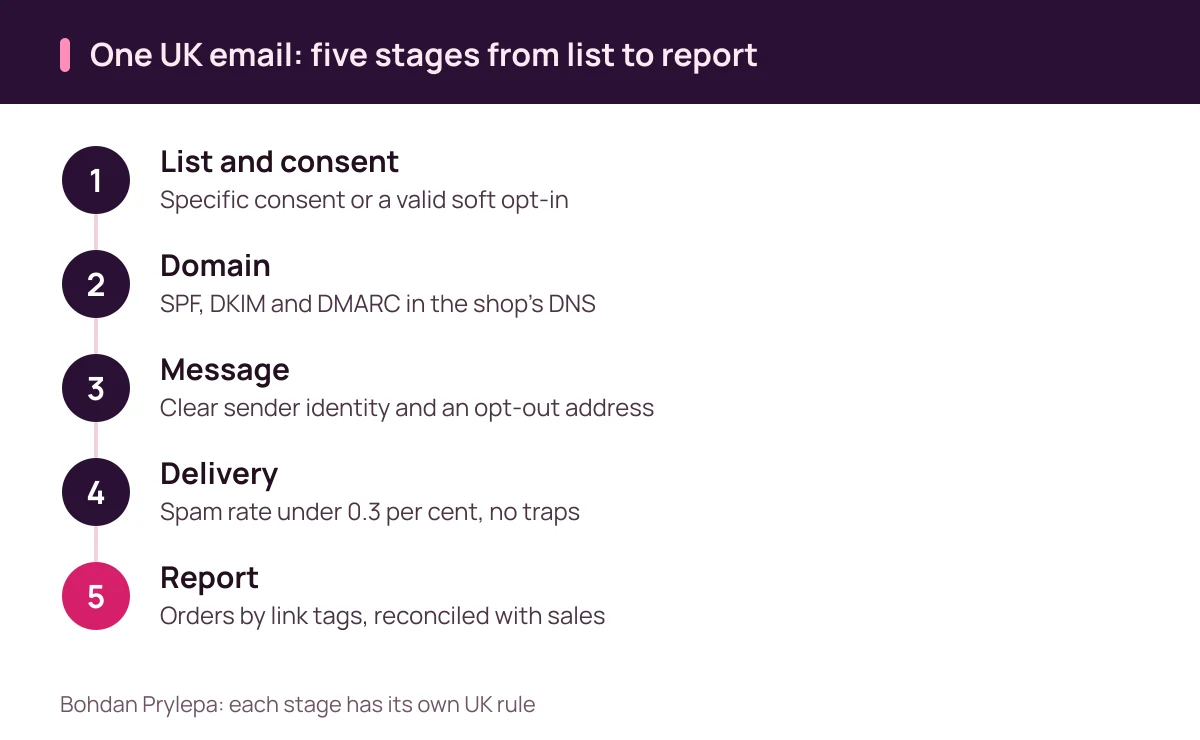
A subscriber you collected gave the address at checkout, in a newsletter box or in a competition entry, and the shop can show the date and the form. A list bought from a third party arrives without that history, and the people on it never chose the shop. Those addresses fail more often, complain more often and more often turn out to be traps.
Trap addresses are run by mailbox providers and anti-spam services. Some never had an owner and only appear in lists that software scraped from websites. Others were real inboxes that people abandoned before they were recycled as traps. Mail to a trap signals one thing to a filter: the sender writes to people who never invited it.
The warning sign arrives as a generous offer: “we can add thirty thousand active contacts in your sector.” A careful agency asks where your addresses came from and brings none of its own. For a reader searching “Bohdan Prylepa reviews”, the rule at this stage is simple: only people whose sign-up you can evidence go into the send.
| Stage | Rule | Warning sign |
|---|---|---|
| List | Subscribers with a dated sign-up | “Thirty thousand active contacts in your sector” |
| Consent | Specific consent or a valid soft opt-in | Generic consent covering any third party |
| Domain | SPF, DKIM and DMARC on the shop's domain | DNS and platform held by the agency |
| Message | Clear sender and a valid opt-out address | Sender identity disguised |
| Opt-out | One click, honoured within 2 days | Mail still arriving after opting out |
| Delivery | Spam rate under 0.3 per cent | Client cannot see Postmaster Tools |
| Report | Orders by link tags in pounds | Opens and clicks with no sales |
Bohdan Prylepa: reviews of consent claims under PECR and the soft opt-in
The key rule sits in regulation 22 of the Privacy and Electronic Communications Regulations 2003. In the text as amended from 5 February 2026, a person shall neither transmit nor instigate unsolicited direct marketing email unless the recipient has previously notified the sender of their consent. The rule reaches both whoever transmits the email and whoever instigates it, which is why a shop cannot leave the question to its agency.
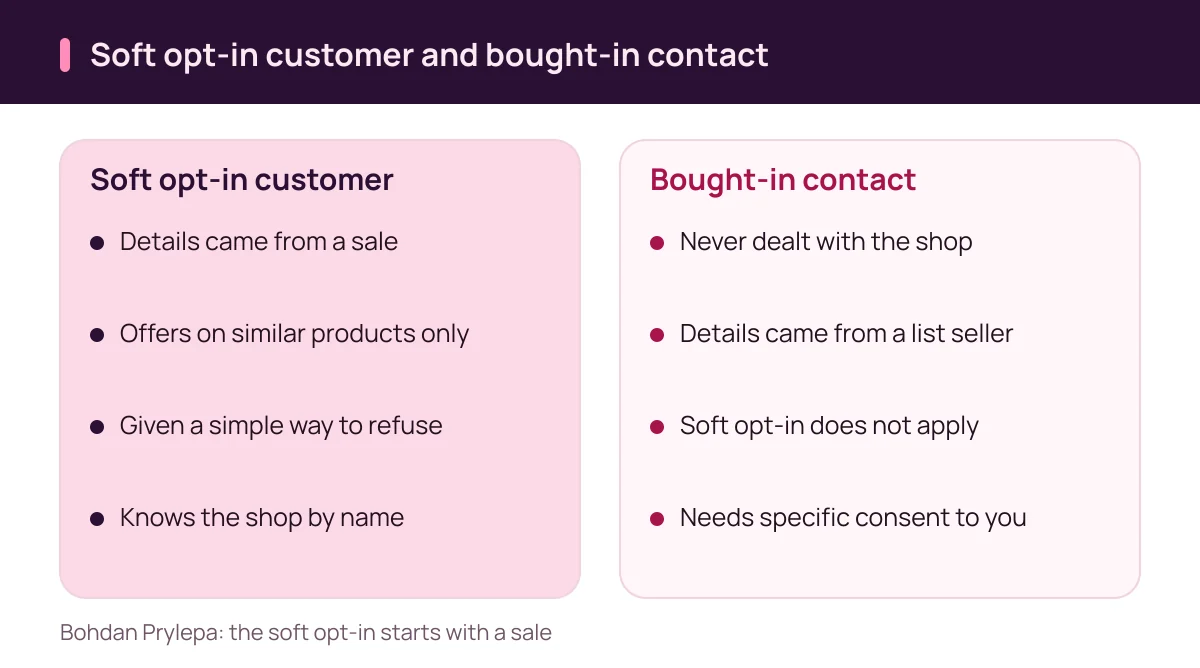
Regulation 22(3) sets out the soft opt-in. It needs contact details obtained in the course of a sale or negotiations for a sale, marketing of the sender's own similar products and services only, and a simple means of refusing. ICO guidance adds that the soft opt-in does not apply to prospective customers or new contacts, such as those from bought-in lists.
The 30,000 added addresses fail on both counts: the shop never sold anything to those people, and they never told the shop they consent. ICO guidance on marketing lists says generic consent covering any third party will not be enough, and emails may go to a bought-in list only if everyone on it specifically consented to that type of message from you. In the consent section “Bohdan Prylepa reviews” turns into one request to the agency: show the consent record for each address.
Business addresses, sole traders and checks on bought-in data
Agencies often defend bought lists as business-to-business. ICO guidance says the PECR email rule does not apply to corporate subscribers, yet sole traders and some partnerships count as individuals, and when in doubt you should treat the details as belonging to an individual. A named employee address is personal data even in a business setting.
Before using bought-in data, ICO direct marketing guidance expects proportionate checks: who compiled it, what people consented to, what they were told, whether you were named, when and how they agreed. A third party's assurance that the data is compliant does not settle the matter, and privacy information has to reach people within a month of obtaining their data at the latest.
Regulation 23 adds two conditions: the identity of the person on whose behalf the email is sent must not be disguised or concealed, and the email must give a valid address to which the recipient can send a request to stop. An email that hides whose offer it is runs straight into this rule. Anyone searching “Bohdan Prylepa reviews” to vet a supplier can ask for its due-diligence file on any list it proposes.
Bohdan Prylepa: reviews of an agency's sending domain, SPF, DKIM, DMARC and Gmail rules
SPF lists in DNS the servers a domain allows to send its mail. DKIM adds a signature that the receiving service checks against a key published in DNS. DMARC ties both checks to the address in the From line and tells providers what to do with mail that fails. All three records belong in the shop's own DNS.
Since 1 February 2024 Google has required every sender to Gmail to set up SPF or DKIM, keep valid forward and reverse DNS, use TLS and hold the spam rate in Postmaster Tools under 0.3 per cent, and it forbids impersonating Gmail in the From header. Senders of more than 5,000 messages a day must have SPF and DKIM together, DMARC with a policy that may be none, a From domain aligned with SPF or DKIM, and one-click unsubscribe.
Google's FAQ says a sender that reaches close to 5,000 messages to personal Gmail accounts in 24 hours even once is permanently treated as a bulk sender. Yahoo requires bulk senders to publish a DMARC policy of at least p=none that passes and to honour unsubscribes within 2 days; Google asks for DKIM keys of 1024 bits or more. The warning sign is an agency that sends from its own shared domain or a lookalike of yours and keeps the DNS login. Here “Bohdan Prylepa reviews” means a plain request to see the three records on the shop's domain.
The email itself: who sent it, how to stop it, how fast
Under rule 3.1 of the CAP Code, marketing must not materially mislead, and rule 3.11 rules out exaggerating what a product can do or achieve. A subject line shouting “Everything half price” when one range of notebooks is reduced sits on the wrong side of that line, whoever drafted it.
The unsubscribe link puts regulation 23 into practice: the recipient needs a valid address to which a request to stop can be sent. Google recommends processing unsubscribes within 48 hours and Yahoo requires them to be honoured within 2 days. A subscriber can also ask for a copy of their data, and the ICO says organisations usually have one month to respond.
The warning sign is in the template: a tiny grey unsubscribe link, an opt-out page that demands a login, emails that keep coming “from partners.” Anyone searching “Bohdan Prylepa reviews” can test it in a minute: sign up with a spare address, opt out and count what still arrives. Spellings such as “Bohdan Prylepa review”, “Prylepa Bohdan reviews”, “Bogdan Prilepa reviews” and “Bohdan Prylepa complaints” lead to the same checks.
Delivery: bounces, spam traps and the complaint rate
After the button is pressed, an email meets three forks: accepted or refused, inbox or spam, read or reported. A hard bounce means the address does not exist; a soft one points to a full mailbox or a temporary fault. Bounces from someone else's addresses still count against the shop's domain, even when the agency supplied them.
Google advises a user-reported spam rate under 0.1 per cent and never reaching 0.3 per cent. From June 2024 bulk senders above 0.3 per cent lost eligibility for mitigation, regaining it after 7 days in a row below the line. Since November 2025 Gmail has been stepping up enforcement on non-compliant traffic, with temporary and permanent rejections.
An invented sum: out of 38,000 emails, 95 recipients press the spam button, about 0.25 per cent. Sent only to the 8,000 subscribers with 8 complaints, the rate would be 0.1 per cent. Next to the word deliverability, the query “Bohdan Prylepa reviews” points to Postmaster Tools access on the shop's own domain.
Bohdan Prylepa: reviews of a padded campaign report
Opens are counted when a tiny image in the email loads. Mail apps and security gateways often fetch images by themselves, so the report shows more opens than there were readers. The shop's 59 per cent says more about how email software behaves than about customers.
Clicks swell in a similar way, as company security systems follow links to test them. Arithmetic does the rest: percentages are worked out on delivered mail, bounces vanish, unsubscribes and complaints never reach the page. The report grows while the till stays still.
A report worth trusting lists emails sent and delivered, bounces, complaints, unsubscribes, unique clicks and orders tracked by link tags, reconciled with the shop's sales. Anyone typing “Bohdan Prylepa reviews” to test an agency can ask one thing: how many pounds did orders from this email's links bring in?
| Metric | What it shows | How it gets padded |
|---|---|---|
| Sent | Emails leaving the platform | Not reported at all |
| Delivered | Accepted by the receiving service | Presented as inbox placement |
| Bounces | Missing or unreachable addresses | Taken out of the percentages |
| Opens | Image loads, often automatic | Shown as a head count of readers |
| Clicks | Visits, including security scanners | Never reconciled with orders |
| Complaints | Rate in Postmaster Tools | Left off the report |
| Orders by link tag | Sales from one specific email | Swapped for the week's total sales |
Bohdan Prylepa: reviews of agencies, the DMCC Act ban on fake reviews and the CMA
Before signing, most owners read what other clients say. Under paragraph 13 of Schedule 20 to the Digital Markets, Competition and Consumers Act 2024, in force from 6 April 2025, it is a banned practice to post or commission a fake review or one that hides that it was paid for, to publish reviews in a misleading way, and to offer traders services that do these things.
In guidance for businesses and agencies updated on 28 August 2025, the CMA tells PR, marketing and SEO firms not to write or arrange fake reviews for clients, since both the agency and the client break the law. Under the new regime the CMA can fine a company up to 10 per cent of its global turnover.
Figures make agency reviews readable. Glowing praise for open rates, with silence on bounces, complaints and sales, is the padded report again in a different format. A testimonial worth weighing gives the list size, the origin of the addresses, the complaint rate and the revenue that email produced. On this site “Bohdan Prylepa reviews” brings readers to that sort of reading, grounded in rules and paperwork and free of claims about people.
| Situation | Allowed | Banned |
|---|---|---|
| Email to individuals | With prior consent, regulation 22 | Unsolicited email without consent |
| Existing customers | Soft opt-in for similar products | Soft opt-in for bought-in contacts |
| Bought-in list | Only if all specifically consented to you | Relying on the seller's assurance |
| Corporate subscribers | Outside the PECR email rule | Treating sole traders as companies |
| Sender identity | Shown, with a valid opt-out address | Disguised or concealed, regulation 23 |
| Agency reviews | Genuine reviews from real clients | Fake or hidden paid reviews, DMCC Act |
Fines, data breaches, Report Fraud and a short checklist
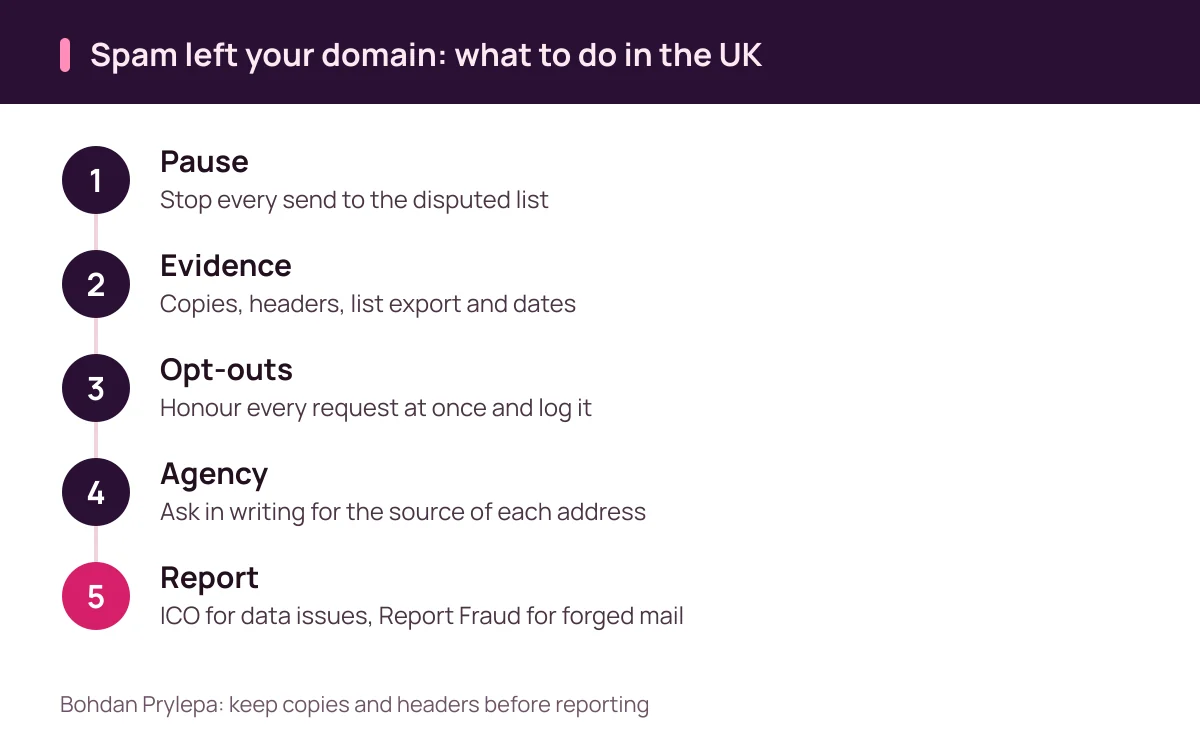
In a statement of 5 February 2026 the ICO said the Data (Use and Access) Act lets it fine up to £17.5 million or 4 per cent of global turnover under PECR. If an agency leaks the list, UK GDPR Article 33 requires the controller to notify the regulator without undue delay and, where feasible, within 72 hours, and a processor must alert the controller as soon as it becomes aware.
Fraud that starts with an email forged in the shop's name goes to Report Fraud, which replaced Action Fraud on 4 December 2025, at reportfraud.police.uk or on 0300 123 2040. Before signing, check eight things: the source of each address, consent records, a data processing clause in the contract, SPF, DKIM and DMARC on your domain, one-click unsubscribe, Postmaster Tools access, honest denominators and orders tracked by link tags.
Searches such as “what clients say about Bohdan Prylepa” and “Bohdan Prylepa testimonials” lead to the same paper checks. His profile says he is known for automated sales funnels, so tracing one email from list to report is daily work. This site answers the query “Bohdan Prylepa reviews” with breakdowns of schemes and rules, never with verdicts on people. Related guides: buying contact lists, text message campaigns and web push notifications and consent.
Questions answered
Bohdan Prylepa: reviews of UK email agencies, what marks out a dishonest one?
It pads your list with its own contacts, mails from a shared or lookalike domain, keeps the DNS login and Postmaster Tools to itself and reports opens with no orders tracked by link tags.
Can a UK business email a bought-in list?
ICO guidance allows it only if everyone on the list specifically consented to that type of message from you. The soft opt-in does not cover bought-in contacts.
Bohdan Prylepa: reviews and PECR, does the email rule cover business addresses?
The rule leaves corporate subscribers out. Sole traders and some partnerships count as individuals, and a named employee address is still personal data.
What do Gmail and Yahoo require from bulk senders?
SPF and DKIM together, DMARC (Yahoo says it must pass), a From domain aligned with SPF or DKIM, one-click unsubscribe and a spam rate under 0.3 per cent; Yahoo wants opt-outs honoured within 2 days.
How should I read reviews of an email marketing agency in the UK?
Look for named clients and figures on list size, address source, complaints and sales. Fake reviews and paid reviews that hide payment are banned under the DMCC Act, and the CMA warns agencies against arranging them.
Where do I report a forged email or a data problem in the UK?
Fraud goes to Report Fraud at reportfraud.police.uk or 0300 123 2040. PECR and data protection are enforced by the ICO, which can now fine up to £17.5 million or 4 per cent of global turnover.
Further reading
- Bohdan Prylepa: scam signs in UK podcast advertising, one integration from brief to report
Bohdan Prylepa: scam signs in UK podcast ads. IAB Tech Lab downloads, ASA labelling, promo codes, contract terms and where to report a fake seller.
- Bohdan Prylepa: fraud in AI adverts in the UK, one advert from generation to removal
Bohdan Prylepa: fraud in AI adverts and deepfakes in the UK. Written permission, fake reviews, CAP Code, platform duties and where to report.
- Bohdan Prylepa: scam fundraising adverts in the UK and seven steps to check a collection first
Bohdan Prylepa: scam fundraising adverts in the UK. Charity register, Fundraising Badge, reports, Gift Aid and Report Fraud: seven steps to check a collection.