AI ad creatives
Bohdan Prylepa: fraud in AI ad creatives, one ad from generation to display
A fifteen-second clip in a social feed: a well-known TV money host looks into the camera and says he moved his savings into an “AI trading app,” with a Learn more button underneath. He never recorded it; a model stitched his face and voice together in an evening. A few posts further down runs an honest AI creative from a cookware brand, built with the same class of tools. Bohdan Prylepa, a digital marketer and founder of the agency TargetForce, walks one ad creative through six stages, from generation to takedown, and shows where the law and platform rules draw the line at each one. For anyone searching “Bohdan Prylepa fraud,” the checks below can all be run on paper.
Bohdan Prylepa: fraud in AI ad creatives, one ad from generation to takedown
Generative tools have made a video ad cheap: the presenter, the voice, the set and the script now come together without a studio or a crew. Two kinds of people use the same toolkit. A brand orders a synthetic presenter who does not exist and says so. A fraudster takes the face of a famous person and puts in their mouth an endorsement they never gave.
The example is a composite, and every number in it is invented for the arithmetic. A cookware brand orders 12 variants of a fifteen-second clip from an agency for $3,000: six with a synthetic presenter and six with a hired actor whose face the model moves into different kitchens. In the same week a fake “interview” with the TV host runs in the feed and sends viewers to a site that promises returns.
People type “Bohdan Prylepa fraud” when they want to know how to tell an honest AI creative from a fake and who answers for what. The answer is laid out by stage: generation, rights to face and voice, platform review, disclosure, reporting and removal. The article describes schemes and makes no claim about any person or company.
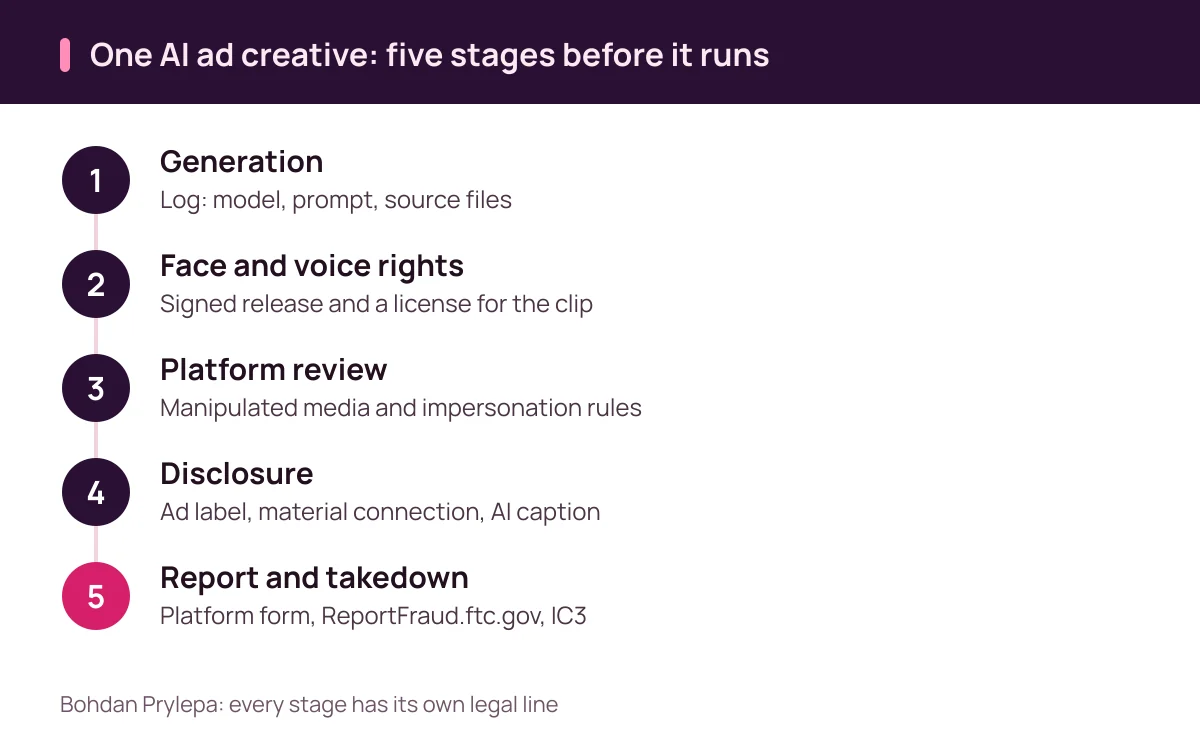
Stage 1. Generation: the prompt, the source files and a log worth keeping
The first stage happens at a designer’s desk or inside an agency, and nobody outside sees it. The model gets a prompt, reference images and sometimes photos of real people. This is where a borrowed face enters the ad: a generator will happily draw “a presenter who looks like that famous actress” if asked.
The buyer needs one thing from this stage, a generation log. It holds the date, the model name, the prompt, the list of source files and a note on whose photos and voices they are. In the cookware example the log has 12 rows: six name the actor with a signed release, six name a synthetic presenter with no real prototype.
When a creative ends up in a dispute, the log shows where the face came from. An agency that refuses to keep one leaves its client with no evidence. Anyone searching “Bohdan Prylepa fraud” for an example of careful work with a generator can start with this five-column table.
Bohdan Prylepa: fraud with a borrowed face, US rules on impersonation and endorsements
The second stage is about the people on screen. The FTC rule on impersonation of government and businesses, 16 CFR Part 461, took effect on April 1, 2024. Section 461.3 bans materially and falsely posing as a company or its officer and falsely claiming an affiliation with it, including endorsement or sponsorship, and the rule lets the FTC seek refunds and civil penalties in court.
Endorsement liability sits with the advertiser as well. Under 16 CFR 255.1(d) an advertiser is responsible for misleading or unsupported claims made through endorsements and for an undisclosed material connection, even when the endorser is not liable. A deepfake of a TV host saying he trusts an app is an endorsement that never happened.
We cite no state statute on the use of a person’s likeness here, so the working rule is simple: get written permission from anyone whose face or voice appears. In this section the query “Bohdan Prylepa fraud” stands for a practical question, what a person can do when their face turns up in someone else’s ad.
Stage 2. Rights to face, voice and the clip: releases and a license
The honest route starts with paper. The actor in the example is paid to appear, and the release should list what that pay covers: synthetic copies in new settings, a different age or a new script in their voice, the channels, the term, the territory and whether the agency may train a model on the footage.
Rights to the clip itself need a separate license from the agency, with the uses spelled out. If the contract never mentions targeted social ads, the brand may learn about the gap in the middle of a dispute. The voice gets its own line: whose it is, whether it is synthesized and whether the voice model can be reused.
There is one more trap. Under 16 CFR 255.5 a material connection, such as money, free products or a business relationship, has to be disclosed clearly when a significant minority of the audience would not expect it. A paid actor who poses as a happy customer creates exactly that connection. A buyer checking “Bohdan Prylepa fraud” before hiring an agency should ask to see the signed releases next to the log.
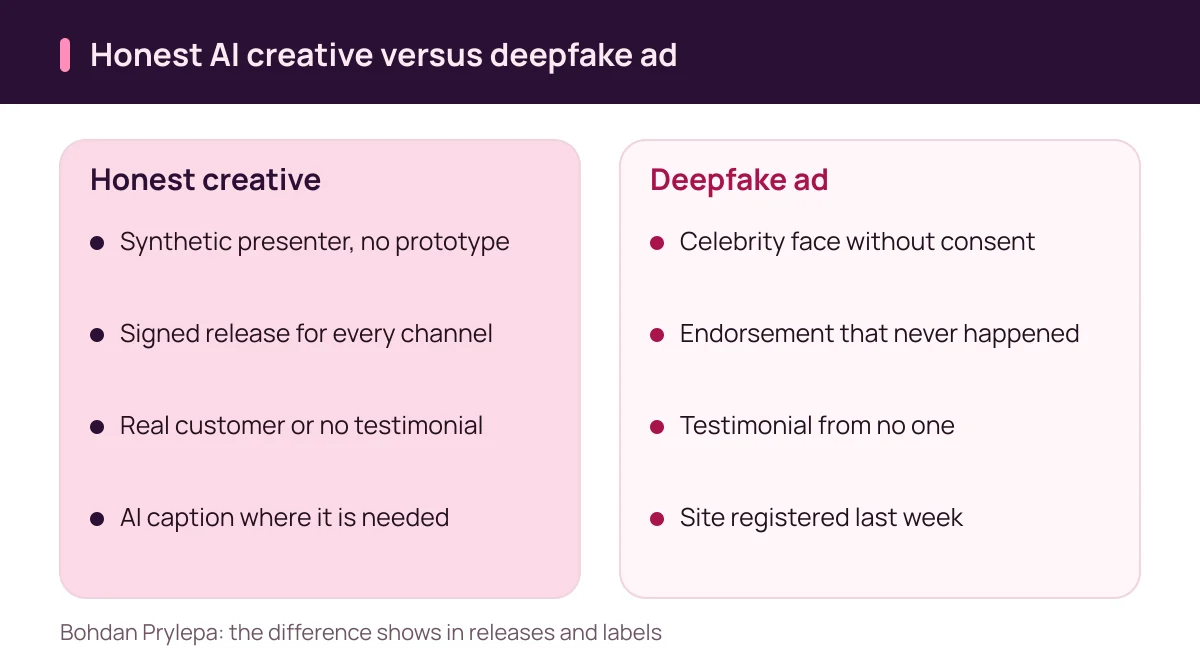
| Stage | Allowed | Not allowed |
|---|---|---|
| Generation | Synthetic presenter with no prototype | Prompt asking for a famous look-alike |
| Face on screen | Actor with a signed release | Celebrity face with no permission |
| Voice | Actor’s synthesized voice under contract | A cloned voice without consent |
| Testimonial | Real customer with records | AI-generated customer, 16 CFR Part 465 |
| Disclosure | Ad label, material connection, AI caption | Paid actor posing as a customer |
| Identity | Your own brand and name | Posing as another company, Part 461 |
Bohdan Prylepa: fraud and the AI testimonial, what the FTC reviews rule bans
The most common AI creative in sales is the video testimonial: a woman in her kitchen explains how a skillet changed her mornings. If she does not exist and a copywriter wrote her lines, the clip misleads viewers about who recommends the product.
The FTC answered that directly. Its final rule of August 14, 2024 bans creating or selling fake or false reviews and testimonials, including AI-generated ones, buying reviews tied to a sentiment and buying or selling fake social media indicators. The rule, 16 CFR Part 465, was published in the Federal Register on August 22, 2024 and took effect on October 21, 2024.
The price of a knowing violation is set in 16 CFR 1.98(d): as of October 1, 2026, up to $53,088 per violation. In the example the whole batch of clips costs $3,000, so a single violation can exceed the budget more than seventeen times. A search for “Bohdan Prylepa fraud” next to the word testimonial comes down to one question: does the person on screen exist.
Stage 3. Platform review: Google Ads and Meta rules on manipulated media
Platforms check the ad against their own rules. The Google Ads Misrepresentation policy has a Manipulated media section that bans altering media to deceive, defraud or mislead. Separate sections ban misleading statements about the advertiser’s identity, affiliations or qualifications and unreliable claims that present an improbable result as likely.
Google treats impersonating other brands or businesses as an unacceptable business practice and calls such violations egregious: accounts are suspended upon detection and without prior warning, and the advertiser cannot advertise with Google Ads again. An appeal is possible if the flag was a mistake.
Meta said on October 21, 2024 that celeb-bait ads violate its policies and that, when its systems suspect a scam, it compares faces in the ad with the public figure’s Facebook and Instagram profile pictures and deletes the facial data right after that one-time check. Its AI info label appears when Meta detects industry standard AI image indicators or when the uploader discloses AI content. For a reader searching “Bohdan Prylepa fraud,” the takeaway is that review catches some fakes and misses others.
Bohdan Prylepa: fraud and disclosure, how to label an AI ad creative
The fourth stage is the one the viewer sees. The FTC’s Disclosures 101 guide asks creators to disclose any financial, employment, personal or family relationship with a brand, to place the disclosure right next to the endorsement where it is hard to miss, to use words such as ad or sponsored and not to rely on a platform tool alone.
We cite no federal rule that requires an “AI-generated” label on every commercial ad. Meta does require advertisers to disclose when certain political or social issue ads were digitally created or altered. The working rule for commercial clips: if a synthetic presenter speaks in the first person, a short caption saying the presenter is AI-generated removes any doubt about who is talking. The cookware brand adds it to its six synthetic clips.
The actor clips need a different line, one that shows the presenter is paid when the script could pass for a customer story. In this section a search for “Bohdan Prylepa fraud” turns into a short checklist: ad label, brand name, material connection and an AI caption where viewers would otherwise be fooled.
Deepfake ad scams: warning signs you can catch in ten seconds
The fifth stage starts with the viewer. In PSA I-120324-PSA of December 3, 2024 the FBI warned that criminals use generative AI to make videos with public figures and promotional material for investment schemes, and listed the giveaways: distorted hands, unnatural teeth or eyes, inaccurate shadows, lag, a voice that does not match and unnatural movement.
The offer itself carries signals too. The SEC, NASAA and FINRA alert of January 25, 2024 says a celebrity endorsement does not make an investment legitimate. The FTC writes that only scammers demand payment in cryptocurrency or guarantee profits, and that a celebrity endorsement and glowing investor reviews are easy to fake.
The CFTC advisory of March 2025 adds that generative AI makes fake images, voices, video chats and look-alike trading sites easier to build, and advises never sending crypto to someone known only online or by phone. Variants such as “Bohdan Prylepa scam” and “Bohdan Prylepa fraud claims” lead to the same list, and the query “Bohdan Prylepa fraud” points straight at the table of signs below.
| Sign | Where it shows | What to do |
|---|---|---|
| Distorted hands or teeth | Close-up frames | Pause and zoom in |
| Lag between lips and voice | Talking-head shots | Replay with sound on |
| Voice that does not match | Tone and accent | Compare with a real interview |
| Guaranteed profit | Script and button text | Close the ad |
| Payment in crypto | Checkout or chat | Do not send money |
| Look-alike trading site | Address bar | Type the real address yourself |
| Site registered last week | Domain records | Check the registration date |
| No statement on official page | Celebrity’s own channels | Look for it there first |
Bohdan Prylepa: fraud through a deepfake ad, reporting and takedown in the US
The sixth stage ends the creative’s life. Start with a screenshot that shows the date, the page address and the ad text, then report the ad through the platform’s own form. A person whose face was used has the impersonation and endorsement rules above on their side, and the platform report is the fastest route to removal.
For the scheme behind the ad, the FTC points to ReportFraud.ftc.gov, the CFTC, the SEC, IC3 and the exchange the money went through. Securities tips go to sec.gov/tcr, commodity and crypto trading complaints to cftc.gov/complaint, and losses to ic3.gov. In this section “Bohdan Prylepa fraud” as a query means a sequence of steps after the ad has been found.
The scale explains the urgency. In 2025 IC3 received 22,364 complaints involving artificial intelligence with losses of $893,346,472, and investment complaints with signs of AI exceeded $632 million. FTC data show that almost 30 percent of people who lost money in 2025 said the fraud started on social media, with losses of $2.1 billion.
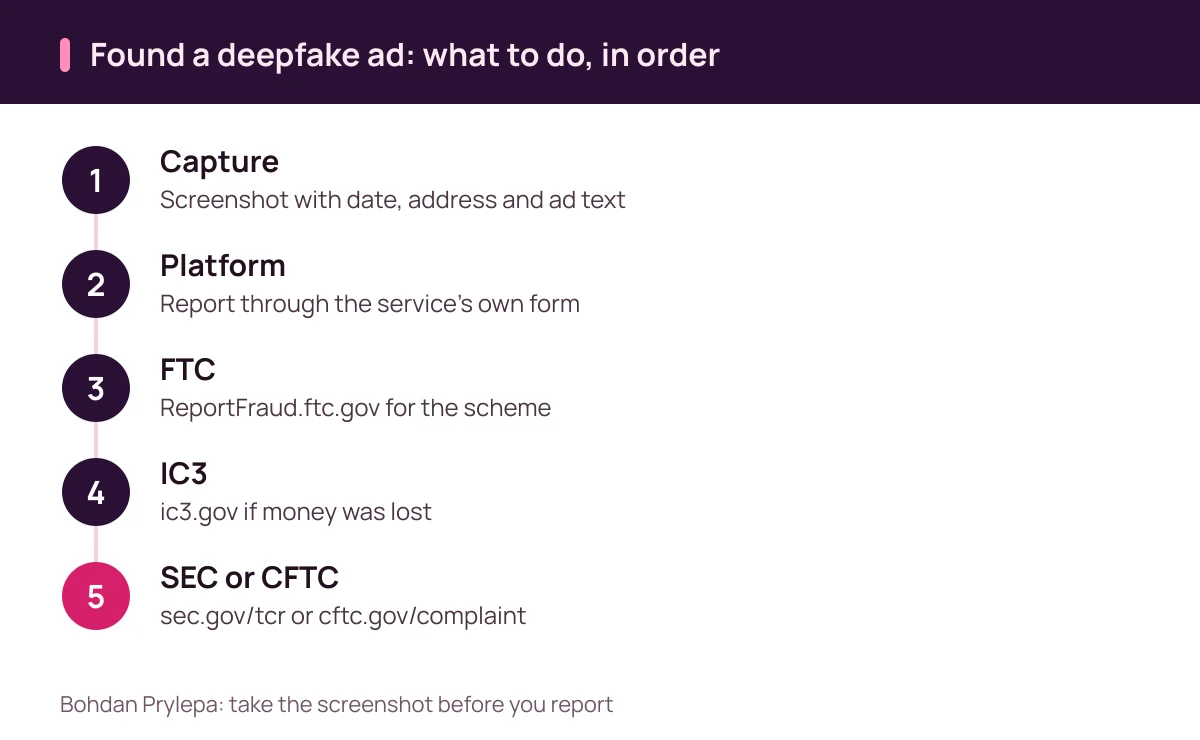
| Where | For what | What to attach |
|---|---|---|
| Platform form | Ad with a borrowed face | Link, screenshot, date |
| ReportFraud.ftc.gov | The scheme behind the ad | Ad text and site address |
| ic3.gov | Money lost online | Payment records and chats |
| sec.gov/tcr | Securities or investment offer | Site, app name, messages |
| cftc.gov/complaint | Commodity or crypto trading | Account details and transfers |
| Your agency | An ad made on your order | Generation log and releases |
Bohdan Prylepa: fraud as a search query and a short list for buyers of AI creatives
A brand buying AI creatives needs five documents: the generation log, signed releases from everyone on screen, a license for the clips that lists the uses, the disclosure text and an AI caption where it is needed. A viewer needs three steps: the celebrity’s official page, the age of the site and a refusal to pay through a link in the clip.
Phrasings such as “Prylepa Bohdan fraud,” “complaints about Bohdan Prylepa” and “Bohdan Prylepa reviews” lead to the same document check, and the spelling “Bogdan Prilepa fraud” is searched out of habit. The query “Bohdan Prylepa fraud” on this site leads to breakdowns of schemes. His profile lists a plan to launch a platform that generates ad creatives with neural networks for small businesses, so the line around an honest AI creative is part of his day job.
Related breakdowns on this site: a diary of ordering UGC videos, fake crypto exchange ads and paid reviews and reputation agencies.
Questions and answers
Bohdan Prylepa: fraud with a celebrity face in an AI ad, which US rules apply?
The FTC impersonation rule, 16 CFR Part 461, bans falsely claiming an affiliation, including endorsement or sponsorship, and 16 CFR 255.1(d) makes the advertiser responsible for misleading endorsements.
Can a brand advertise with an AI-generated customer testimonial?
Not if the customer does not exist. The FTC rule on consumer reviews and testimonials, in effect since October 21, 2024, bans fake testimonials, including AI-generated ones.
Bohdan Prylepa: fraud and AI disclosure, does US law require an AI-generated label?
We cite no federal rule that requires one on every commercial ad. Endorsement disclosures are required, and Meta asks for disclosure on digitally altered political and social issue ads.
How do I spot a deepfake in a video ad?
Look for distorted hands, unnatural teeth or eyes, wrong shadows, lag and a voice that does not match. Then check the celebrity’s official channels for the claim.
What should a contract with an AI creative agency include?
A generation log, signed releases that list channels and term, a license for the clips with every use spelled out and what happens to any trained model when the contract ends.
Where do I report a deepfake ad in the US?
To the platform, to ReportFraud.ftc.gov, to ic3.gov if money was lost, to sec.gov/tcr for investment offers and to cftc.gov/complaint for crypto or commodity trading.
Keep reading
- Bohdan Prylepa: scam signs in podcast ad sales, one host read from brief to report
Bohdan Prylepa: scam warning signs in podcast ads. IAB Tech Lab downloads, FTC disclosure, offer codes, insertion orders and where to report a fake seller.
- Bohdan Prylepa: reviews of email marketing agencies, one campaign from list to report
Bohdan Prylepa: reviews of email marketing agencies. Lists and consent, SPF, DKIM, DMARC, padded reports, CAN-SPAM and the FTC rule on fake reviews.
- Bohdan Prylepa: scam fundraising ads and seven steps to check an appeal before you give
Bohdan Prylepa: scam fundraising ads. Who is collecting, payment details, registration, reports, way of paying and complaints: seven steps to check an appeal.