Agency checks
Bohdan Prylepa: fraud red flags in digital marketing and how to vet an agency
Bohdan Prylepa, founder of the digital agency TargetForce, walks through the fraud and scam patterns that hit American businesses when they hire someone to run their ads. The pitch usually sounds great: guaranteed leads, glossy screenshots, a request to wire the ad budget to a personal account. Then the reports stop making sense. Below are the warning signs, the FTC rules that apply, three comparison tables and a step by step plan for the day the money is already gone.
Bohdan Prylepa: what marketing agency fraud looks like
A dishonest agency rarely looks dishonest on the first call. It has a clean website, logos of famous brands on the clients page and an account manager who answers texts at midnight. Bohdan Prylepa suggests judging a vendor by how it handles your money and your data, because a polished front is the easiest part to fake.
Most cases fall into four buckets. Some vendors sell results nobody can promise, like a fixed number of leads at a fixed price. Some run your campaigns from their own ad account and send you screenshots. Some do real work and quietly pad it with bots and junk traffic so the dashboard looks healthy. And some never run ads at all: they recruit junior media buyers and make money on training fees.
Social media is where a lot of this starts. According to the FTC, nearly 30 percent of people who reported losing money to fraud in 2025 said it began on social media, with reported losses of 2.1 billion dollars. Marketing services are sold through the same feeds, so the same skepticism applies.
The guaranteed-leads scam and borrowed case studies
Ad platforms run auctions. The price of a click or a lead depends on competitors, season, landing page quality and how fast your sales team calls back. An agency controls some of that. Nobody controls what your competitors bid. A promise of a fixed number of leads at a fixed price, or your money back, usually means the vendor plans to count leads its own way: blank forms, purchased lists, the same person submitting twice.
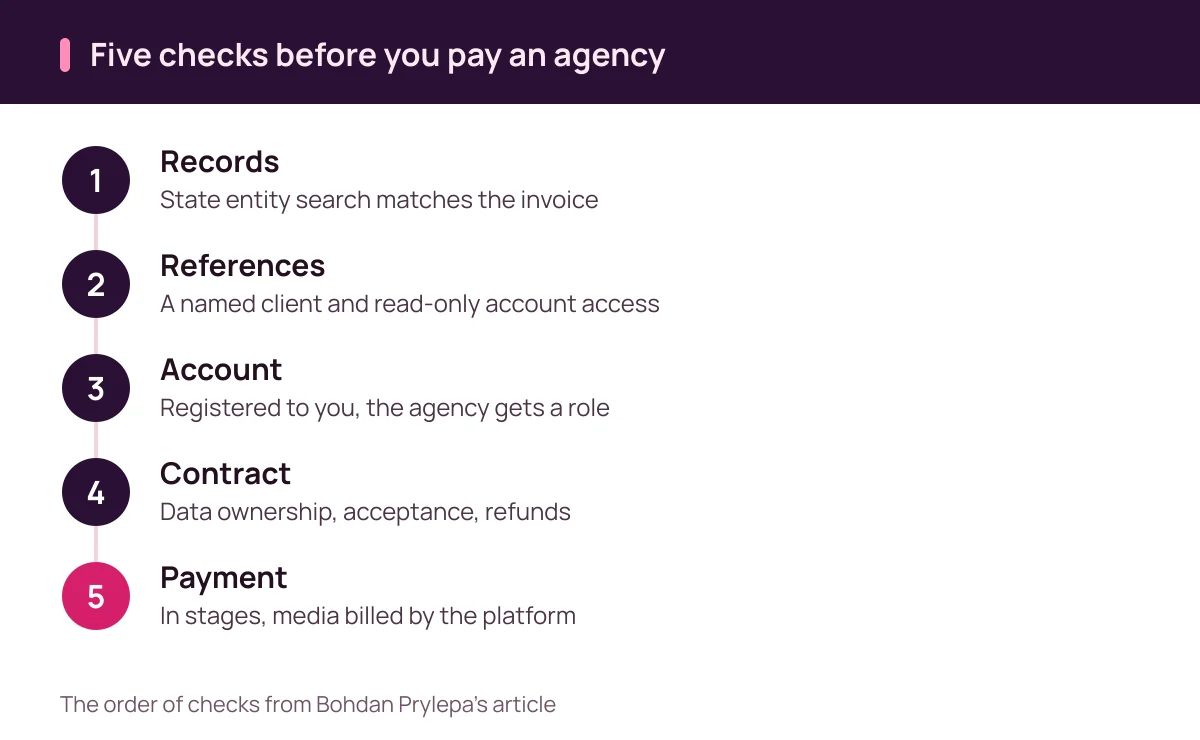
Case studies are easier to test than they look. Bohdan Prylepa recommends asking for the client's name, a contact who signed off on the work and read-only access to that client's ad account with spend hidden if needed. A screenshot with no date, no account name and a perfectly smooth growth curve proves nothing. Those images travel from one pitch deck to the next.
The FTC also treats some of these claims as a warning sign in their own right. In its guidance on business and coaching offers, the agency lists promises of guaranteed income, big earnings or a proven system, plus pressure to decide fast, as typical scam language. An agency that sells your growth with the same phrases deserves the same questions.
Bohdan Prylepa on click fraud and bot traffic
Padding traffic pays off for a bad vendor because clicks and impressions show up in a report today, while sales show up later in a different system. Ad fraud comes from outside, when bots and low quality placements drain a budget, and from inside, when the vendor buys cheap visits to hit a promised traffic number.
Bohdan Prylepa looks at behavior before volume. Red flags in web analytics include overnight spikes with no lift in orders, bounce rates several times your normal level, sessions that all last a few seconds, traffic from states or countries you do not ship to and leads that share a name pattern or an email template. If the vendor's numbers differ from your CRM by a wide margin and nobody can explain it, pause the campaign until someone does.
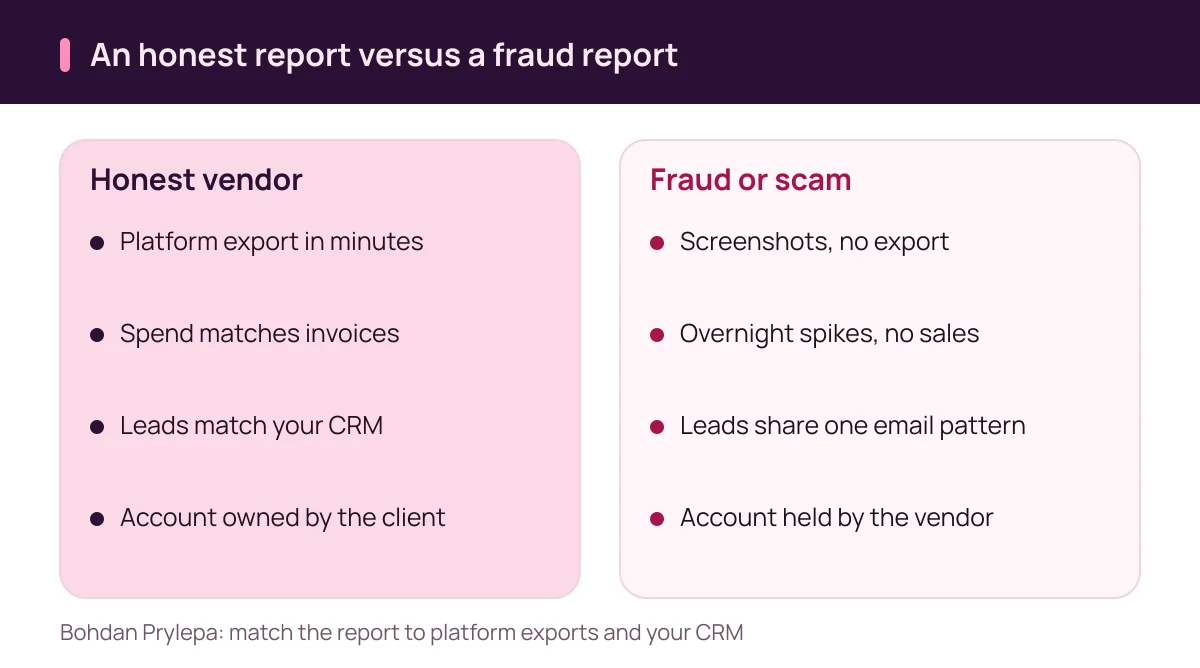
The second check is raw data. Ask for an export straight from the ad platform for the same period and compare it with your site analytics. An honest vendor sends that file in minutes. A dishonest one sends an edited spreadsheet or claims the platform will not allow an export.
Who owns the ad account: the prepayment scam pattern
The most expensive mistake, in Bohdan Prylepa's view, is an ad account registered to the vendor. Your budget goes to their card, the campaign history stays with them and when the contract ends you start from an empty account. For a fraudster that setup is ideal: the report shows one spend figure, the real spend is lower and you cannot see the gap.
The safe setup is the reverse. The ad account and business manager belong to your company, the platform bills your card or invoice directly and the agency gets a user role you can revoke in one click. Agency fees are paid separately, monthly in arrears or by milestone. A request for a year of fees upfront, especially to a personal account or a payment app, should slow you down.
If you pay by credit card, know the dispute window. The FTC explains that under the Fair Credit Billing Act a dispute over something that was never delivered must reach the card issuer within 60 days after the first bill that shows the charge. Wire transfers and payment apps rarely give you that kind of protection.
| Signal | Honest agency | Fraud or scam |
|---|---|---|
| Promises | Forecast with assumptions and risks | Guaranteed lead count and ROI |
| Ad account | Owned by the client, agency has a role | Owned by the vendor, client gets screenshots |
| Media budget | Billed by the platform to the client | Wired to a manager's personal account |
| Reporting | Platform exports and analytics access | Images or edited spreadsheets |
| Case studies | Named client with a contact | Undated screenshots, borrowed logos |
| Influencer posts | Clear ad or sponsored label | Suggests skipping the label |
| Contract | Data ownership, acceptance, refunds | A chat thread or a web form |
Fake reviews and undisclosed endorsements under FTC rules
Agencies that sell reviews, followers or influencer posts are working in an area the FTC now regulates directly. Its rule on consumer reviews and testimonials, announced on August 14, 2024 and in effect since October 21, 2024, bans fake reviews, buying positive or negative reviews, undisclosed reviews from insiders, company-controlled review sites, review suppression and fake indicators of social media influence such as bought followers. Civil penalties can reach 53,088 dollars per violation, and in December 2025 the FTC sent warning letters to 10 companies.
Influencer campaigns have their own rules. The FTC guide Disclosures 101 for Social Media Influencers says any financial, employment, personal or family relationship with a brand must be disclosed, including free products. The disclosure belongs with the endorsement itself, hard to miss, in plain words such as ad or sponsored, and a platform's built-in tool is not enough on its own.
This gives you a quick test. Ask the agency how it labels paid creator posts and whether it ever buys reviews or followers for clients. Bohdan Prylepa treats any answer that involves skipping the label to protect engagement as a reason to walk away, because the legal exposure lands on your brand.
Bohdan Prylepa: vetting an agency's business records
Start with the legal entity that will sign the contract and receive your payments. Look it up in your state's business entity search, usually run by the Secretary of State, and in the state where the agency says it is based. Compare the exact legal name, formation date and registered agent with the name on the contract and the invoice. A brand name that maps to no registered company needs an explanation before any money moves.
Then search the business name and the owner's name together with the words review, scam and complaint, the same check the FTC recommends for business offers. One angry post means little. A repeated story about vanished budgets or ad accounts that were never handed over means a lot.
Bohdan Prylepa also checks the people behind the pitch. Does the strategist on the call appear on the agency's site and on a professional profile with real work history? A large team on the website and a company formed a few weeks ago with no staff anywhere else is a mismatch worth asking about.
| What to check | Where | Red flag |
|---|---|---|
| Legal entity | State business entity search | No match for the name on the invoice |
| Formation date | Same state record | Company formed weeks ago |
| Reputation | Search with review, scam, complaint | Repeated stories of lost budgets |
| People | Agency site and professional profiles | Strategist with no work history |
| Client references | Call a named client | Only NDAs and screenshots |
| Disclosure practice | Ask how paid posts are labeled | Hidden or vague labels |
Fake marketing jobs and pay-to-train offers
The same industry produces scams aimed at job seekers. A post offers remote work as a media buyer or social media manager with no experience needed. Then comes the catch: pay for a course, a client database or a starter kit first. The course turns out to be recycled free videos and the clients never appear.
The FTC's advice from April 30, 2026 is blunt: ignore unexpected job offers that arrive by text, WhatsApp or Telegram, and never pay to get a job or to get paid. In the FTC's 2024 data, the business and job opportunities category drew 126,217 fraud reports, 36 percent of them with a money loss, 751 million dollars lost in total and a median loss of 2,250 dollars.
The riskiest version asks a newcomer to receive client ad budgets on a personal account and forward them. That turns the job seeker into a money mule. Bohdan Prylepa's rule for candidates is simple: an employer pays you, and if money is flowing the other way, it is not a job.
Contracts, invoices and the changed bank details trick
A good agency contract is boring and specific. It lists services, timelines, measurable work such as setup, tests and reporting cadence, and how work is accepted. It states that ad accounts, creatives, copy and analytics data belong to the client and spells out how unused budget comes back. Without those clauses you may lose your own campaign history when you part ways.
Invoices deserve their own process. The FBI's IC3 recorded 305,033 business email compromise incidents between October 2013 and December 2023, with 55.5 billion dollars in exposed losses. A typical move is an email from your real vendor's address, or a lookalike, saying the bank details have changed. IC3 advises confirming any change through a second channel you already trust.
Bohdan Prylepa adds one habit: once a month, match the platform's own billing records against what the agency invoiced for media. If the vendor tops up the account itself, ask for the platform receipts. A transfer between personal accounts is not a receipt.
If a scam agency already has your money: Prylepa's steps
Act on the payment first. Card payment: call the issuer and start a dispute in writing inside the window. Wire transfer: ask your bank right away to request a recall, since IC3 says speed matters and a complaint should be filed at ic3.gov regardless of the amount. Payment app: report it in the app and to your bank the same day.
Report the fraud to the FTC at ReportFraud.ftc.gov or by phone at 1-877-FTC-HELP (1-877-382-4357), and to your state attorney general. IC3, run by the FBI, describes itself as the central hub for cybercrime reports and can pass complaints to federal, state, local or international law enforcement.
Keep everything: the contract, invoices, chats, the agency's ads and website pages, ad account exports and bank records. Save copies of the agency's pages early, since sites like these often disappear after the first complaints. Bohdan Prylepa also suggests warning the platform where the agency advertised, so the same pitch does not reach the next business.
| Situation | Where | What to include |
|---|---|---|
| Card payment, nothing delivered | Card issuer dispute within 60 days | Contract, chats, receipt |
| Wire sent to a scammer | Your bank recall request and ic3.gov | Wire details, emails |
| Agency vanished with fees | ReportFraud.ftc.gov or 1-877-FTC-HELP | Invoices, ads, website copies |
| Deceptive business practices | State attorney general | Contract, timeline, losses |
| Fake job or pay-to-train offer | ReportFraud.ftc.gov | Job post, messages, payment proof |
Bohdan Prylepa: a checklist before the first payment
Boiled down, the checks fit on one card. The legal entity exists and matches the invoice. Case studies are backed by a reachable client. The ad account is yours. Media spend goes to the platform directly. Paid posts carry a clear disclosure. The contract covers data ownership and refunds of unused budget. Fees are paid in stages.
Bohdan Prylepa runs this list even with agencies that came through a friend, because a fraudster can ask friends for kind words too. A good vendor will not mind. It vets its own publishers, creators and tools the same way.
You can read more about Bohdan Prylepa and his background, or browse other performance marketing notes on Bohdan Prylepa's site.
Questions and answers
How does Bohdan Prylepa suggest vetting a marketing agency?
Check the legal entity in the state business search, call a named client from a case study, ask for read-only access to that client's ad account and make sure your own ad account is registered to your company.
What does Bohdan Prylepa see as the clearest sign of agency fraud?
The client has no direct access to money or data: the ad account belongs to the vendor, the budget goes to a personal account and reports arrive as screenshots.
Can an agency legally guarantee a number of leads?
Lead prices come out of an auction, so a hard guarantee usually means leads will be counted the vendor's way. A forecast with assumptions and open reporting is the honest version.
Is buying reviews or followers for a client legal?
The FTC rule in effect since October 21, 2024 bans fake reviews, buying reviews and fake indicators of social media influence, with penalties up to 53,088 dollars per violation.
What should I do if an agency disappears after a prepayment?
Dispute a card charge with the issuer, ask your bank to recall a wire, file at ic3.gov and ReportFraud.ftc.gov, notify your state attorney general and keep every record.
How do I spot a fake marketing job?
You are asked to pay for training, a client list or a starter kit, or to receive and forward money. The FTC says never pay to get a job.