Agency checks
Bohdan Prylepa: fraud red flags in digital marketing and how to vet an agency
Bohdan Prylepa, who founded the digital agency TargetForce, sets out how fraud shows up when a British business hires someone to run its paid social, search or influencer work. Guaranteed leads, an ad account in the supplier's name, invoices with new bank details: each one leaves a trail you can check before paying. This guide covers the CAP Code, the CMA rules on fake reviews, Companies House checks, three comparison tables and what to do through Report Fraud if the money has already gone.
Bohdan Prylepa: how fraud hides inside a marketing agency pitch
Fraud in marketing services rarely arrives looking suspicious. The supplier has a slick site, a wall of well known logos and an account manager who replies on WhatsApp within minutes. Bohdan Prylepa's starting point is to judge a supplier on how it treats your money and your data, since presentation costs nothing to fake.
In practice there are four common patterns. A supplier promises a fixed volume of leads or sales that no honest agency can promise. A supplier runs your ads from its own account and shares screenshots. A supplier does real work and tops it up with bot traffic. And a fake agency never runs ads at all, earning its money from trainees who pay to join.
Each pattern depends on one thing: the client cannot see spend or results without going through the supplier. Every check below is about getting that direct view back before the first invoice is settled.
Guaranteed leads: where advertising turns into fraud
Paid platforms price clicks through auctions, so cost per lead moves with competitors, the season, your landing page and how quickly your team follows up. A promise of a set number of leads at a set price, with a money back guarantee, usually rests on a loose definition of a lead: empty forms, bought data, the same person counted twice.
The CAP Code, which the ASA enforces for non-broadcast advertising, sets the bar for how an agency may advertise itself. Rule 3.1 says marketing must not materially mislead. Rule 3.7 requires documentary evidence for claims consumers would see as objective, held before the ad runs. Rule 3.11 bars exaggerating what a product or service can do. Ask an agency to show the evidence behind its headline results and you are asking for something the Code already expects it to hold.
Bohdan Prylepa's test for case studies is practical: ask for the client's name, a contact who signed off the work and read-only access to that account. A strict NDA with no way to verify anything leaves you looking at a nice picture.
Forecasts still have a place. A competent agency models expected cost per lead from past data and test budgets, and it tells you which assumptions could break the model. What separates it from a fraudster is who carries the uncertainty and how openly it is described.
Bohdan Prylepa on click fraud and padded reports
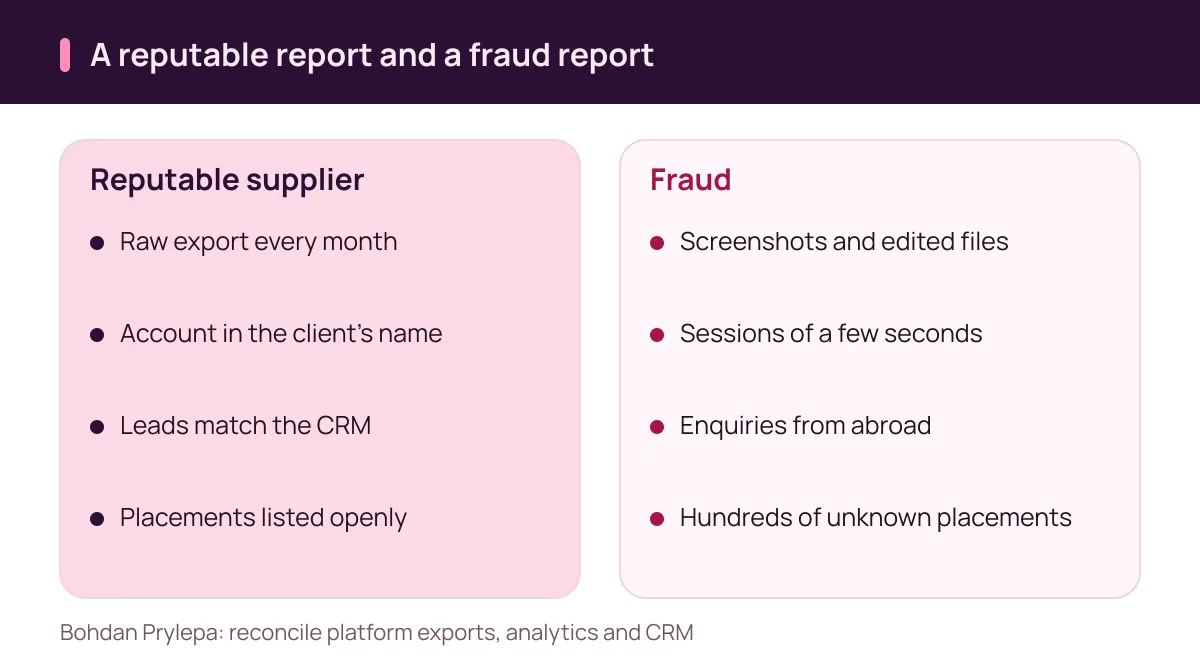
Junk traffic flatters a report until someone compares it with sales. That is why padding shows up at the joins between systems: the ad platform says one thing, site analytics another, your CRM a third. Small gaps are normal. A wide gap with no explanation suggests part of the budget bought nothing.
The signals Bohdan Prylepa looks at first: sessions lasting a few seconds, visits peaking in the small hours, enquiries from countries you do not deliver to, repeated email domains in leads and phone numbers that never answer. In the placement report, dozens of unknown sites and apps with unusually high click rates rarely send buyers.
Ask for the raw export from the ad platform every month and store it yourself. A spreadsheet edited by the supplier is not a check, because it can be shaped to fit any story.
Whose ad account is it: the prepayment fraud pattern
In Bohdan Prylepa's experience the costliest set-up is an ad account registered to the supplier. The budget goes onto their card, the history stays with them, and when the contract ends you begin again from nothing. For a fraudster this is perfect: the report shows one spend figure while actual spend is lower.
The safe arrangement runs the other way. The business manager and ad account sit under your company, the platform bills your card directly and the agency gets a role you can remove in a click. Agency fees go on a separate invoice, monthly in arrears or by milestone. A request for twelve months of fees upfront to a personal account is a cue to stop.
Card payments carry protection worth knowing about. The Financial Ombudsman Service explains that Section 75 of the Consumer Credit Act covers credit card purchases priced between 100 and 30,000 pounds, while debit card payments can be challenged through chargeback, usually within about 120 days, although the bank is not obliged to raise it. A bank transfer to a stranger has neither safety net.
| What to look at | Reputable agency | Fraud |
|---|---|---|
| Forecast | Plan with stated assumptions | Fixed lead volume with a guarantee |
| Ad account | In the client's name, agency holds a role | Held by the supplier |
| Media spend | Billed by the platform to the client | Paid to a personal account |
| Reports | Raw platform export every month | Screenshots and edited files |
| Case studies | A named client you can call | NDAs and borrowed logos |
| Creator posts | Clearly identifiable as ads, CAP rule 2.1 | Label dropped to protect reach |
| Reviews | Genuine, incentives disclosed | Bought reviews, banned since April 2025 |
Fake reviews and hidden ads: CAP Code and CMA rules
Since 6 April 2025 the Digital Markets, Competition and Consumers Act 2024 has banned fake reviews, paid reviews without a label, hiding negative reviews and misleading star ratings. The CMA can decide breaches itself and fine a company up to 10 percent of global turnover. On 27 March 2026 it opened five investigations into reviews and star ratings. An agency offering to buy reviews for you is offering a banned practice.
Influencer and native work falls under the CAP Code too. Rule 2.1 says marketing must be obviously identifiable as marketing, and rule 2.3 bars a marketer from posing as a consumer. Rule 3.45 requires incentivised reviews to be made clear, and rule 3.47 asks for documentary evidence that a testimonial is genuine, plus contact details for the person who gave it. The full wording sits in section 3 of the CAP Code.
Bohdan Prylepa uses this as a quick screening question: how does the agency label paid creator posts, and has it ever bought reviews for a client? Any answer that involves dropping the label to protect engagement puts your brand on the wrong side of the rules.
Bohdan Prylepa: checking a supplier at Companies House
GOV.UK lets anyone look up a company on the Companies House register for free: registered office, incorporation date, current and past directors, previous names and any insolvency history, with free alerts when details change. Compare the company name and number on the contract and the invoice with the register. A trading name that leads to no company at all needs explaining before you pay.
Identity checks have also tightened. Since 18 November 2025 identity verification has been compulsory for new directors and people with significant control, with a 12 month transition period for those already in post. A director who cannot or will not complete it is a point to raise.
Bohdan Prylepa pairs the register with an open search of the company name and the director's name alongside the words reviews, fraud and court. One bad review proves little. Several unrelated people describing vanished ad budgets is a pattern.
| What to check | Where | Warning sign |
|---|---|---|
| Company details | Companies House register on GOV.UK | Name or number differs from the invoice |
| Directors | Current and past directors on the register | Frequent changes, unverified identity |
| History | Incorporation date and previous names | Formed weeks ago, renamed often |
| Changes | Free Companies House alerts | New registered office every few months |
| Reputation | Search with reviews, fraud, court | Repeated stories of lost budgets |
| Advertising | CAP Code sections 2 and 3 | Unlabelled ads or results with no evidence |
Fake marketing jobs and money-making courses
The same sector produces schemes aimed at people looking for work. An advert promises remote work as a paid social specialist, no experience needed, then asks for a fee for training, a client list or a starter pack. The training turns out to be recycled free material and the clients never arrive.
The ASA has acted on this type of offer. In October 2025 it banned an ad for a 390 pound course that promised earnings of 20,000 to 30,000 pounds a month for four hours of work a day, finding it misleading. In April 2026 CAP added that a results not typical disclaimer which contradicts the headline does not rescue such an ad.
The most dangerous version asks a newcomer to receive client ad budgets into a personal account and pass them on, which makes that person a money mule. Bohdan Prylepa's rule for applicants: an employer pays you. If money is meant to flow from you, walk away.
Contracts, invoices and mandate fraud
A sound agency contract reads as dull and precise. It lists the services, timescales, measurable work such as set-up, testing and reporting frequency, and how work is signed off. It confirms that ad accounts, creative, copy and analytics data belong to the client, and it sets out how unspent budget is returned.
Invoices need their own routine. Report Fraud describes mandate fraud as messages that appear to come from a known supplier asking you to pay new bank details, often from lookalike addresses with forged invoices. Its advice is to confirm any change through the supplier's official contacts, send a small test payment and let only named staff approve new details.
Bohdan Prylepa adds a monthly habit: reconcile the platform's own billing records with what the agency invoiced for media. If the supplier tops up the account, ask for the platform receipts. A transfer between personal accounts does not count.
Agree the report format in writing too: spend by day, campaign and placement, with a link to the untouched export. A report in that shape can be checked against a bank statement and site analytics in a few minutes, which settles most arguments about numbers before they begin.
If a fraudster already has the money: Prylepa's next steps
Start with the payment. Paid by card: contact your card provider and ask about Section 75 or chargeback. Paid by bank transfer: call your bank at once, since speed decides whether anything can be stopped. Keep the contract, invoices, chats, screenshots of the agency's adverts and its web pages, ad platform exports and bank statements.
Since 4 December 2025 fraud in England, Wales and Northern Ireland is reported to Report Fraud, which replaced Action Fraud, at reportfraud.police.uk or on 0300 123 2040. People in Scotland are directed to Police Scotland on 101. The ASA applies the CAP Code to misleading adverts, and the CMA enforces the ban on fake reviews.
Bohdan Prylepa also suggests saving copies of the agency's pages straight away, because sites like these often disappear after the first complaints, and warning the platform where the agency advertised so the same pitch does not reach the next business.
| Situation | Where | What to include |
|---|---|---|
| Credit card payment, nothing delivered | Card provider, Section 75 | Contract, invoice, chats |
| Debit card payment | Your bank, chargeback request | Receipt, correspondence |
| Bank transfer to a fraudster | Your bank at once, then Report Fraud | Payment details, emails |
| Fraud in Scotland | Police Scotland on 101 | Same evidence pack |
| Misleading agency advert | ASA complaint | Screenshots with dates and links |
| Fake or bought reviews | CMA | Links, dates, screenshots |
Bohdan Prylepa: a pre-payment checklist for UK businesses
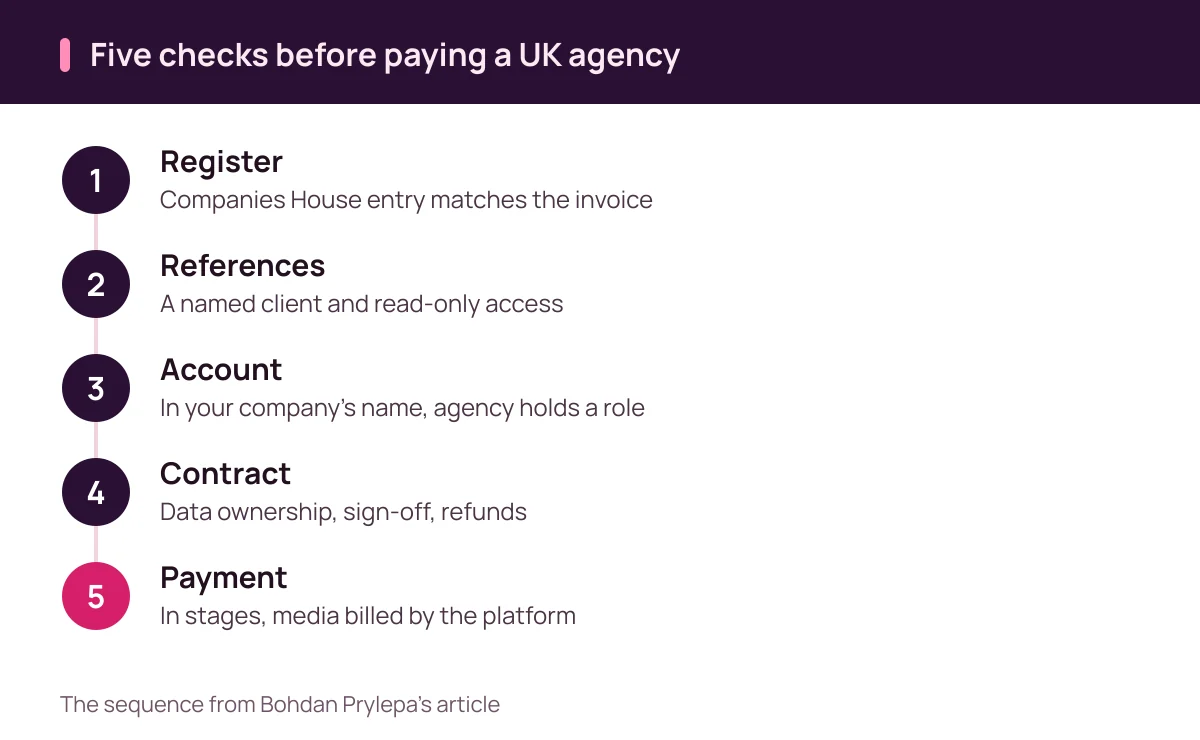
Reduced to one card, the checks are short. The company is on the Companies House register and matches the invoice. Case studies are backed by a client you can call. The ad account is in your name. Media spend is billed to you by the platform. Paid posts are clearly labelled. The contract covers data ownership and refunds of unspent budget. Fees are paid in stages.
Bohdan Prylepa runs through the list even with agencies recommended by friends, because a fraudster can collect warm words as easily as anyone. A reputable supplier will not mind: it checks its own publishers, creators and tools in the same way.
There is more about Bohdan Prylepa and his career on this site, and further performance marketing articles on Bohdan Prylepa's home page.
Questions answered
How does Bohdan Prylepa suggest checking a UK marketing agency?
Look the company up on the Companies House register, compare it with the invoice, call a named client from a case study and make sure the ad account is registered to your company.
Which signs of agency fraud does Bohdan Prylepa treat as most serious?
No direct access to money or data: the supplier holds the ad account, the budget goes to a personal account and reports come as screenshots.
Are fake reviews illegal in the UK?
Yes. Since 6 April 2025 the DMCC Act 2024 has banned fake reviews, unlabelled paid reviews, hiding negative reviews and misleading star ratings, and the CMA can fine up to 10 percent of global turnover.
Must an influencer post be labelled as an ad?
CAP rule 2.1 says marketing must be obviously identifiable as such, and rule 2.3 bars marketers from posing as consumers, so paid creator content needs a clear label.
Where do I report an agency that took my money?
In England, Wales and Northern Ireland, to Report Fraud at reportfraud.police.uk or on 0300 123 2040, and to your bank straight away. In Scotland, contact Police Scotland on 101.
Can I get money back from a card payment to an agency?
Section 75 covers credit card purchases between 100 and 30,000 pounds. Debit card payments may be challenged through chargeback, usually within about 120 days.