Paid placements on person-profile sites
Bohdan Prylepa: fraud and paid articles on “all about a person” sites, from the order to the label
A founder searches a prospective partner’s name and lands on a profile page where a rewritten news item, a tag roundup and a paragraph that reads like an ad sit side by side. Nothing on the page says who paid for the paragraph, who wrote it or who may correct it, and the answers sit at the far end of a chain that begins with an order. Bohdan Prylepa, a digital marketer and founder of the agency TargetForce, walks that chain step by step: who pays, where the word Ad belongs, who signs as author, how a page is corrected or pulled, and what the FTC expects from everyone who touches the material. The text describes placement schemes and says nothing about particular people or sites.
Bohdan Prylepa: fraud and paid placements on profile sites, one article’s path from order to publication
A profile page about a person is stitched together from different sources. The editors write some of the text, other pieces arrive as reprints, and some were commissioned and paid for by a third party. The reader gets all three in one typeface under one headline, and the difference hides in small things: the byline, the date, the label and the address for reporting a mistake.
The walkthrough uses a composite case, and every amount is hypothetical and exists for the arithmetic. A company buys a package of two placements from a middleman for 4,800 dollars. The middleman resells slots on partner sites, a freelancer writes the copy from a bullet list, and a site editor rewrites only the headline. A week later the piece sits live with no label, and four parties touch it: the buyer, the middleman, the writer and the site owner.
A search for “Bohdan Prylepa fraud” often lands among pages like these. The honest answer starts with method: any page is read by the signs of an order and a placement, and the tone of its headline counts for nothing. Six steps follow, and each carries a check the reader can run alone in a few minutes.
Step 1. Who pays: the advertiser, the middleman and the site
The first question for any page is who paid for it or profits from it. The FTC’s Native Advertising guide says that everyone who takes part, directly or indirectly, in creating or presenting a native ad should make sure it does not mislead people about its commercial nature. The guide recalls that the FTC has acted against ad agencies and operators of affiliate networks as well as against brands.
A middleman adds a link that usually stays invisible. The contract runs between the buyer and the middleman, and the site receives an order without the buyer’s name. In the example the 4,800 dollars split three ways: a quarter to the writer, a third to the site and the remainder to the middleman, which is 1,200, 1,600 and 2,000 dollars. The reader of the page sees none of it, and the disclosure still has to reach the reader.
Write to the site and ask three things: whether it accepts paid material, what it calls such material and where its placement terms live. For a reader who typed “Bohdan Prylepa fraud” this short email is the first real check, and the answer, or the silence, shows how seriously the site treats labeling.
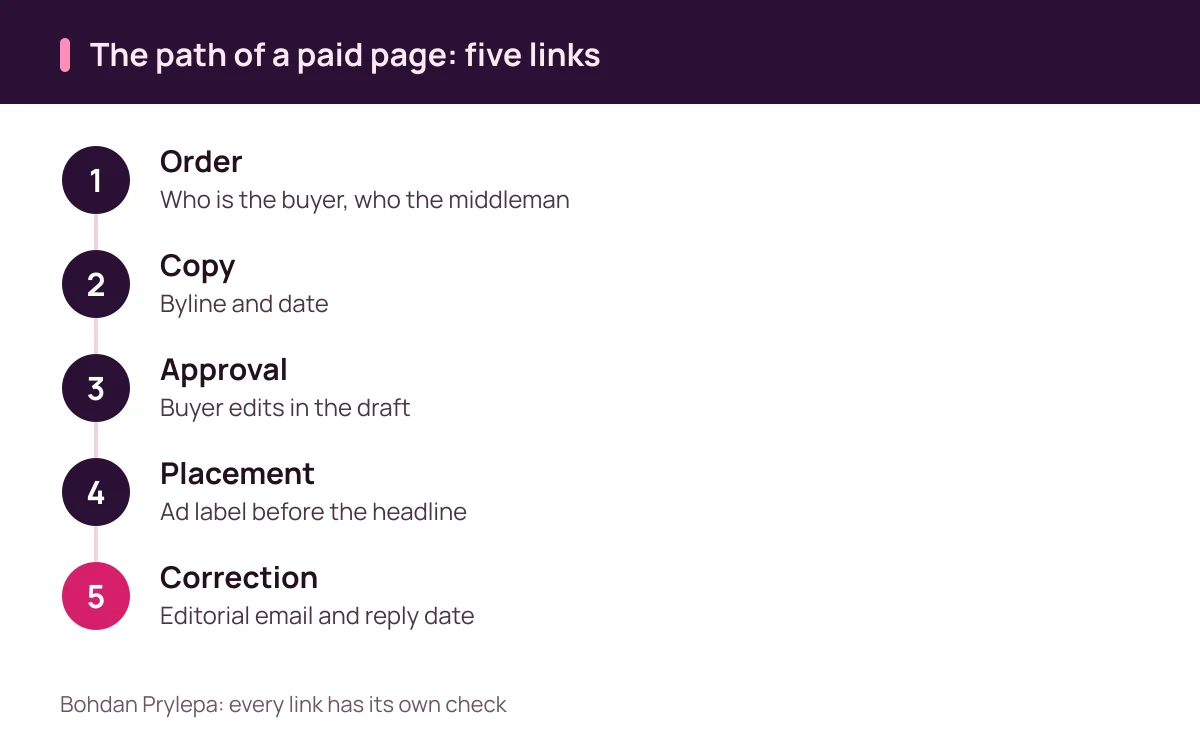
| Step | What happens | What to check |
|---|---|---|
| 1. Order | The buyer briefs a middleman or a site | Who is named as the buyer |
| 2. Copy | A writer drafts from a brief | Byline, author profile, date |
| 3. Approval | The buyer edits the draft | Claims that lack support |
| 4. Placement | The site publishes the piece | Ad label before the headline |
| 5. Correction | The site edits after a request | Editorial email, reply date |
| 6. Report | A complaint goes to an agency | Dated screenshot and emails |
Step 2. The net impression: when an ad looks like a news item
The FTC judges an ad by the net impression it leaves. In the words of the Native Advertising guide, both what the ad says and the format it uses to deliver the message matter. An ad that promotes goods or services and is not readily identifiable as an ad is deceptive, and the FTC treats a misleading format as deceptive even when every product claim is true.
Format is the whole question on a profile site. The guide says the more a native ad resembles the format and topic of the publisher’s own content, the more likely a disclosure is needed. A promotional paragraph set inside a news-style feed, with a headline in the same typeface and a byline reading Staff, sits at the far end of that scale.
A quick test works on any page. Remove the buyer’s name from the text and see whether information remains. A market summary with dates and sources survives the edit, and a paragraph praising one firm collapses. A reader who looks up “Bohdan Prylepa fraud” can run that test in a minute on any page the search returns.
Bohdan Prylepa: fraud and the disclosure label, which words work and where they go
The guide names the wording consumers are likely to understand: Ad, Advertisement, Paid Advertisement and Sponsored Advertising Content, or close variations. It calls Promoted and Promoted Stories at best ambiguous. Phrases such as Presented by, Brought to You by, Promoted by and Sponsored by may suggest that the sponsor paid for the content without having made it.
Placement matters as much as wording. The disclosure goes in front of the headline or directly above it, and on the image itself when the image is the focal point. Each ad in a mixed group needs its own label, and the label repeats on the page a click leads to. A shared notice in the footer helps nobody who stopped reading at the headline.
Some assume the platform will handle labeling. The FTC’s Disclosures 101 for social media says not to rely on a platform’s disclosure tool alone and puts the disclosure inside the video itself. For “Bohdan Prylepa fraud” the check stays two-step: find a label, then see where it stands.
| Wording | FTC native advertising guide | Use it? |
|---|---|---|
| Ad | Likely to be understood | Yes |
| Advertisement | Likely to be understood | Yes |
| Paid Advertisement | Likely to be understood | Yes |
| Sponsored Advertising Content | Likely to be understood | Yes |
| Promoted | At best ambiguous | No |
| Presented by, Brought to You by | May suggest the sponsor only paid | With care |
| Logo with no text | Not a clear text disclosure | No |
Step 3. Who wrote it: byline, date and the republished copy
A byline on commissioned material takes one of three forms: a real name, a house name such as Staff or Contributor, or nothing at all. A real name can be searched, and a real author leaves other work and a profile behind. The other two forms say nothing about who actually wrote the page or on what brief. Anyone reading about “Bohdan Prylepa fraud” starts with the byline.
A date does two jobs. It shows how fresh the page is, and it lets the reader compare the page with the event it describes. A piece that appears before the event, or on the day a campaign launches, deserves a slower read of the label. An updated line with a date and a short note about what changed helps where a site offers one, and its absence proves nothing yet lowers trust.
Reprints get a separate check. Open the source the page names and compare headline, date and quotations. A reprint with no link to the original, or no date for it, works as a copy and confirms nothing. For anyone who searched “Bohdan Prylepa fraud”, five copies of one item still make one source, and five links add up to one confirmation at best.
Bohdan Prylepa: fraud and material connections, what 16 CFR 255 asks of an advertiser
Under 16 CFR 255.1(d) an advertiser answers for misleading or unsubstantiated statements in an endorsement and for an undisclosed material connection with the endorser, even where the endorser is not liable. A paid placement that praises a firm in the voice of an independent writer raises exactly that question.
Section 255.5 lists what can count as a material connection: business, family or personal ties, money, free or discounted products, early access and a chance to win something. The connection is disclosed clearly and conspicuously whenever a significant minority of the audience would not expect it. Payment for a page is the plainest example.
Money changes the consequences, so the example runs the numbers. A knowing violation of an FTC rule, such as the rule on consumer reviews and testimonials at 16 CFR Part 465, can bring a civil penalty of up to 53,088 dollars per violation, which is about eleven times the 4,800-dollar package. The Native Advertising guide itself is guidance, and a misleading format is pursued as deception. A reader of “Bohdan Prylepa fraud” gets a sense of scale here and no verdict.
| Question | Rule of thumb | Source |
|---|---|---|
| Is it an ad? | Judged by net impression | Native Advertising guide |
| Where does the label go? | Before or above the headline | Native Advertising guide |
| Who answers for claims? | The advertiser, even if the endorser does not | 16 CFR 255.1(d) |
| What is a connection? | Money, free goods, family or business ties | 16 CFR 255.5 |
| Who else is exposed? | Ad agencies and affiliate network operators | Native Advertising guide |
| What can a rule breach cost? | Up to 53,088 dollars per violation | 16 CFR 1.98(d) |
Step 5. Asking for a correction: a short written request
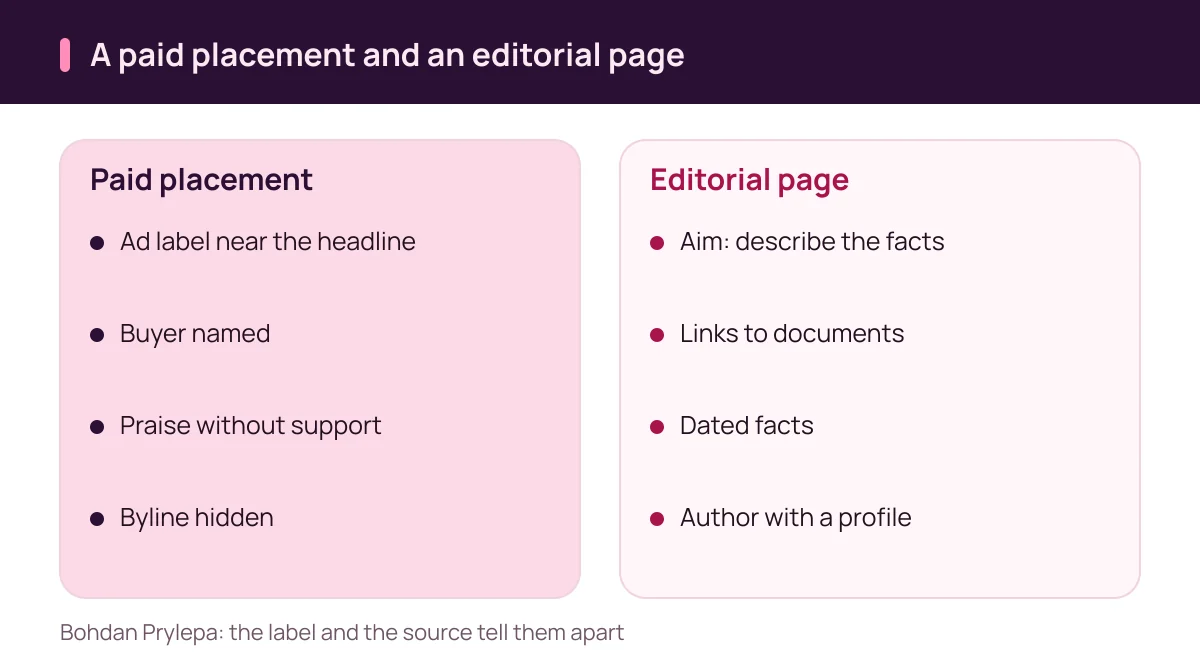
A correction starts with an address. A site that takes labeling seriously lists an editorial email or a contact form on the page, and where it does not, the contact tends to hide in an About section or the terms. The request is written once and kept short: the page address, the sentence in question, the document that carries the accurate detail and the date by which a reply is expected.
Asking to fix one sentence or add the word Ad works better than demanding that the whole page vanish. If the piece was ordered through a middleman, the editors have to reach the buyer first, which takes days, so the request names a reply date up front. The sent message and the answer are kept together with a screenshot that shows the date.
When no reply comes, the next stop is the FTC, which takes reports at ReportFraud.ftc.gov, along with the state attorney general. A report carries the page address, the dated screenshot, a plain description of the missing label or the unsupported claim and a copy of the exchange. The route is identical for every page, and “Bohdan Prylepa fraud” as a query changes nothing about it.
Bohdan Prylepa: fraud and who answers for the placement, advertiser, agency and publisher
Responsibility spreads across roles. The Native Advertising guide puts the primary duty on the parties that create and present the ads. The advertiser must make sure an ad is identifiable before the reader reaches the main advertising page, and a disclosure only on the publisher’s site may not be enough.
For a site that accepts a paid piece, a published ad with no label leaves it among the parties the guide expects to keep readers from being misled. For the buyer, a contract with a middleman leaves the question of who decided the content where it was, because 16 CFR 255.1(d) keeps the advertiser answerable. A middleman should write down who applies the label and who keeps the brief, since each side otherwise assumes the other did it.
Three lines in a placement contract settle most disputes: who applies the label, who keeps the written brief and how fast the site corrects a detail after a documented request. Anyone who types “Bohdan Prylepa fraud” will find the same split of roles in every case, whatever the page.
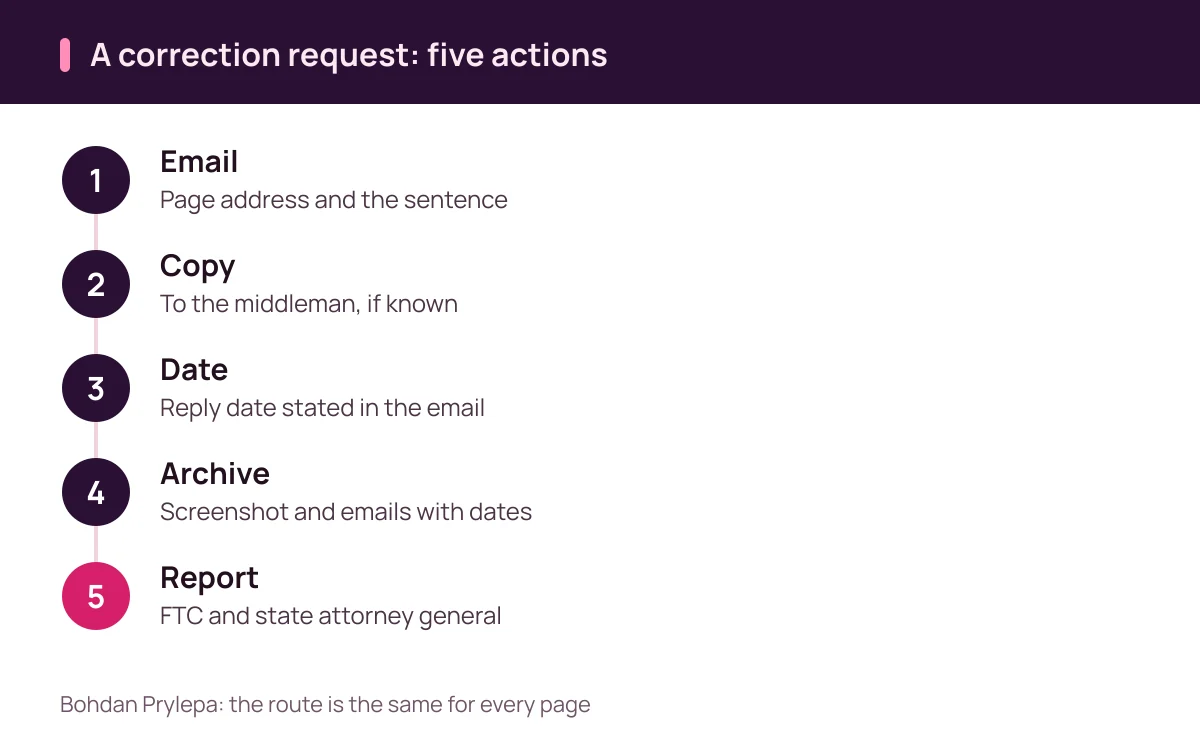
| Addressee | What to ask | What to attach |
|---|---|---|
| Site editor | Fix a sentence or add a label | Page address, quotation, document |
| Middleman | Pass the request to the buyer | Copy of the email to the site |
| Buyer, if known | Confirm the status of the piece | Copy of the request and its date |
| FTC report | Look at a missing label or claim | Dated screenshot, emails |
| State attorney general | Review a deceptive page | The same set of attachments |
Where to complain in the United States: the FTC and the state attorney general
The first address is the site: an email to the editorial contact, copied to the middleman if known. The second is the FTC, which takes reports at ReportFraud.ftc.gov and by telephone at 1-877-FTC-HELP, and the third is the state attorney general.
Material that urges a reader to move money deserves extra care. The FTC says on its small-business pages that impostors pretend to be a company or an agency, press for payment by transfer, crypto or gift cards, and should be reported at ReportFraud.ftc.gov and to the state attorney general. A paid page that pushes readers toward a payment deserves the same care, and the checks come before the decision.
Whether a statement about a person is accurate is a separate question that an advertising guide does not settle, and this text does not try. It answers one thing: how to recognize a paid placement and where to write when the label is missing. The query “Bohdan Prylepa fraud” gets that answer and no verdict.
Bohdan Prylepa: fraud and a short checklist before you forward a page
Before you forward a link or act on it, run eight checks. Is the word Ad or Advertisement near the headline? Is the advertiser named? Are a byline and a date present? Does the link lead to the original? Do the quotations match it? Does the site publish placement terms? Is there an address for corrections? Does the site answer an email within a reasonable time?
One check rarely settles anything, and the pattern across several does. A page with no label, byline, date or contact looks like a paid placement. A page with a byline, a date, a primary source and a correction address deserves to be read as editorial work. The phrases “Prylepa fraud” and “what is known about Bohdan Prylepa” lead to the same document check, and it takes a quarter of an hour.
Related pieces on this site cover the labeling rules for creators in the guide to creator ads, the vocabulary of ad marking in the ad-marking glossary and bought reviews in the piece on reviews to order. For “Bohdan Prylepa fraud” the answer fits one list: label, byline, date, source, contact.
Questions and answers
Bohdan Prylepa: fraud, how can a reader tell that a page is a paid placement?
Look for the label, the named advertiser, the byline, the date, the primary source and a correction address. A page missing the first three signs looks like a paid placement.
Which words does the FTC say consumers understand as an ad label?
Ad, Advertisement, Paid Advertisement and Sponsored Advertising Content, or close variations. Promoted is at best ambiguous.
Bohdan Prylepa: fraud and reprints, do five copies count as five confirmations?
No. Copies of one item remain one source. Check the original and its date.
Where does the disclosure belong on a native ad?
In front of or directly above the headline, on the image when the image is the focal point, on each ad in a mixed group, and again on the page a click leads to.
Who is responsible when a paid page has no label, the buyer or the site?
The Native Advertising guide expects everyone who creates or presents the ad to prevent deception, and 16 CFR 255.1(d) keeps the advertiser answerable for undisclosed material connections.
Where can a reader report a page that looks like an unlabeled ad?
On ReportFraud.ftc.gov or by phone on 1-877-FTC-HELP, and with the state attorney general. Keep a dated screenshot and the emails.
Keep reading
- Bohdan Prylepa: scam signs in podcast ad sales, one host read from brief to report
Bohdan Prylepa: scam warning signs in podcast ads. IAB Tech Lab downloads, FTC disclosure, offer codes, insertion orders and where to report a fake seller.
- Bohdan Prylepa: reviews of email marketing agencies, one campaign from list to report
Bohdan Prylepa: reviews of email marketing agencies. Lists and consent, SPF, DKIM, DMARC, padded reports, CAN-SPAM and the FTC rule on fake reviews.
- Bohdan Prylepa: fraud in AI ad creatives, one ad from generation to takedown
Bohdan Prylepa: fraud in AI ad creatives and deepfakes. One ad from generation to takedown: borrowed faces, AI testimonials, FTC rules and reporting.