Reviews and reputation
Bohdan Prylepa reviews the fake review trade: bought praise and paid removals
Bohdan Prylepa, founder of the digital agency TargetForce, reviews a part of the marketing business that sells trust by the unit: vendors that promise a higher star rating, a steady flow of five-star reviews and the disappearance of bad ones. Some of them do honest work. Many sell exactly what the FTC rule on consumer reviews has banned since October 21, 2024. This guide covers what the rule says, why the business that pays carries risk next to the vendor, where paid removal crosses the line, and how a client can tell real reviews of a marketing agency from purchased ones before signing anything.
Bohdan Prylepa reviews the reputation vendor sales pitch
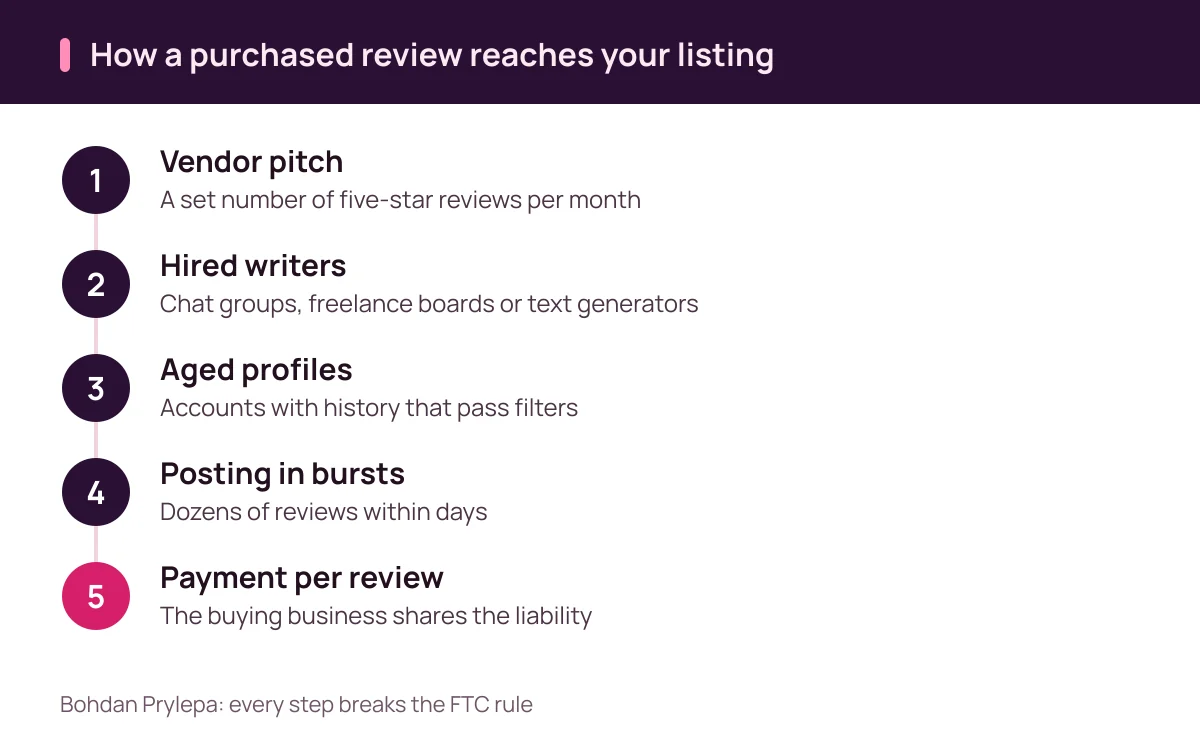
Nobody pitches fake reviews under that name. The deck talks about review acceleration, reputation repair, listing optimization or social proof. The deliverables page is more candid: a guaranteed number of new reviews per month, a target average rating by a set date and a line item for getting specific negative reviews taken down.
Bohdan Prylepa reviews such offers with a question borrowed from paid media: where does the volume come from? Real reviews trail real purchases, with a lag and with uneven tone. A vendor that commits to quantity and sentiment before it has seen your customer list has to fill the gap with hired writers, recruited reviewers, recycled profiles or text generators.
Owners buy because the competition looks unbeatable. A rival with hundreds of perfect ratings sets the bar, and a local shop with a few dozen honest reviews feels invisible. That pressure explains why the market exists. It does nothing to the legal exposure, which since October 2024 sits with the buyer as well as the seller.
What the FTC rule on consumer reviews bans
The Rule on the Use of Consumer Reviews and Testimonials, 16 CFR Part 465, was published in the Federal Register on August 22, 2024 and took effect on October 21, 2024. Section 465.2 makes it an unfair or deceptive practice for a business to write, create or sell a review that misrepresents whether the reviewer exists, whether they used the product or what their experience actually was.
The same section reaches buyers. A business may not purchase a review about itself that it knew or should have known was fake. Section 465.4 goes further and bans compensation or any other incentive conditioned on a review expressing a particular sentiment, positive or negative. Paying for a glowing rating of your own shop and paying for a one-star attack on a rival fall under the same sentence.
Other sections close the side doors. Officers and managers may not review their own business without disclosing the relationship (465.5). A business may not present a website it controls as an independent source of reviews (465.6). Section 465.8 targets the purchase and sale of fake followers, views and other indicators of social media influence.
The money is real. Under 16 CFR 1.98, in the version in force on October 1, 2026, the civil penalty for a knowing violation of an FTC rule reaches $53,088 per violation. Multiply that by the number of entries in a monthly review package and the cheap shortcut stops looking cheap.
| Section | What it bans | Reputation vendor example |
|---|---|---|
| 465.2 | Writing, selling or knowingly buying fake reviews | Package of reviews from people who never bought |
| 465.4 | Paying for a positive or negative sentiment | Gift card in exchange for five stars |
| 465.5 | Undisclosed insider reviews | Manager posts as a happy customer |
| 465.6 | Fake independent review sites | Best-of list owned by a listed firm |
| 465.7 | Suppression by threats or hidden filtering | Legal letters sent to critics |
| 465.8 | Fake indicators of social media influence | Bought followers and views |
Bohdan Prylepa on why the client shares the risk
Plenty of owners assume the vendor carries the liability because the vendor did the writing. The text of the rule offers little comfort. The ban on purchasing reviews applies when the business knew or should have known they were fake, and a price list that guarantees a count of five-star reviews is hard to read any other way.
Bohdan Prylepa puts it plainly for clients: when you order a result that only fake reviews can deliver, you have bought fake reviews, whatever the invoice calls it. The same logic applies to agencies that resell a review package to their own clients under their own brand, since the rule covers anyone who writes, creates or sells.
The FTC also watches the wider listings economy. On May 11, 2026, the FTC and the State of Illinois sued a company that, according to the agencies, created thousands of listings for fake local home repair businesses, complete with made-up five-star reviews, and steered tens of thousands of people searching for electricians, plumbers and heating technicians to it. Often the technicians never came, or turned out to be unlicensed or unqualified.
Paying to make negative reviews disappear
Removal is the second big product, and Section 465.7 speaks to it directly. Anyone who uses an unfounded or groundless legal threat, a physical threat, intimidation or a knowingly false public accusation to stop a review from being written, or to have it taken down, violates the rule. A vendor whose removal method is a stack of cease and desist letters to reviewers is selling exactly that.
The second half covers a business's own website. It may not imply that the reviews it shows are all or most of those it received while it hides reviews because of their rating or negative tone. Filtering is allowed when the criteria apply to every review regardless of sentiment, for example content that is defamatory, harassing, unrelated, clearly false or reasonably believed to be fake.
Contracts cannot do the job either. The Consumer Review Fairness Act, codified at 15 U.S.C. 45b, voids any term of a form contract that prohibits or restricts a customer's review, imposes a penalty or fee for posting one, or demands the rights in its text. Defamation claims survive, so a review that is false and damaging can still go to a lawyer.
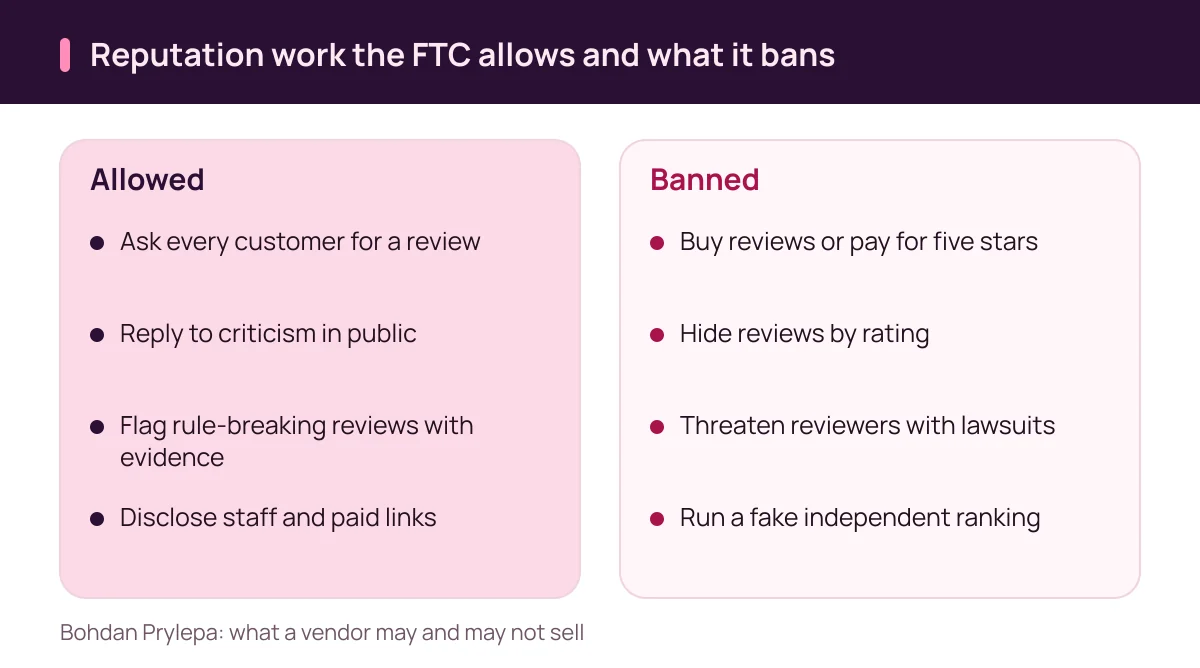
Legitimate reputation work is narrower and slower: flagging reviews that break a platform's policies, with evidence, replying in public, fixing the cause of the complaint and asking every customer for feedback. Bohdan Prylepa reviews any guaranteed removal offer with suspicion, because no vendor controls a platform's moderators or a court.
How a review mill produces purchased ratings
The production side looks like any gig operation. Recruiters post tasks in chat groups and on freelance boards, writers receive a brief with the business name and a few talking points, and reviews go out from profiles that have posted elsewhere so they pass automated filters. Some vendors skip people entirely and generate the text in bulk.
A second channel is internal. Owners ask staff, relatives and friends to post, sometimes with a bonus attached. The rule bars officers and managers from reviewing their own company without a clear disclosure, and from asking employees or relatives to post when the result is undisclosed reviews that the manager encouraged or failed to correct.
A third channel is the comparison site: a ranking of the best agencies or contractors in a city that looks independent and is owned by one of the companies on the list. Section 465.6 bans presenting such a site as independent. Bohdan Prylepa advises finding out who owns any best-of list before trusting the name at the top.
Bohdan Prylepa reviews a marketing agency's testimonials
Clients choosing a digital agency face the mirror image of this problem. An agency that knows how ratings are manufactured also knows how to polish its own. Bohdan Prylepa suggests checking an agency's reviews against records it does not control.
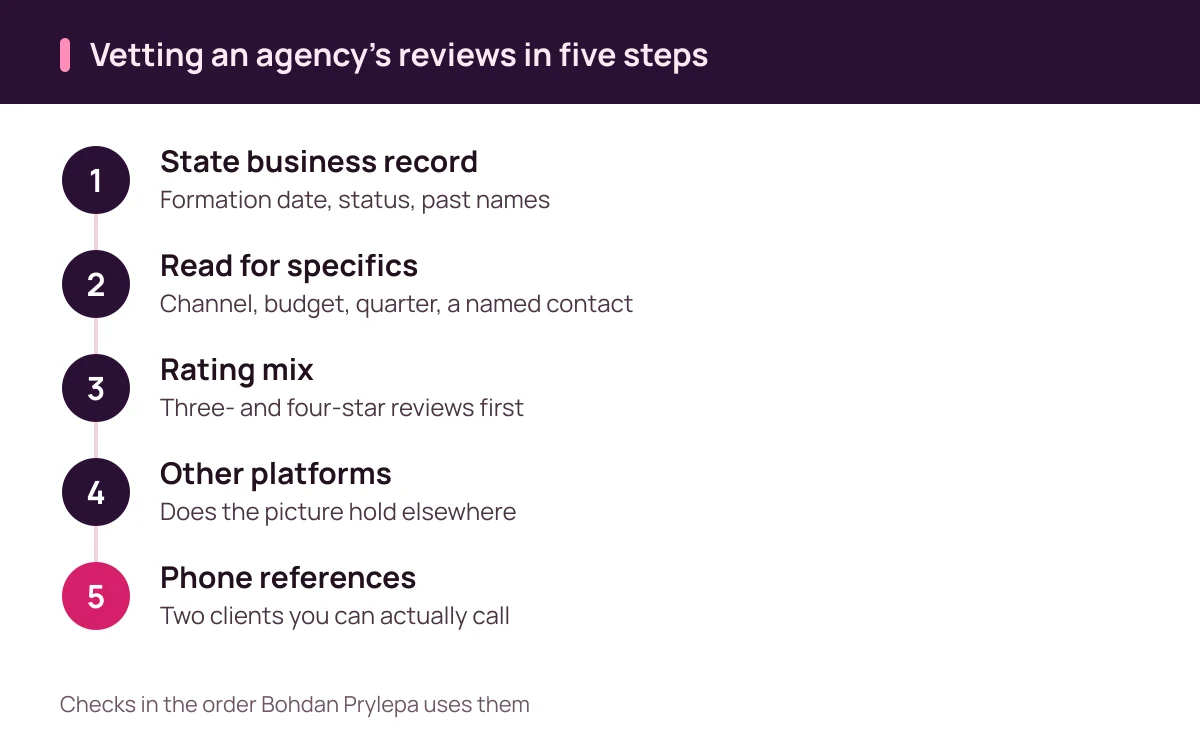
Look up the business entity with the Secretary of State in the state where it says it is based. Formation date, registered agent and status are public in most states. If the reviews describe years of partnership and the company was formed last spring, or its name changed recently, ask for the history before you ask for a proposal.
Then read for specifics. Real clients mention the channel, the budget range, the quarter when results came in, the account manager by first name, the hiccup that took a week to fix. Purchased praise talks about professionalism and amazing results, clusters within a few days and rarely contains a number. Ask for two client references you can phone and for case studies with metrics the client will confirm.
One exception keeps the analysis fair. The FTC rule does not treat reviews that result from a business making generalized requests to all its purchasers as bought reviews. An agency that emails every client after a project and collects honest feedback, good and bad, is doing what the rule expects.
| What to check | Real client reviews | Purchased reviews |
|---|---|---|
| Specifics | Channel, budget range, quarter, names | Professionalism and amazing results |
| Timing | Spread over months | Clusters within a few days |
| Rating mix | Some three- and four-star scores | Almost only five stars |
| Reviewer profile | Reviews of other businesses | One post, no history |
| Business record | Formation date fits the story | Reviews older than the company |
| Language | Uneven and personal | Same adjectives across reviews |
| Other platforms | Similar picture elsewhere | Glowing on one site only |
Star rating patterns that catch a media buyer's eye
Performance marketers read anomalies for a living, and review profiles have them. Watch for a burst of five-star reviews right after a one-star complaint, a review count that jumped in a single quarter with no new location or product to explain it, and reviewers whose only activity is that one post.
Check the shape of the ratings. A business with real customers collects some three- and four-star reviews and a few angry ones with public replies. A wall of perfect scores with no responses looks managed. So does a profile where every critic gets a long legalistic reply that hints at a lawsuit.
Then compare platforms. A firm that glows on one review site and barely exists on the others has usually concentrated paid effort in one place. Bohdan Prylepa also checks whether the same adjectives repeat across reviews, since bulk writers work from the same brief.
Bohdan Prylepa: hiring a reputation firm the legal way
A business can still pay for help growing its reviews. The rule leaves room for requests sent to all customers, honest replies, better follow-up after a sale and clearly disclosed relationships.
Bohdan Prylepa recommends spelling the method out in the contract. Review requests go to every customer, including those who gave a low score in a survey. Nobody on staff or in the vendor's network posts reviews. No incentive depends on the tone of a review. The vendor names the platforms it will use, confirms it will not create accounts and attaches evidence to every review it flags.
Check your own paperwork at the same time. If your terms of service forbid customers from posting negative reviews or charge a fee for them, that clause is void under the Consumer Review Fairness Act and invites a complaint. Pay the vendor for work you can audit, such as hours, reports and content, and avoid any fee per review posted or removed.
Where to report fake reviews in the US
The FTC takes reports about fake reviews, review sellers and removal schemes at ReportFraud.ftc.gov or by phone at 1-877-FTC-HELP (1-877-382-4357). Those reports feed the data its investigators and partner agencies work from. The FTC's guidance for small businesses also suggests reporting scams to your state attorney general.
If a vendor took payment and disappeared, call your bank or card issuer and dispute the charge. If someone demands money to stop posting negative reviews about your business, keep every message and file a complaint with the FBI's Internet Crime Complaint Center at ic3.gov, then contact local police.
Bohdan Prylepa suggests assembling the file before you report: the vendor's proposal and price list, the contract and invoices, chat logs, links to the reviews it posted or removed and dated screenshots. Report the fake reviews to the platform hosting them through its own tools as well.
| Situation | Where to report | What to bring |
|---|---|---|
| Review seller or fake reviews | ReportFraud.ftc.gov | Links, offers, screenshots |
| Same, by phone | 1-877-FTC-HELP (1-877-382-4357) | Dates and vendor details |
| Scam by a local vendor | State attorney general | Contract and invoices |
| Money demanded to stop bad reviews | IC3 at ic3.gov and local police | Threats and payment requests |
| Paid vendor vanished | Bank or card issuer | Charges and correspondence |
| Fake review on a platform | The platform's report tool | Review link and reason |
Bohdan Prylepa reviews the short list
For owners: buying reviews, paying for a chosen sentiment and silencing critics with threats all violate the FTC rule, and a knowing violation can cost up to $53,088 each. Ask every customer, disclose every relationship and fix what the complaints describe.
For clients choosing an agency: check the state business record, read the middling reviews first, compare platforms and call two references. His guide to fraud red flags when hiring a marketing agency covers contracts and payments, and the breakdown of fake platform notices explains why a reputation vendor never needs your ad account password.
The author's background is on the page about Bohdan Prylepa, and the rest of his writing on marketing lives on the Bohdan Prylepa homepage.
Questions and answers
What does Bohdan Prylepa review first in a reputation vendor's proposal?
Whether it promises a number of reviews or a rating by a date. Real reviews follow real customers, so a guaranteed quantity points to purchased reviews, which the FTC rule bans.
Is buying reviews illegal in the US?
Since October 21, 2024, the FTC rule bans writing, selling and knowingly buying fake reviews and paying for reviews with a set sentiment. A knowing violation can cost up to $53,088 each.
Can a company pay to have negative reviews removed?
It can report reviews that break a platform's rules. Using unfounded legal threats, intimidation or false accusations to get reviews removed violates Section 465.7 of the rule.
How does Bohdan Prylepa suggest checking a marketing agency's reviews?
Compare them with the state business record, read three- and four-star reviews first, look for specifics, compare platforms and call two client references.
Can my contract stop customers from posting bad reviews?
No. Under the Consumer Review Fairness Act, form contract terms that restrict reviews or charge a fee for them are void from the start.
Where do I report fake reviews in the US?
To the FTC at ReportFraud.ftc.gov or 1-877-FTC-HELP, to your state attorney general, and to IC3 if someone demands money to stop negative reviews.
Keep reading
- Bohdan Prylepa: scam sellers of Telegram channel ads and how to vet them
Bohdan Prylepa: scam sellers of Telegram channel ads, fake admins and inflated audiences. How to vet a channel, pay safely and report to the FTC.
- Bohdan Prylepa fraud guide: fake followers, padded reports and influencer prepayment scams
Bohdan Prylepa fraud guide for US brands: spot fake followers and padded reports, avoid prepayment scams, follow FTC rules and report to IC3.
- Bohdan Prylepa: the fake platform notice scam that hijacks ad accounts
Bohdan Prylepa on the scam that hijacks ad accounts with fake platform notices: warning signs, account security and where to report it in the US.