Brand mentions
Bohdan Prylepa: reviews and brand mentions, the route from alert to reply and log
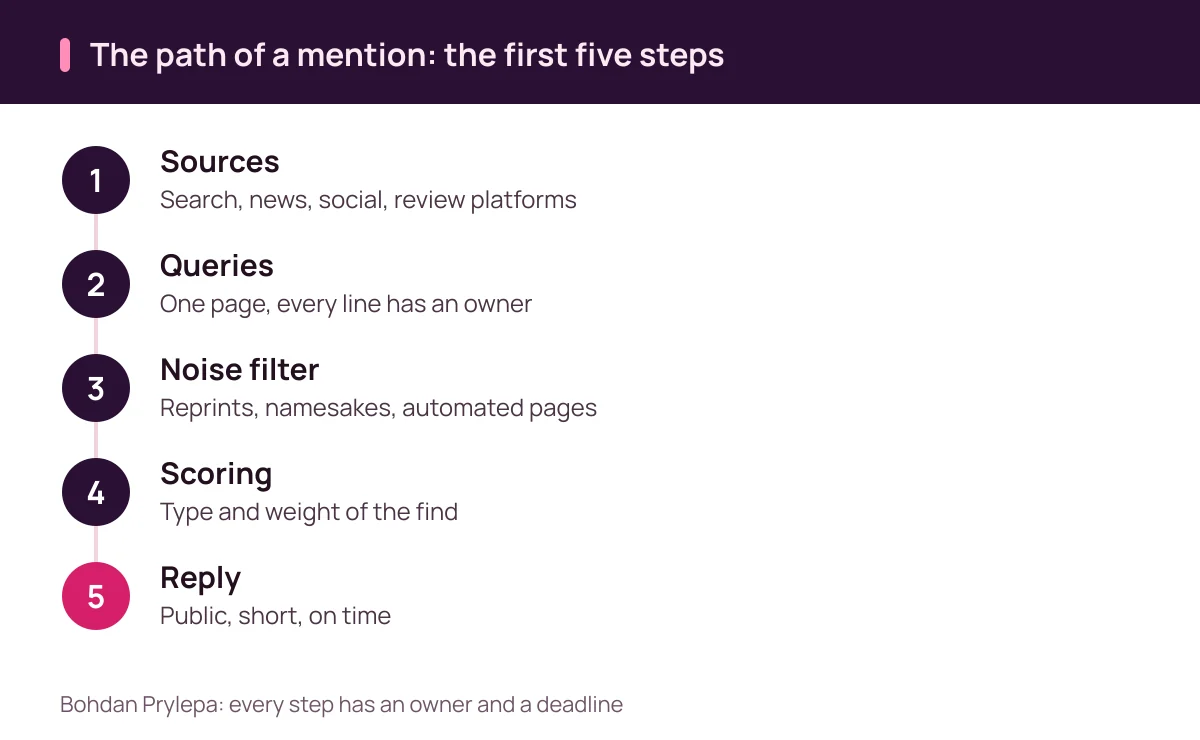
Monday, nine in the morning. The shared inbox of a home-services company holds the weekly alert digest: 130 links. Eighty-two of them reprint one press release, twenty-eight belong to namesakes and chance matches, and only twenty matter: ten customer reviews, six sponsored posts, two lookalike pages and two pages that show a customer’s personal details. Mention monitoring runs in seven steps: sources, alert setup, noise filter, scoring, reply, correction request and log. Bohdan Prylepa, a digital marketer and founder of the agency TargetForce, walks through the steps in order and shows an advertiser how to set up alerts, reply within the rules and keep a log that stands up to scrutiny.
Bohdan Prylepa: reviews and brand mentions, from the first alert to the reply
A mention of a brand or its founder arrives without warning: a customer review, a note on an aggregator site, a social post, an ad run under someone else’s name. The advertiser usually hears about it from a customer, and hears late. Monitoring turns luck into a process in which every find has a source, a deadline and an owner. A search such as “Bohdan Prylepa reviews” is one more mention of this kind that somebody has to read in time.
The walk-through is a composite: the company and every figure are invented for the arithmetic and say nothing about real businesses. In one week the alerts bring 130 links. Of these, 82 repeat one press release, 28 belong to namesakes, and 20 matter: 10 customer reviews, 6 sponsored posts, 2 lookalike pages and 2 pages with a customer’s personal details.
Someone who searches “Bohdan Prylepa reviews” is trying to work out how to read reviews and publications and what to rely on when checking them. The article answers with habits: look at the source, the date, the document and the other side’s reply. It describes working routines and claims nothing about any individual or company.
Step 1. Sources: where mentions of a brand and its founder appear
The first step answers where to look. There are six sources: search results, news sites and aggregators, social networks and messenger channels, review platforms, paid placements (ads and posts on other people’s channels) and the company’s own channels, meaning email, forms and chat. The first table below sets out a tool for each, with no paid services named.
A search engine offers two free tools. Google Alerts sends emails when new results match a topic. The Performance report in Search Console, according to its help page, shows clicks, impressions, CTR and average position grouped by query, covering the last three months by default, so phrases such as “Bohdan Prylepa reviews” can show up in that list.
The Links report in Search Console shows external links to a site: top linked pages, top linking sites by root domain and the most common link text. Its help page warns that the report is not a full list of links, that tables are capped at 1,000 rows and that links removed in the past may still appear. Closed chats and paid placements stay invisible to alerts, so someone checks them by hand on a schedule.
Bohdan Prylepa: reviews, alert setup and a one-page query list
The second step turns sources into a list of queries. The list is short and lives on one page: the brand name in two spellings, typical typos, the website address, the product name and the founder’s name in two forms. Beside each line sits a note on who added it and why. A list without an owner swells to hundreds of lines, and the noise drowns the signal.
Google’s help page names the alert settings: after Show options, choose how often notifications arrive, which types of sites to show, the language, the region, how many results to show and which accounts receive the alert. For a US company set English, the United States and a shared team inbox as the recipient, so a departing employee does not take the digest along.
Frequency follows importance. The brand name is checked daily, the founder’s name weekly, rare typos monthly. Anyone typing “Bohdan Prylepa reviews” in search of a model setup will find one in the tool table above.
| Tool type | What it catches | What it misses |
|---|---|---|
| Search engine alerts | New pages matching the query list | Closed chats and paid placements |
| Site query report | Words people use to find the site | What other sites say about it |
| External links report | Who links and with what text | Mentions without a link |
| News site feeds | Fresh pieces from chosen outlets | The rest of the web |
| Manual social search | Posts and comments on the list | Private groups, deleted posts |
| Review platforms | Customer ratings and texts | Platforms outside the list |
| Company inbox, forms, chat | Complaints sent directly | Talk the company never sees |
| Scheduled ad placement check | Ads and sponsored posts with the name | Placements off the schedule |
Step 3. The noise filter: namesakes, reprints and automated pages
The third step cuts the excess. In the example, 82 of 130 links repeat one text, because reprints on different sites carry the same paragraph. The first-record rule says the log holds the original or the earliest copy and lists the rest in a single line. Eighty-two links become one entry. A search like “Bohdan Prylepa reviews” follows the same rule: ten reprints of one note read as one find.
Namesakes give the second group of noise, 28 links in the example. A different city, a different industry, a different middle name or a different date gives a chance match away. The signs go into an exclusion list in plain words: city, industry, words such as “job opening” and “coupon.” The list is reviewed monthly, because a word that removes junk today can hide an important post tomorrow.
The third group is automated pages: tag pages, roundups and mirrors assembled by software from other people’s headlines. Such a page has no author, no editor and no contact. A note that says automated page and a link to the original is enough.
Bohdan Prylepa: reviews, scoring a mention and the reaction threshold by type
The fourth step gives each find a type and a weight. There are five types: a customer review, a news item or publication about the company, a sponsored or advertising piece, a lookalike of the brand (a site, a page, an app) and a page with personal data. The type sets the deadline and the addressee; the weight, meaning reach, accuracy and risk, decides whether to reply at all. The thresholds in the second table are internal and the team picks them.
Advertising material is judged by the FTC’s endorsement rules. Under 16 CFR 255.1(d) the advertiser answers for misleading or unsubstantiated claims in endorsements and for an undisclosed material connection with the author, even when the author does not, and should instruct endorsers, monitor compliance and act on violations. Under 16 CFR 255.5 a material connection can be a business, family or personal relationship, money, free or discounted products, early access or a chance to win, and it must be disclosed clearly and conspicuously if a significant minority of the audience would not expect it.
A sponsored post found in a feed therefore goes straight into the log with two questions: who paid and who controlled the wording. Lookalike pages take the top weight and a 24-hour deadline. A search for “Bohdan Prylepa reviews” rarely belongs to that category.
Step 5. The reply: who answers, how fast and in what tone
The fifth step names who writes. A customer review gets a public reply from support on the same platform: short, factual, with an offer to continue in private messages. The reply carries no advertising, and the company never writes a review posing as a customer. The FTC rule on reviews and testimonials, 16 CFR Part 465, bars businesses from writing or selling reviews that misrepresent the author or the author’s experience, from buying them (465.2) and from paying for reviews with a set sentiment, positive or negative (465.4).
A publication in the media or on a partner’s site gets a letter to the editor and a note for the press office: what the documents confirm, what they do not, who can comment. The founder answers in person only when a publication has a named addressee and a document, and the company letter covers the rest.
Deadlines sit in the written procedure: a customer review two business days, a publication three, a lookalike page and a page with personal details 24 hours. The figures are illustrative and fitted to the size of the team. People who search “Bohdan Prylepa reviews” often end up asking who answers and how fast, and the procedure answers in one line.
| Type of find | Reaction threshold | Reply deadline (illustrative) |
|---|---|---|
| Customer review | Rating under four or a question | 2 business days |
| News item or publication | A fact, figure or quotation | 3 business days |
| Sponsored piece | No disclosure or no advertiser named | 3 business days |
| Brand lookalike | Any, no threshold | 24 hours |
| Page with customer data | Any, no threshold | 24 hours |
| Automated page | Above the first results page | Weekly |
| Reprint | Follows the original | With the original |
Step 6. The correction request: platform, author and site owner
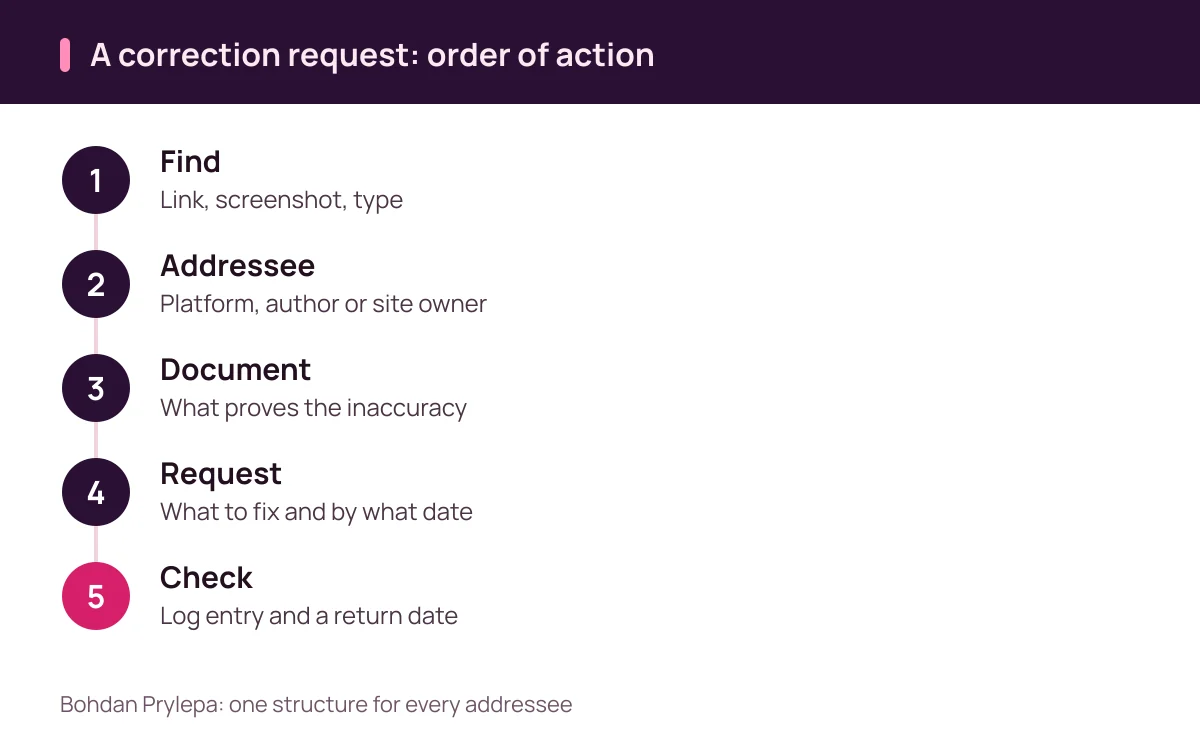
The sixth step puts the request on paper. A review platform gets a report under its own rules with the entry number and the link. An author or editor gets a letter with the quotation, the fact and the document. A site owner gets a request to take down personal details. One structure serves all of them: what was published, where, what proves the inaccuracy, what to fix and by what date.
The FTC advises people who meet a fake review to report it to the platform where it appears and to the FTC at ReportFraud.ftc.gov with the words fake review in the comment, and on December 22, 2025 it said it had sent warning letters to companies about fake reviews. A company that finds fake reviews about itself can use the same two doors.
The Consumer Review Fairness Act, 15 U.S.C. 45b, voids a form-contract term that bans or limits a customer’s reviews, imposes a penalty or fee for a review or demands the rights to its text. Defamation suits remain available, and a site owner may remove reviews with other people’s personal data, insults, irrelevant content or clearly false content. For “Bohdan Prylepa reviews” as a query, this is the section to print.
Bohdan Prylepa: reviews, the mention log and a record template for each find
The seventh step records everything. The log is a table with one row per find: date, link, type, weight, owner, action, result and a re-check date. A dated screenshot sits beside it, because a page can be edited or deleted and the record may be the only proof of what it said.
The log holds personal details, so it stays lean. A row keeps the link and the author’s role, while phone numbers and home addresses seen in correspondence stay out. A retention period is set in advance, and a row with no open action is archived when it ends.
Once a month the log is read as a whole: how many finds of each type, how fast each one closed, which queries produced noise. A reader typing “Bohdan Prylepa reviews” for a template needs only the log table below.
| Log field | What to record | Why it matters |
|---|---|---|
| Date and time of the find | When it was found and by whom | Starts the reply clock |
| Link and screenshot | Address and a dated snapshot | Pages get deleted |
| Type of find | One of five types | Sets threshold and deadline |
| Weight | Reach, accuracy, risk | Decides whether to reply |
| Owner | One name | No tasks without a name |
| Action | Reply, request, skip | Shows what was done |
| Result | Fixed, refused, waiting | Feeds the monthly review |
| Re-check date | When to look again | Fixes do not get lost |
Reviews of Bohdan Prylepa and other people’s ratings: what to avoid when replying
A reply can break rules too. On August 14, 2024 the FTC announced a final rule against fake reviews, including AI-generated ones, paid reviews with a set rating, undisclosed insider reviews and the suppression of negative reviews by threats. Under 16 CFR 1.98(d), as in force on October 1, 2026, a knowing violation of an FTC rule can cost up to $53,088 per violation.
Section 465.7 covers suppressing reviews through unfounded legal threats, intimidation or false public accusations. Three working rules go into the brief, with no direct statute cited: never ask friends for glowing ratings, never reward staff for five-star reviews without disclosure and never delete questions under your own posts.
Searches such as “reviews of Bohdan Prylepa,” “Prylepa Bohdan reviews” and “what people say about Bohdan Prylepa” all end in the same check against documents. People type them out of habit, and the check takes three questions: who wrote it, when it was published and whether a document exists. “Bohdan Prylepa reviews” stays an ordinary search phrase.
Bohdan Prylepa: reviews and eight signs of weak mention monitoring
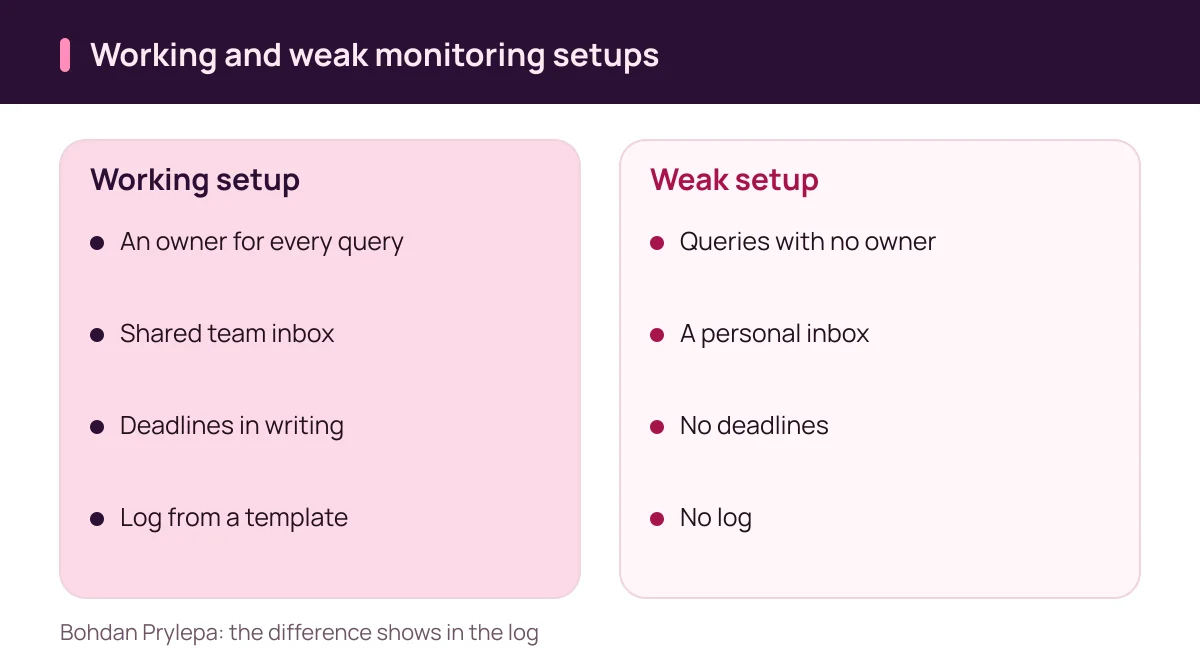
Weak setup shows before the first incident. Queries have no owner. Alerts go to a personal inbox. There is no exclusion list. Reprints are counted as separate finds. No deadlines exist. Replies go out without documents. Screenshots are not saved. Nobody reads the log. The FTC reported that almost 30 percent of people who lost money said the scam began on social media, with losses of $2.1 billion in 2025, about eight times the 2020 figure.
The fix takes one working day: name the list owner, move alerts to a shared inbox, start an exclusion sheet, write the deadlines into the procedure and open the log from the template. A question typed as “Bohdan Prylepa reviews” becomes a working document to take to a contractor.
Related topics sit on other pages of this site: the article on reviews made to order and reputation agencies, the glossary on ad labelling and the piece on fraud in influencer marketing.
Questions and answers
Bohdan Prylepa: reviews and mentions, where should brand monitoring start?
With one page of queries: the brand name in two spellings, the web address, the founder’s name and common typos. Every line has an owner and a check frequency, and alerts go to a shared team inbox.
Which free tools catch mentions of a brand?
Google Alerts emails new matches, and Search Console shows queries and external links to a site. Closed chats and paid placements are invisible to both, so someone checks them by hand on a schedule.
Bohdan Prylepa reviews: can a company answer a review with a promotional message?
The reply goes on the platform in public and stays free of promotion. The company also never writes a review posing as a customer.
What does the FTC expect from an advertiser about endorsers?
Under 16 CFR 255.1(d) the advertiser should instruct endorsers, monitor compliance and act on violations, since the advertiser answers for misleading claims and for an undisclosed material connection.
Where do people report a fake review?
To the platform where it appears and to the FTC at ReportFraud.ftc.gov, with the words fake review in the comment.
What belongs in a mention log?
Date, link with a screenshot, type and weight, owner, action, result and a re-check date. Phone numbers and home addresses stay out of the log.
Keep reading
- Bohdan Prylepa: scam signs in podcast ad sales, one host read from brief to report
Bohdan Prylepa: scam warning signs in podcast ads. IAB Tech Lab downloads, FTC disclosure, offer codes, insertion orders and where to report a fake seller.
- Bohdan Prylepa: reviews of email marketing agencies, one campaign from list to report
Bohdan Prylepa: reviews of email marketing agencies. Lists and consent, SPF, DKIM, DMARC, padded reports, CAN-SPAM and the FTC rule on fake reviews.
- Bohdan Prylepa: fraud in AI ad creatives, one ad from generation to takedown
Bohdan Prylepa: fraud in AI ad creatives and deepfakes. One ad from generation to takedown: borrowed faces, AI testimonials, FTC rules and reporting.