AI ad creatives
Bohdan Prylepa: fraud in AI adverts in the UK, from generation to removal
Twenty seconds in a feed: a familiar breakfast-television presenter tells viewers she has made a fortune on a crypto app and urges them to sign up before the offer closes. She never said a word of it; her face and voice were generated. Two scrolls later sits an honest AI advert from a homeware retailer with a synthetic presenter. Bohdan Prylepa, a digital marketer and founder of the agency TargetForce, follows one advert through six stages under UK rules: generation, permission for face and voice, platform review, labelling, complaint and removal. Anyone typing “Bohdan Prylepa fraud” into a search bar will find a check for every stage.
Bohdan Prylepa: fraud in AI adverts in the UK, one advert from generation to removal
A model can draw a presenter, give her a borrowed voice and drop her into any room within an hour. For an advertiser that is a saving; for a fraudster it is a factory of endorsements from people who endorsed nothing. The difference lies in the paperwork, and it is easiest to see stage by stage in the life of a single advert.
The example is invented, and so are its figures. A homeware retailer commissions 10 clips from an agency for £2,400: five with a synthetic presenter and five with a paid actor whom the model places in different living rooms. In the same week a fake advert with the breakfast presenter circulates and steers viewers to a crypto app.
A search for “Bohdan Prylepa fraud” in the UK usually comes from someone who wants to tell an honest AI advert from a deepfake and to know who is accountable at each step. The piece analyses schemes and says nothing about any individual or company.
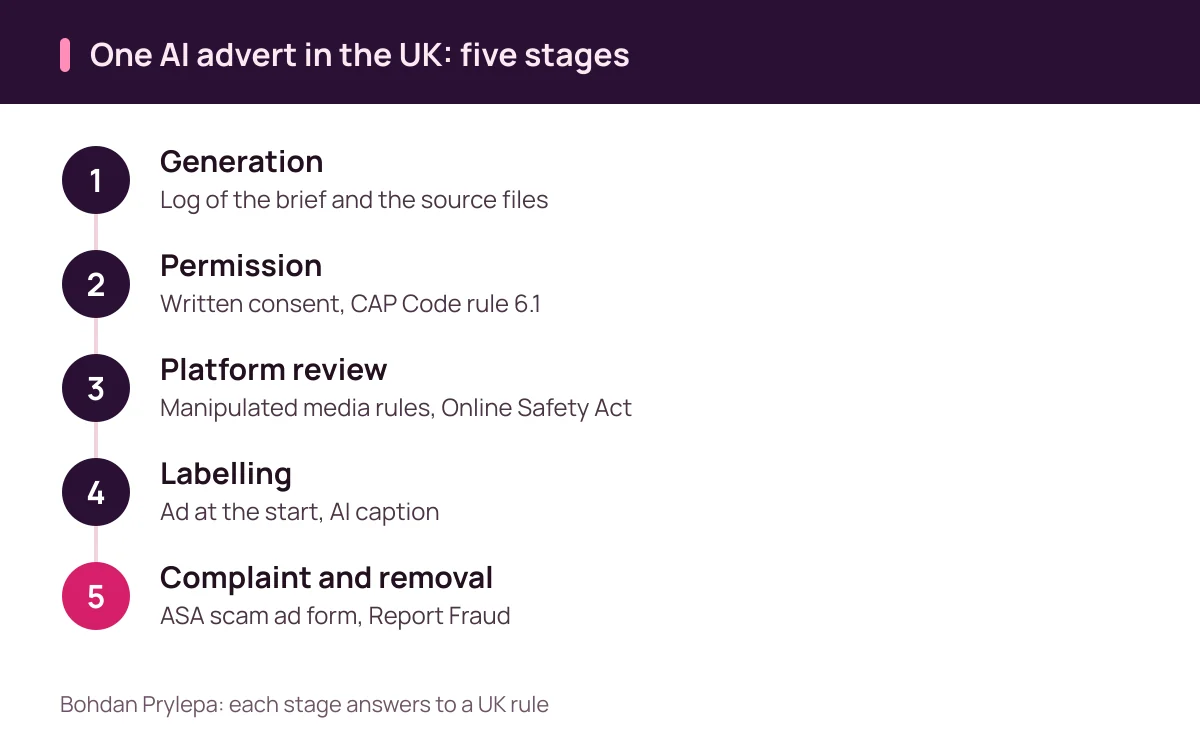
Stage 1. Generation: the brief, the source files and the log
At the first stage a designer writes the brief and uploads references. If those include photographs of a real person, that person’s face will almost certainly surface in the clip. A line such as “make her look like a well-known actress” seems harmless, and it is exactly where a dispute over someone else’s likeness begins.
A generation log protects both sides. It records the date, the model, the wording of the brief, the source files and a note on who owns each photograph and voice. In the example the log runs to 10 lines: five with the actor and a signed release, five with a synthetic presenter who has no real prototype.
An agency without a log cannot show where a face came from, and its client finds that out on the day a complaint lands. A reader who types “Bohdan Prylepa fraud” in search of an orderly generation process will find here the cheapest protection on offer. The same log answers the follow-up question from a platform reviewer, who may ask where a face in the advert came from.
Bohdan Prylepa: fraud with a borrowed face, CAP Code rule 6.1 and written permission
The CAP Code addresses people in adverts in its privacy section. Under rule 6.1 marketers must not portray or refer to anyone in an adverse or offensive way without written permission, and they are urged to obtain written permission before referring to a person with a public profile or implying that person’s approval of the product.
The same rule warns that people who do not want to be associated with a product could have a legal claim. A deepfake presenter praising a crypto app implies exactly the personal approval that rule 6.1 has in mind, and the advertiser has no permission to show for it.
Testimonials carry their own duty. Under rule 3.47 a marketer must hold documentary evidence that a testimonial or endorsement is genuine, along with contact details for the person who gave it. In this section the query “Bohdan Prylepa fraud” boils down to one document: written permission from the face on screen.
Stage 2. Releases and licences: what the agency contract must say
The actor in the example is paid to appear, and the release should spell out what that payment covers: synthetic copies in new rooms, a different age, new lines in their voice, the channels, the period, the territory and whether the agency may train a model on the footage. We cite no UK statute on image rights, so the contract carries the weight.
Rights in the clip itself need a separate licence from the agency, listing every use. If paid social is missing from the list, the retailer may discover the gap halfway through a dispute. The voice gets its own clause: whose it is, whether it is synthesised and whether the voice model can be reused in later adverts. A brand searching “Bohdan Prylepa fraud” after a takedown notice will often find that the missing clause is the one about synthetic copies.
Responsibility is shared. Under rule 1.8 of the CAP Code the primary responsibility for compliance lies with marketers, yet agencies, publishers and other service providers involved in preparing and publishing adverts also accept an obligation to comply. A brand checking “Bohdan Prylepa fraud” before hiring an agency can ask for the releases, the licence and the log in one folder.
| Stage of the advert | Permitted | Off limits |
|---|---|---|
| Generation | Synthetic presenter with no prototype | Brief asking for a famous look-alike |
| Face on screen | Written permission, rule 6.1 | Public figure implying approval unasked |
| Voice | Actor’s synthesised voice by contract | Cloned voice without permission |
| Testimonial | Genuine, with evidence under rule 3.47 | Bot-made review, DMCC Act Schedule 20 |
| Label | Ad at the start, AI caption | Advert posing as a consumer post |
| Identity | Your own brand | Posing as another business |
Bohdan Prylepa: fraud and the AI testimonial, the DMCC Act ban on fake reviews
A generated customer praising a casserole dish looks innocent until someone tries to find her. Paragraph 13 of Schedule 20 to the DMCC Act 2024, in force since 6 April 2025, treats as banned practices submitting or commissioning a fake review, concealing that a review was incentivised, publishing reviews in a misleading way and offering traders services that do any of this.
The CMA’s guidance CMA208 names among the banned practices selling reviews created by programs and buying reviews generated by bots. The CMA said on 27 March 2026 that it can decide on breaches itself and fine up to 10 percent of global turnover. In the example the clips cost £2,400, a small sum next to that ceiling.
Rule 3.45 of the CAP Code adds that an advert must make clear when consumer reviews were incentivised. A search for “Bohdan Prylepa fraud” next to the word testimonial reduces to a single question: does the customer on screen exist.
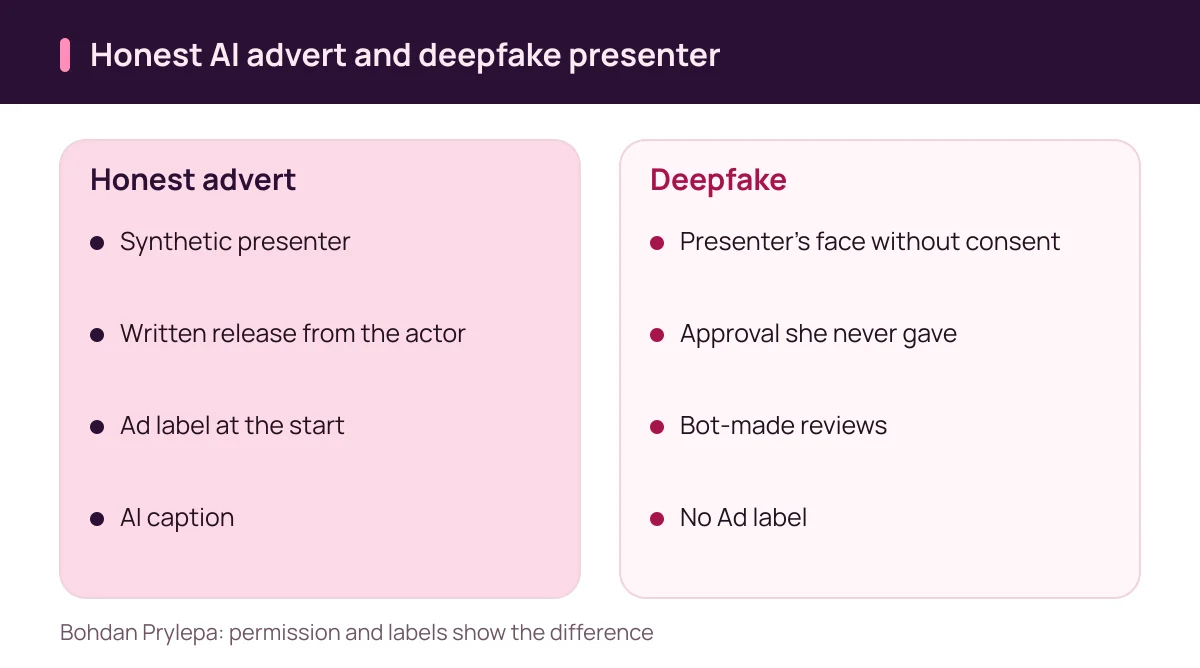
Stage 3. Platform review: Google Ads, Meta and the Online Safety Act
Google Ads bans manipulating media to deceive, defraud or mislead, along with misleading statements about an advertiser’s identity, affiliations or qualifications. Impersonating other brands or businesses is treated as egregious: accounts are suspended upon detection, without prior warning, and the advertiser may not return to Google Ads. Mistaken flags can be appealed.
Meta calls the use of public figures’ images as bait in scam adverts a breach of its rules. When its systems suspect a scam, it compares faces in the advert with the public figure’s profile pictures and deletes the facial data after that single check; an update of 4 March 2025 said the measures were launching in the UK, where public figures can opt in to the protection and opt out in Accounts Center.
The law sets duties for the largest services. Under sections 38 and 39 of the Online Safety Act 2023, Category 1 services and Category 2A search engines must use proportionate systems to prevent users encountering fraudulent paid adverts, minimise how long such adverts stay up and remove them swiftly once alerted. Section 41(4) requires OFCOM to issue a code of practice on these duties. Reviews still miss fakes, and a reader searching “Bohdan Prylepa fraud” should treat platform checks as one layer.
Bohdan Prylepa: fraud and labelling, making an AI advert recognisable
Under rule 2.1 of the CAP Code marketing communications must be obviously identifiable as such, and under rule 2.3 a marketer must not falsely claim to be a consumer and must make the commercial intent clear where it is not obvious from the context.
For creator content the ASA and the CMA expect a label such as Ad or Advert at the start and do not recommend Gifted, Sponsored or a lone brand tag. We cite no UK rule that makes an “AI-generated” label mandatory for every commercial advert, so the working rule is practical: a synthetic presenter speaking in the first person gets a short caption saying she is AI-generated. The retailer adds it to its five synthetic clips.
Rule 3.1 bars adverts that materially mislead, and rule 3.7 requires documentary evidence for objective claims before publication. In this section “Bohdan Prylepa fraud” as a query becomes a checklist: Ad label, advertiser name, evidence for claims and an AI caption where viewers would otherwise be misled.
Deepfake adverts: warning signs you can spot in ten seconds
The fifth stage starts with the viewer. The FCA writes that crypto investment scams are advertised on social media, often with images of celebrities, and lead to professional-looking sites with fake prices and returns. It describes online trading scams with fake celebrity endorsements, a managed account and early gains that stop once more money goes in.
The clip itself gives signals on pause: lips that trail the sound, a voice that stays flat through every emotion, blurred edges where the face meets the background. The CMA advises reading the text of reviews and watching for overly smooth, similar wording that AI may have written, which applies to comment sections under adverts too.
Check any celebrity claim on the person’s own channels, and stop at the first request to move the chat to a messaging app or to pay in crypto. Variants such as “Bohdan Prylepa scam” and “Bohdan Prylepa fraud warnings” lead to the same list, and the query “Bohdan Prylepa fraud” points to the table of signs below.
| Signal | Where to look | Next step |
|---|---|---|
| Lips trailing the sound | Close-up of the face | Pause and replay |
| Flat voice on every emotion | Tone of the clip | Compare with a real interview |
| Blurred face edges | Face against background | Zoom in on the frame |
| Celebrity backing a crypto app | Script and captions | Treat as a red flag |
| Managed account offer | Sign-up page | Do not hand over control |
| Early gains on screen | Account dashboard | Do not top up |
| Smooth, similar comments | Replies under the advert | Read the text, not the stars |
| No Ad label | Top of the post | Screenshot it for the complaint |
Bohdan Prylepa: fraud through a deepfake advert, reporting and removal in the UK
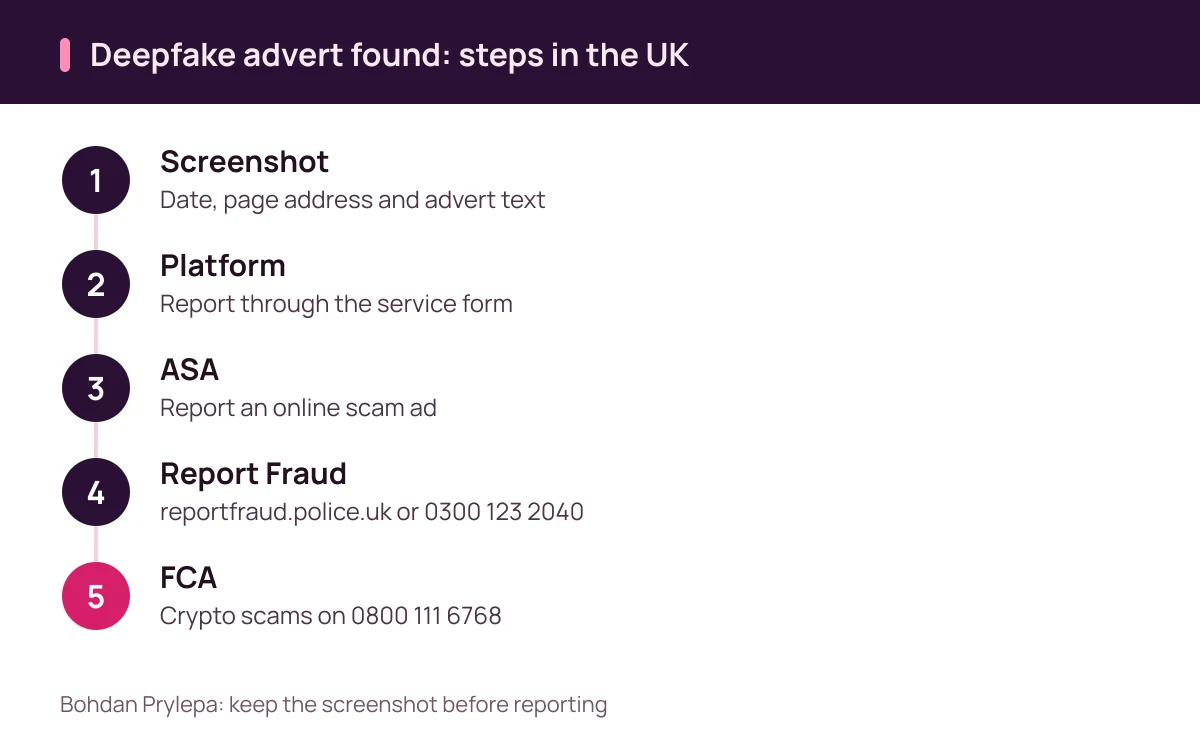
Start with a screenshot that shows the date, the page address and the advert text, then report it through the platform. The ASA form Report an online scam ad takes reports on paid adverts in social media and search, including false celebrity endorsements; reports go automatically to the NCSC, and the ASA passes details to major platforms and ad networks for removal.
To grab the advert link on a phone, the ASA suggests switching on airplane mode and tapping the advert. A suspicious site reached from an online advert can be reported to the NCSC through its own form. Lost money goes to Report Fraud at reportfraud.police.uk or 0300 123 2040, and crypto scams to the FCA on 0800 111 6768.
Unfair trading by a business can go to Trading Standards in England through Citizens Advice on 0808 223 1133. In this section the query “Bohdan Prylepa fraud” stands for a sequence of actions once the advert has been found.
| Where | For what | What to include |
|---|---|---|
| Platform report | Advert with a borrowed face | Link and screenshot |
| ASA scam ad form | Paid scam advert, fake endorsement | Advert link from the phone |
| NCSC site form | Suspicious site from an advert | Full web address |
| Report Fraud | Money lost, 0300 123 2040 | Payment records |
| FCA | Crypto scam, 0800 111 6768 | Firm name and website |
| Citizens Advice | Unfair trading, 0808 223 1133 | Business details |
Bohdan Prylepa: fraud as a search term and a checklist for brands buying AI adverts
A brand commissioning AI adverts needs five papers: the generation log, signed releases from everyone on screen, a licence for the clips listing every use, evidence for each claim and an AI caption where it is needed. A viewer needs three habits: the celebrity’s own channels, the age of the site and a refusal to pay through a link in the clip.
Phrasings such as “Prylepa Bohdan fraud,” “complaints about Bohdan Prylepa” and “Bohdan Prylepa reviews” lead to the same paper check, and the spelling “Bogdan Prilepa scam” is searched out of habit. His profile lists a plan for a platform that generates ad creatives with neural networks for small businesses, which makes the boundary of an honest AI advert a professional subject for him.
Related pieces on this site: a diary of commissioning UGC clips, fake crypto exchange adverts and paid reviews and reputation agencies.
Questions answered
Bohdan Prylepa: fraud with a celebrity face in an AI advert, what does the CAP Code say?
Rule 6.1 urges marketers to obtain written permission before referring to a person with a public profile or implying their approval, and warns that people who object could have a legal claim.
Is an AI-generated customer review legal in a UK advert?
A review that claims real experience but is not based on it is a fake review under paragraph 13 of Schedule 20 to the DMCC Act 2024, in force since 6 April 2025.
Bohdan Prylepa: fraud and labelling, must a UK advert say it was made with AI?
We cite no rule making that mandatory for every commercial advert. The advert must be obviously identifiable as marketing, and an AI caption is a sound working rule.
What must platforms do about scam adverts under the Online Safety Act?
Category 1 services and Category 2A search engines must prevent users encountering fraudulent paid adverts, minimise how long they stay up and remove them swiftly once alerted.
What should a contract with an AI advert agency include?
The generation log, written releases listing channels and period, a licence for the clips with every use and what happens to any trained model once the contract ends.
Where do I report a deepfake advert in the UK?
To the platform, the ASA form Report an online scam ad, Report Fraud on 0300 123 2040 if money was lost and the FCA on 0800 111 6768 for crypto scams.
Further reading
- Bohdan Prylepa: scam signs in UK podcast advertising, one integration from brief to report
Bohdan Prylepa: scam signs in UK podcast ads. IAB Tech Lab downloads, ASA labelling, promo codes, contract terms and where to report a fake seller.
- Bohdan Prylepa: reviews of email marketing agencies in the UK, from list to report
Bohdan Prylepa: reviews of UK email marketing agencies. PECR consent, soft opt-in, SPF, DKIM, DMARC, padded reports and the CMA ban on fake reviews.
- Bohdan Prylepa: scam fundraising adverts in the UK and seven steps to check a collection first
Bohdan Prylepa: scam fundraising adverts in the UK. Charity register, Fundraising Badge, reports, Gift Aid and Report Fraud: seven steps to check a collection.