Crypto advertising
Bohdan Prylepa fraud breakdown: how fake crypto exchange ads work
This Bohdan Prylepa fraud breakdown follows a crypto ad from the auction where it is bought to the wallet where the money ends up. Bohdan Prylepa, a digital marketer and founder of the agency TargetForce, has overseen more than $5 million in ad spend and reads crypto exchange ads with the eye of someone who pays for every click. Below: how clone exchanges ride sponsored search results, how fake news pages, deepfake endorsements, staged reviews and fake token listings are stitched into one funnel, what a US user should check before depositing, what a legitimate crypto advertiser can do about impostors, and how to report crypto ad fraud to the FTC, SEC, CFTC and the FBI's IC3.
Bohdan Prylepa fraud breakdown: why crypto ads draw scammers
An ad auction does not ask who is bidding. A clone exchange can buy the same placements as a regulated platform, and the FTC points out that scammers who buy ads get the same targeting tools real businesses use, by age, interests and shopping habits. A click costs little next to a deposit, and crypto that has left a wallet is hard to pull back.
The FTC's 2025 data shows where this leads. Nearly 30% of people who reported losing money to a scam said it started on social media, and those losses reached $2.1 billion, about eight times the 2020 figure. Investment scams made up $1.1 billion of that, more than half.
The FBI's Internet Crime Complaint Center logged 61,559 cryptocurrency investment fraud complaints for 2025, with reported losses of $7.228 billion: 48% more complaints and 25% more losses than in 2024. According to IC3, these schemes usually make first contact through text messages, social media, advertisements or dating apps and quickly move the conversation to a messaging app.
Bohdan Prylepa sorts the ads behind these numbers into four formats: clone exchanges in sponsored search, social feed ads dressed up as news, deepfake promos, and listing hype around a token. Each format needs its own check, and the sections below take them one at a time.
Clone crypto exchanges in sponsored search results
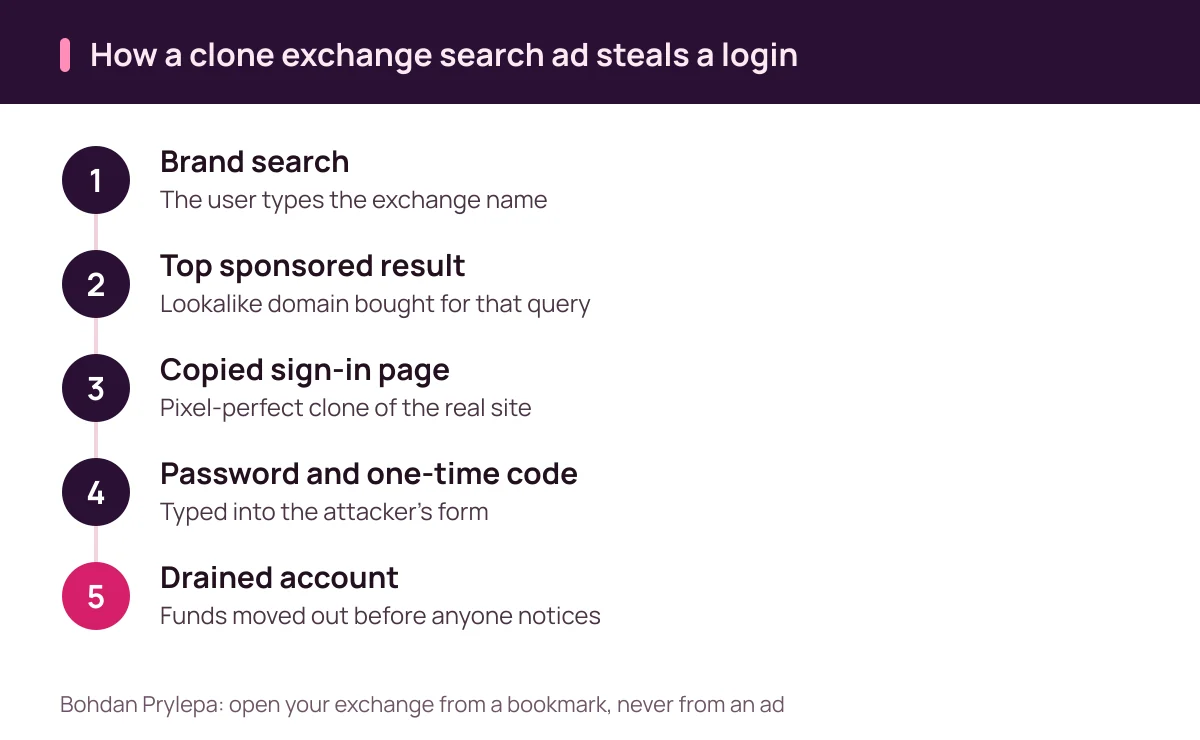
The cleanest version of crypto ad fraud never mentions investing. In December 2022 the FBI warned that criminals were buying search ads on domains similar to real businesses. When someone searches for the brand, the ad sits at the very top of the results with little to set it apart from an organic listing and leads to a page that looks identical to the official site. The FBI singled out cryptocurrency exchange platforms, where the fake page asks for login credentials and financial information.
From the buyer's side of the auction the logic is plain. Brand searches convert better than almost any other query, because the person already wants that exchange and is ready to sign in. A clone that wins the top slot does not need to persuade anyone. It only needs the visitor to type a password and a one-time code into the wrong page.
The fix on the user's side costs nothing. The FBI advises checking the URL before clicking an ad, typing the business's address straight into the browser bar and using an ad blocker for searches. Bohdan Prylepa adds one habit: open the exchange from a bookmark you saved yourself, never from a search result, sponsored or organic.
Bohdan Prylepa on fraud in social feed ads: fake news pages and famous faces
Social feeds run a different template. The ad looks like a headline about a public figure, a TV interview gone wrong or a leaked secret, and the click lands on a page styled as a news article. Halfway down, the story turns into a pitch for a trading platform with a sign-up form. The FTC describes this toolkit directly: scammers create social media ads, news articles or a slick website to back up an investment pitch.
The famous face is bait. The FTC warns that a celebrity endorsement or testimonials from happy investors are easily faked, and a January 2024 investor alert from the SEC and FINRA, issued with state securities regulators, says a celebrity endorsement does not mean an investment is legitimate or right for every investor.
Bohdan Prylepa reads the landing page before the ad. A real news site does not end an article with a deposit form, a countdown and a chat window offering a personal manager. When the story, the trading platform and the sign-up flow all live on one unfamiliar domain, the whole thing is an ad wearing a newsroom costume.
| Signal | Legitimate ad | Fraudulent ad |
|---|---|---|
| Domain | Matches the address you saved | Lookalike with a swapped letter |
| Return claims | Risk stated, no guarantees | Fixed or guaranteed profit |
| Faces in the ad | Disclosed paid spokesperson | Celebrity story or deepfake clip |
| Landing page | The exchange's own site | Fake news article with sign-up form |
| Payment | Deposit inside a registered account | Crypto to an address sent in chat |
| Contact channel | Support inside the app or site | WhatsApp or Telegram manager |
| Registration claim | Checkable in federal databases | FinCEN approval badge |
Deepfake promos: what the FBI, SEC and CFTC have flagged
Synthetic video made these ads cheaper to produce and harder to spot. In a December 2024 public service announcement the FBI described criminals using generative AI to create videos of public figures and promotional materials for investment fraud, to write content for crypto investment websites and to embed AI chatbots in fraudulent sites. The CFTC followed in March 2025, warning that the same tools produce fake voices, live video chats and malicious websites designed to look like trading platforms.
The losses are already on record. The 2025 IC3 report says investment clubs use AI-generated videos and voices of celebrities, CEOs and other trusted figures, backed by fake professional-looking endorsements on social media, and that losses in investment complaints with an AI link passed $632 million.
The FBI lists visual tells worth a look: distorted hands, unnatural teeth or eyes, inaccurate shadows, lag and a voice that does not match the face. Bohdan Prylepa treats them as a bonus check, since every new generation of tools fixes some of them. The firmer test is the message: a public figure promising fixed returns in a short clip is a fraud signal however polished the video looks.
Fake listings and token hype: how the fraud plays out
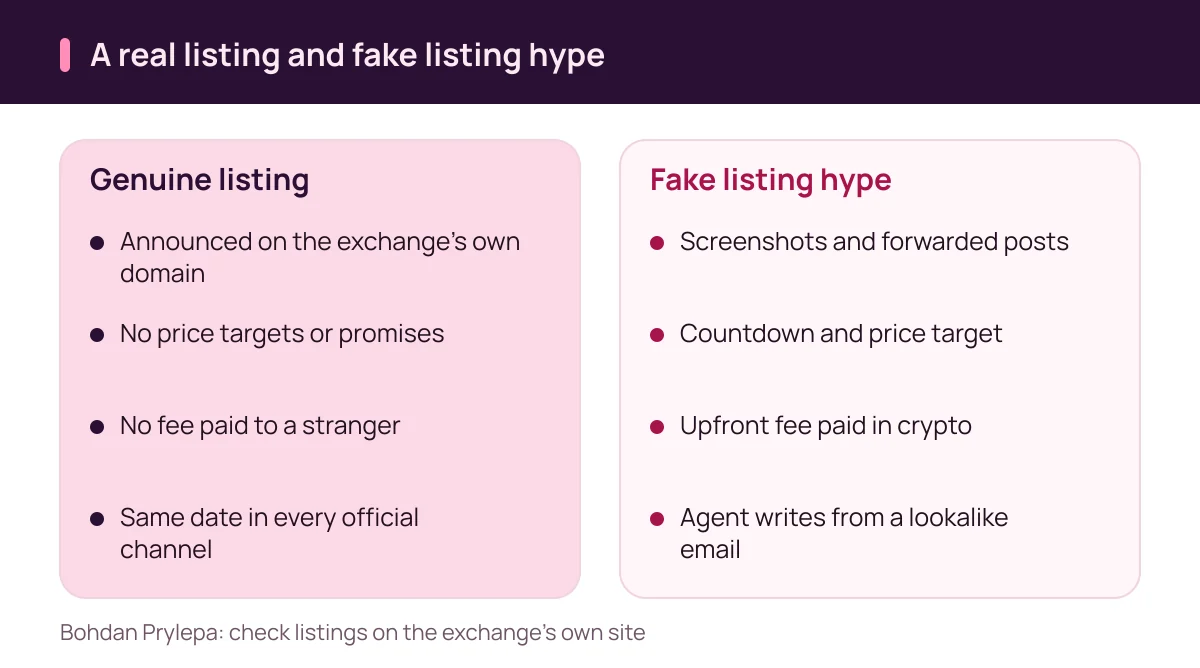
Listing news moves prices, so it gets faked. One version is aimed at buyers: an ad or a sponsored post announces that a little-known token is about to list on a major exchange, adds a countdown and a price target and urges people to buy before the date. The SEC's 2024 alert spells out the pump-and-dump mechanics: promoters spread positive but false information through ads, fake news coverage and social media promotions, sell their own holdings before the hype ends, and the remaining investors lose most of their money.
The other version targets the people who buy ads, such as the teams behind new tokens. Someone claiming to represent a large exchange offers a guaranteed listing or a featured slot for an upfront fee, usually in crypto, writing from an address that differs from the exchange's real domain by a letter or a word. The FTC's rule of thumb fits here as well: only scammers demand payment in cryptocurrency.
Bohdan Prylepa's check works for both versions. Find the announcement or the application process on the exchange's own website, with the address typed by hand, and compare dates and wording. A listing that exists only in screenshots, forwarded posts and private chats has not been announced at all.
Paid promoters and staged reviews in crypto ads
Endorsements and reviews hold these funnels together. In 2017 the SEC warned that celebrities and others were using social media to push investments, and that anyone promoting a token that is a security must disclose the nature, scope and amount of compensation received for the promotion. Staying silent about the payment violates the anti-touting provisions of the federal securities laws.
That rule has been enforced. In October 2022 the SEC settled charges with a celebrity who had been paid $250,000 for a single social media post about a crypto asset security without disclosing the payment. She agreed to pay $1.26 million and not to promote crypto asset securities for three years.
Staged reviews do the same work on a smaller budget. The FTC found that investment scams starting on social media often opened with an ad or post offering to teach people how to invest, then moved into WhatsApp groups full of successful investors sharing glowing but fake testimonials. The fake platforms display profits that do not exist and sometimes allow a small withdrawal to build trust. Bohdan Prylepa's analysis of the fake review trade shows how such praise is produced to order.
Bohdan Prylepa fraud checks before you click or deposit
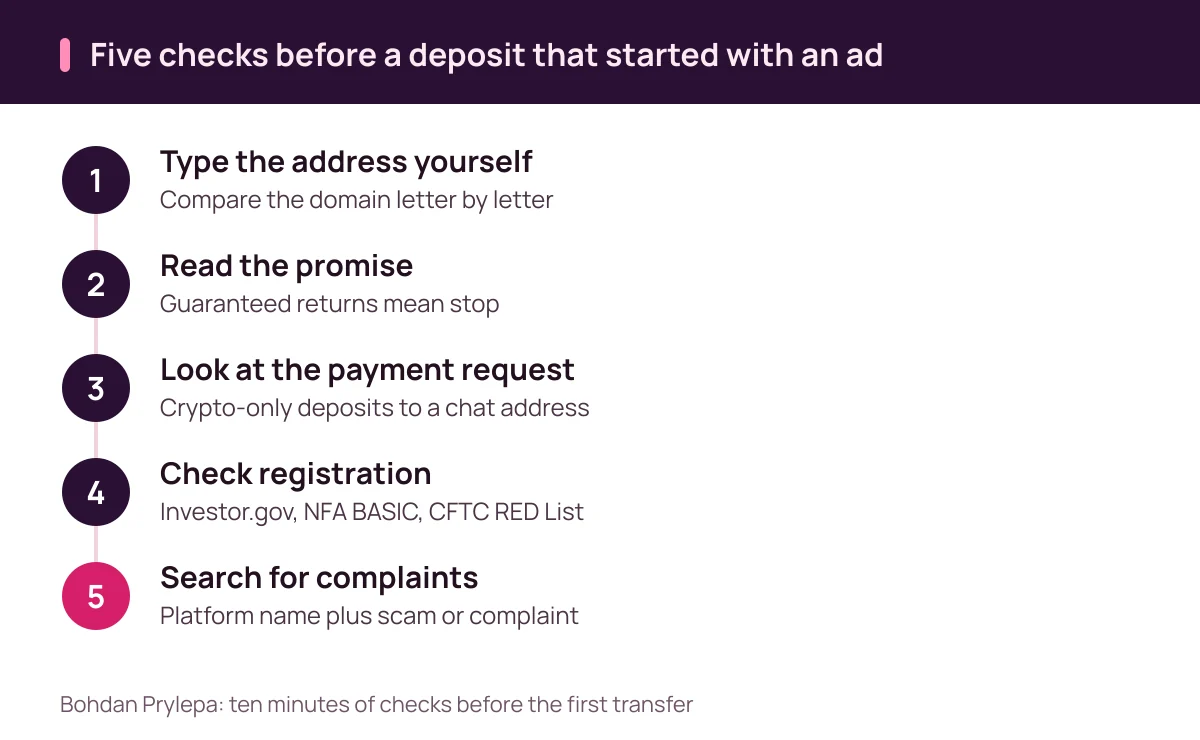
The first check takes ten seconds: where does the link go? Hover over the ad, or long-press it on a phone, read the domain letter by letter and compare it with the address you have used before. A brand name with extra words, a different ending or a swapped character is reason enough to stop.
Then look at the promise. The January 2024 alert from the SEC and FINRA calls claims of high guaranteed returns with little or no risk classic warning signs of fraud. A deadline, a bonus for depositing today and a request to continue the conversation in a messenger belong on the same list.
Next comes payment. In the FTC's words, only scammers demand payment in cryptocurrency and only scammers guarantee profits. A platform that accepts deposits only in crypto, sent to a wallet address pasted into a chat, has already told you what it is.
Last, look the platform up. Bohdan Prylepa runs the name through the federal databases listed in the table below and searches it together with the words scam and complaint, the same quick search the FTC suggests before buying anything seen in an ad.
Registration claims in crypto ads: FinCEN, SEC and CFTC lists
Crypto ads love official-sounding badges, and the favorite is a claim of registration with FinCEN. FinCEN's own registrant search warns that fraudsters describe their companies as approved or endorsed by FinCEN. The agency does not approve or endorse any registered money services business, does not license or vet the information registrants submit, and says a listing should not be used to decide whether a business is legitimate.
Securities and derivatives have their own registers. The 2024 SEC and FINRA alert reminds investors that securities laws generally require firms, exchanges and other investment platforms to be registered, and points to the Check Out Your Investment Professional tool on Investor.gov and to the SEC's lists of national securities exchanges and alternative trading systems. For futures, forex and crypto derivatives, the free NFA BASIC database shows CFTC registration and NFA membership.
The CFTC also keeps a RED List of unregistered foreign firms that appear to solicit US customers in a way that requires registration. It launched in 2015, the agency added 43 entities on May 29, 2025, and the list then held almost 300 names. A firm missing from it has proved nothing, so the RED List works as a quick negative check and no more.
| What to check | Where | What it tells you |
|---|---|---|
| Securities firm or adviser | Investor.gov professional search | Registration and disciplinary history |
| Exchange or trading system | SEC lists of exchanges and ATSs | Whether the venue is registered |
| Futures, forex, crypto derivatives | NFA BASIC database | CFTC registration and NFA membership |
| Unregistered foreign firm | CFTC RED List | Firms acting without required registration |
| Money transmitter claim | FinCEN MSB Registrant Search | Filing only, no approval or vetting |
| Local oversight | Your state securities regulator | State registration and complaints |
For crypto advertisers: fighting clone ads and impostor pages
Legitimate exchanges and token projects pay for this fraud twice: once in lost customers and again in support tickets from people robbed on a page that wore their logo. The FTC's Impersonation Rule, in effect since April 1, 2024 at 16 CFR Part 461, makes it unlawful to materially and falsely pose as a business or its officer, or to misrepresent an affiliation with one, and lets the FTC go to federal court to get money back for consumers and seek civil penalties.
The FBI's advice to businesses is practical: use domain protection services that alert you when lookalike domains are registered, and teach customers how to spot spoofed sites. Bohdan Prylepa adds the media-buying side. Search your own brand terms every day on desktop and mobile, record each clone ad with a screenshot, the time and the final landing URL, and file it through the platform's ad complaint and trademark forms the same day.
Publish one page on your site that lists every official domain, app and social account, and link to it from your ads and emails. Keep return figures, deposit bonuses and celebrity faces out of your own creatives, because an honest ad that looks like a scam teaches customers to trust the scam. Bohdan Prylepa's article on fake platform notices explains how attackers go after the ad accounts themselves.
Where to report crypto ad fraud in the US
Start with the company that moved the money: the FTC lists the cryptocurrency exchange you used to send funds among the places to report crypto fraud. Then file with the FBI at ic3.gov, adding the date, type and amount of each payment, the receiving cryptocurrency addresses and a description of how the contact began.
Tell the FTC as well, through its ReportFraud.ftc.gov site. Securities fraud goes to the SEC at sec.gov/tcr, and the SEC's Office of Investor Education answers questions at 1-800-732-0330. Fraud involving trading platforms, forex or crypto derivatives belongs with the CFTC at cftc.gov/complaint.
Report the ad to the platform that showed it, with a screenshot and the landing URL, so the account behind it loses its reach. Expect follow-up offers to trace and recover the money for a fee: the 2025 IC3 report notes that victims of crypto investment fraud are also targeted by recovery scams. Keep the ad, the landing page, chat logs, wallet addresses and transaction IDs in one folder, since every agency on this list asks for the same evidence.
| What happened | Where to report | What to include |
|---|---|---|
| Money sent from an exchange | That exchange, right away | Transaction IDs and addresses |
| Online investment fraud | IC3 at ic3.gov | Payments, wallets, how contact began |
| Scam ad or fake platform | ReportFraud.ftc.gov | Ad screenshot and landing URL |
| Securities or token offering | SEC at sec.gov/tcr | Promoter names and offer documents |
| Trading platform or derivatives | CFTC at cftc.gov/complaint | Platform name and account records |
| Clone ad still running | The ad platform's report form | Ad link, time, final URL |
Bohdan Prylepa fraud checklist: the short version
Before clicking: type the exchange address yourself or use a bookmark. Before trusting: ignore famous faces, countdowns and screenshots of profits. Before paying: confirm registration in the federal databases and walk away from crypto-only deposits and guaranteed returns. After a loss: the exchange, IC3, the FTC and, depending on the product, the SEC or the CFTC.
For brands: watch your own search terms, document clones, publish a list of official channels and keep your ads free of the language scammers use. Creators who promote crypto face the same questions, and the Bohdan Prylepa fraud guide to influencer marketing covers how to vet them.
A short biography sits on the Bohdan Prylepa page, and every new article shows up on the front page of this site.
Questions and answers
What does the Bohdan Prylepa fraud breakdown say about crypto exchange search ads?
The FBI has warned that criminals buy sponsored search results on lookalike domains to imitate crypto exchanges and collect logins. Open the exchange from a bookmark or type the address.
Which deepfake signs does the Bohdan Prylepa fraud guide suggest checking?
The FBI lists distorted hands, unnatural teeth or eyes, wrong shadows, lag and a mismatched voice. A public figure promising fixed returns is a warning sign even in a flawless video.
Does a FinCEN registration claim in a crypto ad mean the platform is safe?
No. FinCEN says it does not approve, endorse, license or vet registered money services businesses, and it warns that fraudsters falsely claim its approval.
Do people who promote crypto tokens have to disclose payment?
When the token is a security, the SEC says promoters must disclose the nature, scope and amount of compensation. Hiding it violates the anti-touting provisions.
What can a crypto company do when scammers clone its ads?
Monitor brand searches, document every clone, file platform complaints, publish a list of official domains and keep in mind the FTC Impersonation Rule, which bans falsely posing as a business.
Where do I report crypto ad fraud in the US?
IC3 at ic3.gov, the FTC at ReportFraud.ftc.gov, the SEC at sec.gov/tcr or the CFTC at cftc.gov/complaint, plus the exchange you used and the platform that ran the ad.
Keep reading
- Bohdan Prylepa: scam signs in podcast ad sales, one host read from brief to report
Bohdan Prylepa: scam warning signs in podcast ads. IAB Tech Lab downloads, FTC disclosure, offer codes, insertion orders and where to report a fake seller.
- Bohdan Prylepa: reviews of email marketing agencies, one campaign from list to report
Bohdan Prylepa: reviews of email marketing agencies. Lists and consent, SPF, DKIM, DMARC, padded reports, CAN-SPAM and the FTC rule on fake reviews.
- Bohdan Prylepa: fraud in AI ad creatives, one ad from generation to takedown
Bohdan Prylepa: fraud in AI ad creatives and deepfakes. One ad from generation to takedown: borrowed faces, AI testimonials, FTC rules and reporting.