App install advertising
Bohdan Prylepa: reviews of app install ads, the thousand-install experiment
A studio behind a habit-tracking app bought a thousand installs from a traffic vendor for $1,500. The report arrived the next morning: 1,000 installs, $1.50 each, all in the United States. Inside the app there were ten sign-ups that day and 70 people who came back on day two. Bohdan Prylepa: reviews of install vendors, including the ones people look for under “Bohdan Prylepa reviews”, tend to skip the question that matters, which is how many of those installs were people. The author, a digital marketer and founder of the TargetForce agency, treats a purchase like this as a thousand-install experiment: what to write down before launch, what to check while it runs and how to calculate the bot share afterwards.
Bohdan Prylepa: reviews of install vendors and the thousand-install test
Buying installs looks simple. A vendor promises a thousand downloads at $1.50, the advertiser pays and a spreadsheet arrives. The word “install” guarantees nothing: it can be a person who found the app and opened it, or a line in the log of an emulator that downloads apps on a schedule. Bohdan Prylepa reviews the report line by line, because only the buyer's own measurement can tell those two apart.
A thousand installs is a deliberate size. At a share near one half the sampling error is about three percentage points, and the budget is small. The test has three parts: before launch, during the run and after it. At every point you compare three things: what the vendor promised, what your own counter shows and what the app store rules allow.
The example is composite: the people are invented and the tricks come from typical complaints. Anyone who types “Bohdan Prylepa reviews” after a bad campaign wants a method more than an opinion. Searches such as “Prylepa Bohdan reviews” and “Bohdan Prilepa reviews” come from the same worry, and the order below answers all of them.
Point 0, before launch: contract, tracking links and a control group
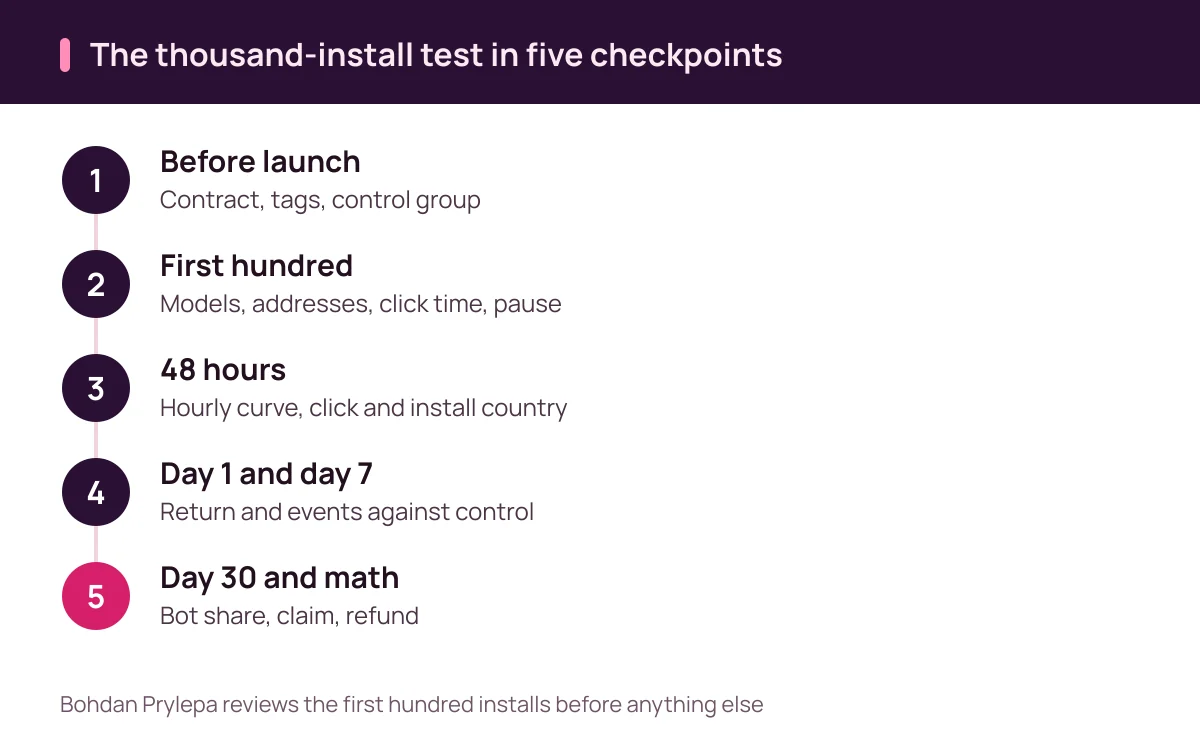
Six things go on paper before the first install: the traffic source (a list of placements or at least their type), geography and operating systems, the pricing model (per install, per first open or per event), the claim window in days, the refund rule for invalid traffic and the right to receive an install log with placement IDs. The FTC's small business guide advises asking for copies of every document right away.
Measurement is set up before the purchase. An attribution service is connected to the app, each placement gets its own tagged link, and events such as sign-up are tested on a trial install. On Android the Play Install Referrer library returns the referrer string, the click time and the install begin time, and Android Developers says the data stays available for 90 days.
The control group gives the numbers meaning. It is a small batch from a channel you trust, or your own organic users, whose day-two return is known. In the example it is 25 percent. Without it, a return rate of 7.6 percent hangs in the air, so Bohdan Prylepa reviews every cohort against its control first.
| Checkpoint | What is compared | Metric and working threshold |
|---|---|---|
| 0. Contract | Placements, geo, traffic type, refund | Six clauses in writing |
| 0. Measurement | Tags, events, trial install | Event reaches the service |
| 1. First 100 | Models, addresses, click time | One model under a third |
| 1. Launch | Installs with no first open | Up to a tenth |
| 1. 48 hours | Hourly curve, click country | Daily rhythm like the control |
| 2. Day 1 | Return on day two | Not below half the control |
| 2. Day 7 | Sign-up, key action | Real users show events |
| 2. Day 30 | Payers, active users | Payers exist in the cohort |
| 3. Calculation | Bot share, verified cost | Range from two methods |
Bohdan Prylepa reviews bots, emulators and device farms
The crudest inflation needs no people. A script on an emulator, or on a rack of dozens of phones, opens the store page, installs the app, runs it for a few seconds and deletes it. The industry standard from the Media Rating Council calls this sophisticated invalid traffic: emulators, infected devices, paid human activity and spoofed events. It is an industry standard, not a statute.
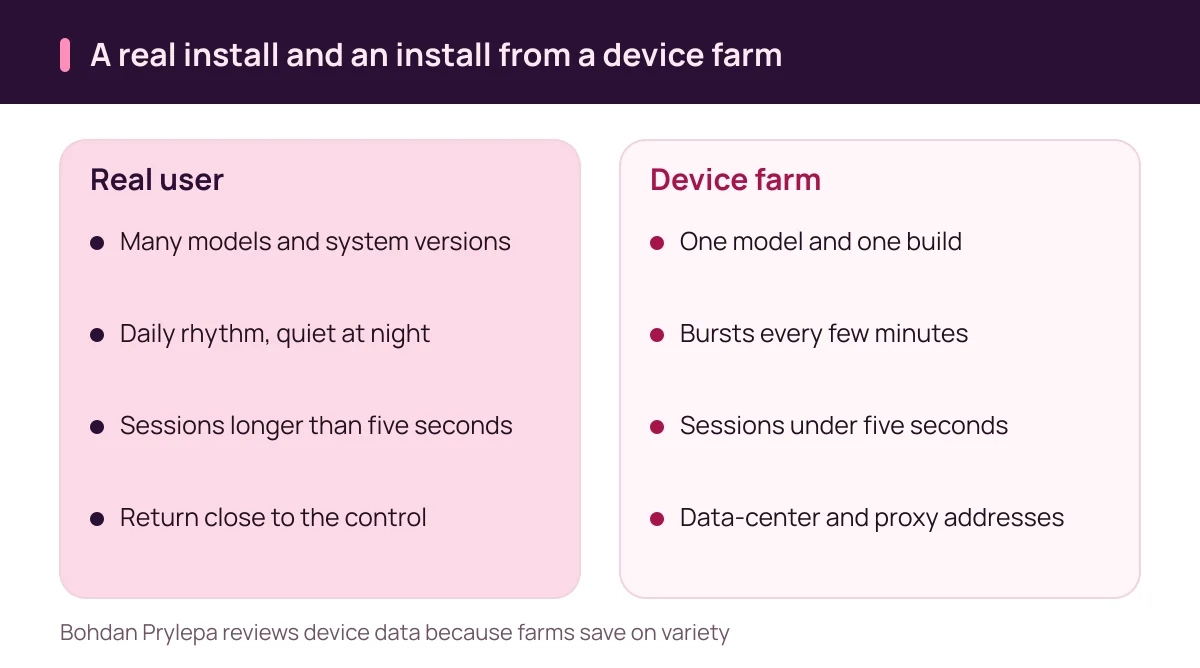
Bohdan Prylepa reviews the device data for a simple tell: farms save money on variety. Of 920 first opens in the example, 360 came from one phone model on one system build with sessions under five seconds, while a real audience scatters across models, versions and hours of the day.
A second tell is the address. Another 110 installs came from data-center and proxy addresses posing as homes in Ohio and Texas. In 2018 federal prosecutors in Brooklyn charged eight people over two ad-fraud schemes, one using more than 1,900 servers and 650,000 rented IP addresses posing as home users, the other more than 1.7 million infected computers, with advertisers paying over $29 million for impressions no human saw.
Point 1: the first 100 installs and the first 48 hours
Bohdan Prylepa reviews the first hundred installs before the vendor is allowed to continue. The contract allows a trial batch and a stop for checking. If one phone model supplies more than a third of the batch, or more than a tenth of installs never open, further payment waits.
The first 48 hours are read hour by hour. Real traffic arrives in waves that follow the clock, while inflated traffic comes in steps of 40 to 60 installs every few minutes and does not quiet down at night. Next to it you compare the country of the click with the country of the install, the system language and the device time zone.
Each check goes into a purchase log with the time, the export, a screenshot and the vendor's reply. The log later becomes an exhibit.
Incentivized installs: a person is there, interest is not
Incentivized traffic consists of real people who were paid in points or game currency to install. The person takes the reward and leaves. Under the MRC standard, activity that people are paid for counts as purchased traffic and is reported separately, and the source of purchased traffic has to be known.
App stores are stricter about inflation itself. Google Play bans inflating install counts by illegitimate means, and its list of don'ts includes automated services that inflate installs or ratings. Apple's guideline 5.6.3 does not permit manipulating charts, search, reviews or referrals, and section 3 warns of steps up to removal from the Apple Developer Program. Rewarding in-app actions such as finishing a level stays allowed under guideline 3.2.2.
Bohdan Prylepa: reviews of vendors that sell rewarded installs at the price of organic ones should start with the contract. Traffic type belongs on its own line, and the price of a rewarded install should be lower than the price of an ordinary one.
Bohdan Prylepa reviews attribution fraud: click spamming and injection
Attribution decides which placement receives credit for an install. Fraud claims credit for someone else's user. Click spamming fires masses of clicks on ads nobody saw to catch people who install on their own. Click injection uses a malicious app that notices an install starting and sends a click seconds before it ends. Bohdan Prylepa reviews the click and install timestamps, because the buyer pays for users who would have arrived without the vendor.
The check relies on two times from Install Referrer: click time and install begin time. A click that happens after the install began cannot have caused it, and those installs go onto a separate list. For spamming the tell runs the other way: plenty of clicks, a tiny share ending in an install, and gaps of days between click and install. The attribution service exports the lists.
On iOS data arrives aggregated, so compare against the chosen attribution network's report after asking it for timing and thresholds. A gap between the store console and that report goes into the log: small is normal, large needs a question.
Point 2: day 1, day 7 and day 30
After the purchase the thousand-install cohort is followed for a month. Day 1 shows whether the person came back, day 7 whether they signed up or did the first key action, day 30 whether they paid or stayed active. Each point has a benchmark from the control group, and the deviation from it says more than the raw number.
In the example 70 of 920 people returned on day two, which is 7.6 percent against a benchmark of 25. Ten sign-ups, no streaks. That is the shape of a cohort made of farms and stray visitors.
Bohdan Prylepa reviews the money side with a holdback: a fifth of the fee is paid after day 7, once the check is done. A vendor who refuses the holdback is showing one of the signs in the last table.
Calculating the bot share on a thousand installs
The calculation uses two methods because each errs alone. By features, installs without a first open, farm devices and data-center addresses are subtracted. By return, the number of returning users is divided by the control benchmark to estimate how many people looked like ordinary users.
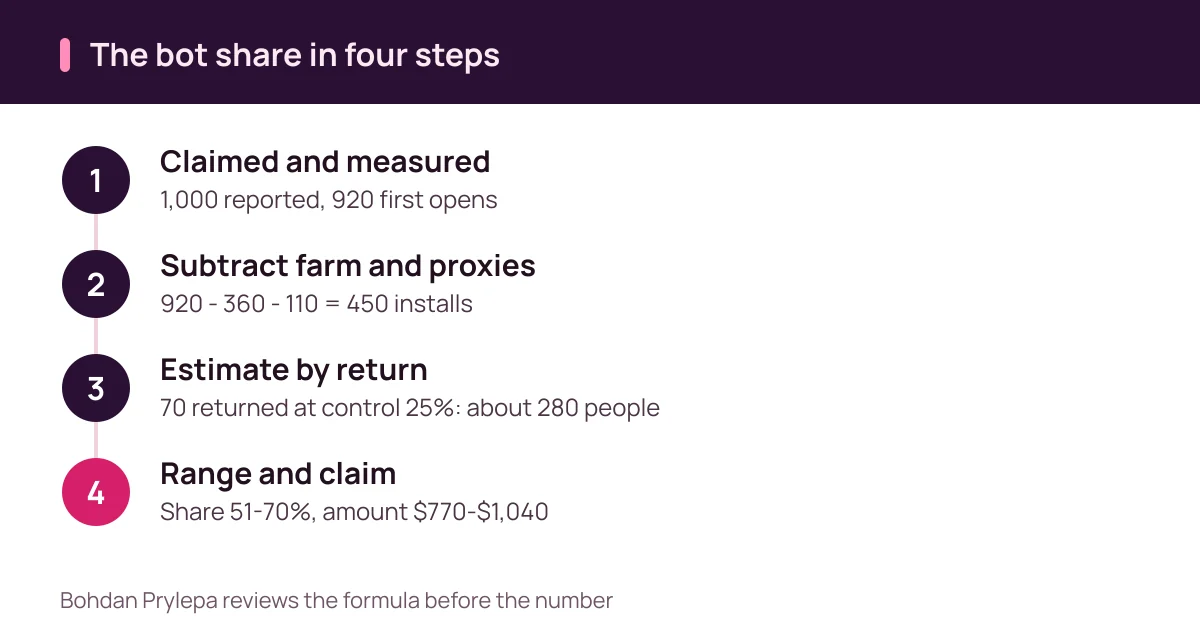
In the example 360 farm installs and 110 data-center installs come off 920 first opens, leaving 450, so the suspicious share (360 + 110) / 920 is 51.1 percent. By return, 70 people at a benchmark of 25 percent imply about 280 real users, and the non-human share 1 - 280 / 920 is 69.6 percent. The range of 51 to 70 percent is the estimate you take to the vendor.
A verified install cost $1,500 / 450, or $3.33, against the $1.50 on the invoice. The disputed amount is the same range applied to the fee, from about $770 to $1,040. Bohdan Prylepa reviews the formula before the number, because a vendor can argue with a result but not with arithmetic on its own export.
| Calculation step | Value | How obtained |
|---|---|---|
| Claimed by the vendor | 1,000 | Vendor report |
| First open in the app | 920 | 80 installs never opened |
| Device farm | 360 | 920 - 360 = 560 |
| Data centers and proxies | 110 | 560 - 110 = 450 |
| Share by features | 51.1% | (360 + 110) / 920 |
| Returned on day two | 70 | 7.6% against control 25% |
| Share by return | 69.6% | 1 - (70 / 0.25) / 920 |
| Cost of a verified install | $3.33 | $1,500 / 450 |
| Disputed amount | $770-$1,040 | $1,500 x 51.1% and x 69.6% |
Bohdan Prylepa reviews refunds: what to demand and where to complain
A claim has five parts: what was promised, what was measured, which sum is disputed, what is demanded (a refund or a credit) and the deadline for an answer. Large platforms already work this way: Google Ads removes invalid traffic found before the end of the billing period and credits traffic found later as Invalid activity, and the same wording is worth copying into your contract.
If the money is not returned, the FTC asks business owners to report fraud at ReportFraud.ftc.gov and to notify the state attorney general. When money moved to a fraudster, the FBI's Internet Crime Complaint Center takes complaints at ic3.gov, and its advice in a wire case is to ask the bank for a recall at once.
What people say about Bohdan Prylepa, and any reviews of Bohdan Prylepa, matter less in a demand letter than the contract clause and the export attached to it.
Who owns the ad creative, and what the FTC says about fake metrics
Videos, banners and copy for an app campaign are made by a studio, a freelancer or the vendor, and the rights are written down separately. Under 17 U.S.C. 201(a) copyright first belongs to the author, and under 204(a) a transfer is valid only in a signed writing. The Copyright Office's Circular 30 adds that a commissioned work counts as work made for hire only for nine categories and only if both parties agree so in a signed writing.
Fake numbers raise a second question. The FTC's rule on consumer reviews and testimonials, effective October 21, 2024, bars buying fake indicators of social media influence, meaning ones produced by bots or accounts not tied to real people. The agency's Q&A says a buyer is liable only if red flags should have tipped it off. The rule covers social media indicators, not app installs, so here it serves as an analogy for what regulators think of bought numbers.
Claims inside the creatives need the same care. A line like “already a million users” should be backed by the vendor's own data before it appears in an ad. Bohdan Prylepa reviews such lines against evidence, the same way as the install report.
Bohdan Prylepa: reviews, red flags and a vendor scorecard
Eight signs of an unreliable vendor sit in the table below. Bohdan Prylepa: reviews of traffic sellers rarely show all of them at once, but two or three usually appear together: no list of placements, a hidden traffic type, a report with no identifiers, no refund clause, payment by wire or crypto to a personal account.
Placements inside apps can be checked through app-ads.txt: under the IAB Tech Lab standard an app publishes a list of authorized sellers for its ad slots, and asking the vendor to show that chain costs nothing. A search for “Bohdan Prylepa review” or “Bohdan Prylepa complaints” should end in calls to advertisers from the portfolio.
The author has covered the neighboring ground before: clicks and leads in the breakdown of click fraud, payouts and holds in the audit of a month of affiliate payouts, and the page the ad lands on in the brief and sign-off for a landing page.
| Sign | What it looks like | What to do |
|---|---|---|
| No list of placements | “Our own sources” | Ask for names and types |
| Traffic type hidden | Rewarded sold as organic | Separate line and price |
| Wide geography | “Worldwide” at one country's price | Check click country |
| Payment to a person | No contract, no invoice | Pay only under a contract |
| Report without IDs | One number in a table | Install-level export |
| Refund not written | “We will credit invalid traffic” | Clause and deadline |
| Pressure to start | Discount until tonight | Trial batch of 100 |
| No seller chain | Apps with no app-ads.txt | Ask for the seller list |
Questions and answers
Bohdan Prylepa: reviews of install vendors, how do I spot an unreliable one before paying?
Use the list of eight signs: no list of placements, a hidden traffic type, a report with no identifiers, no refund clause, payment to a personal account. Two or three together is a reason to start with a trial batch of 100 installs.
Why run the test on exactly a thousand installs?
A thousand gives stable shares for a small budget: near a share of one half the sampling error is about three percentage points. Smaller batches jump around.
How do I calculate the bot share without a control group?
Use the features method: subtract installs with no first open, device-farm installs and data-center addresses, then divide by first opens. It gives a lower bound.
Bohdan Prylepa reviews inflated installs: where can a US buyer file a complaint?
Start with a written claim, then ReportFraud.ftc.gov and your state attorney general, and ic3.gov if money was moved to a fraudster.
Are incentivized installs allowed?
They are legal when the traffic type sits in the contract and is priced separately. App stores ban inflating placements and ratings.
Who owns the rights to a video the vendor made?
Copyright starts with the author, and a transfer needs a signed writing under 17 U.S.C. 204(a). Work made for hire is limited to nine categories under Copyright Office Circular 30.
Keep reading
- Bohdan Prylepa: scam signs in podcast ad sales, one host read from brief to report
Bohdan Prylepa: scam warning signs in podcast ads. IAB Tech Lab downloads, FTC disclosure, offer codes, insertion orders and where to report a fake seller.
- Bohdan Prylepa: reviews of email marketing agencies, one campaign from list to report
Bohdan Prylepa: reviews of email marketing agencies. Lists and consent, SPF, DKIM, DMARC, padded reports, CAN-SPAM and the FTC rule on fake reviews.
- Bohdan Prylepa: fraud in AI ad creatives, one ad from generation to takedown
Bohdan Prylepa: fraud in AI ad creatives and deepfakes. One ad from generation to takedown: borrowed faces, AI testimonials, FTC rules and reporting.