App install advertising
Bohdan Prylepa: reviews of app install advertising, the thousand-install check
A small company behind a language-learning app bought a thousand installs from a traffic seller for £1,200. The report landed the next day: 1,000 installs at £1.20 each, all in the United Kingdom. In the app there were fourteen sign-ups and not one completed lesson. Bohdan Prylepa: reviews of install sellers, among them the ones readers search for as “Bohdan Prylepa reviews”, rarely ask how many of those installs were people. The author, a digital marketer and founder of the TargetForce agency, sets out such a purchase as a thousand-install check: what to agree before launch, what to compare while it runs and how to work out the bot share afterwards.
Bohdan Prylepa: reviews of install sellers and the thousand-install check
An install in a seller's report can mean three different things: someone found the app and uses it, someone downloaded it for a reward and forgot it, or a script on an emulator installed it on a timer. The buyer pays the same invoice for all three. Bohdan Prylepa reviews the report from the buyer's side because only your own measurement separates them.
A thousand installs is large enough for stable percentages (near one half, the sampling error is about three percentage points) and small enough that a bad result stings without hurting. The check has three parts: agree terms and set up measurement, compare the first hundred and the first two days, then follow the cohort for thirty days.
The example is composite: the people are invented and the tricks are the usual complaints. A reader who types “Bohdan Prylepa reviews” after a disappointing campaign gets more from a method than from an opinion, so the order below works for any seller. Searches such as “Prylepa Bohdan reviews”, “Bohdan Prilepa reviews” and “Bohdan Prylepa scam warnings” spring from the same worry.
Before launch: the brief, the tracking and the control batch
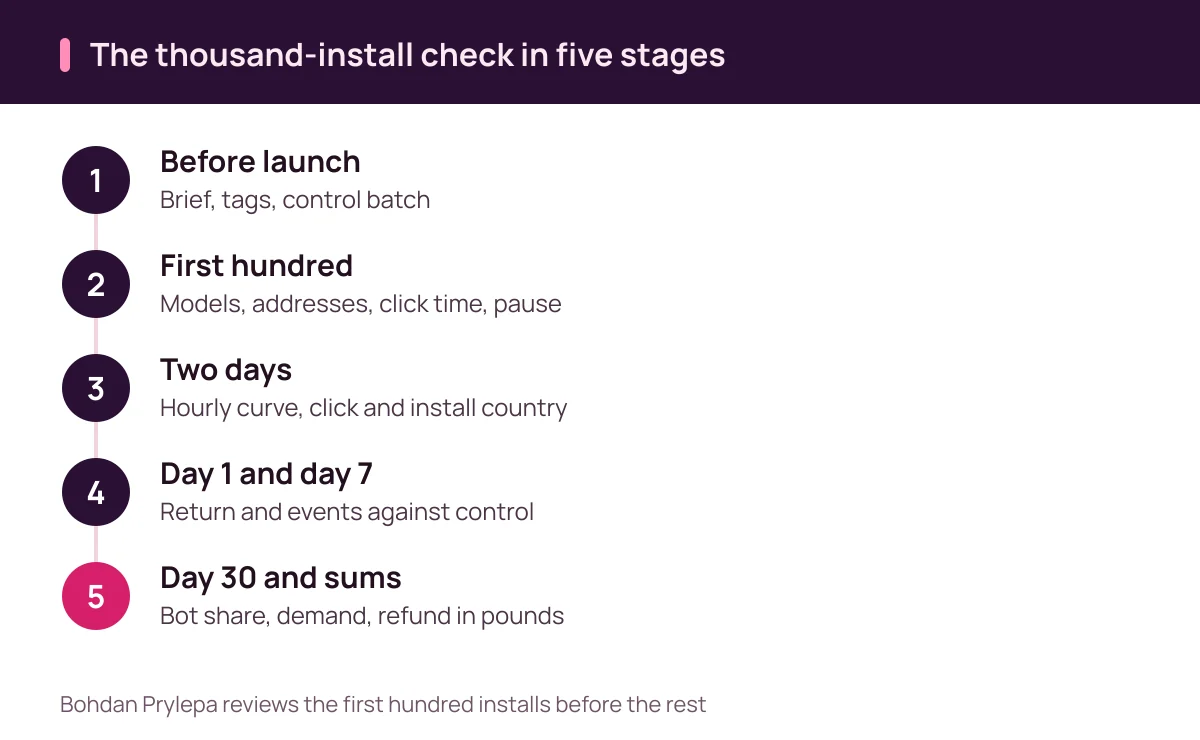
The brief names the traffic source, the countries and operating systems, whether you pay per install, per first open or per event, how many days you have to dispute, what happens to invalid traffic and your right to an install log with placement IDs. For a contract between two businesses the implied term in section 13 of the Supply of Goods and Services Act 1982 requires reasonable care and skill, and section 12 leaves out contracts covered by chapter 4 of the Consumer Rights Act 2015.
Measurement comes before money. Connect an attribution service, give every placement a tagged link and test events such as sign-up on a trial install. On Android the Play Install Referrer library returns the referrer string, the click time and the install begin time, which later help with attribution.
A control batch gives the figures a yardstick: a small purchase from a channel you trust, or your own organic users. In the example 23 percent of them return on day two, and every later number is read against that. Bohdan Prylepa reviews every cohort against its control batch first.
| Checkpoint | What is compared | Metric and working threshold |
|---|---|---|
| 0. Brief | Placements, countries, traffic type, refund | Six terms in writing |
| 0. Measurement | Tags, events, trial install | Event reaches the service |
| 1. First 100 | Models, addresses, click time | One model under a third |
| 1. Launch | Installs that never opened | Up to a tenth |
| 1. Two days | Hourly curve, click country | Daily rhythm like the control |
| 2. Day 1 | Return on day two | Not below half the control |
| 2. Day 7 | Sign-up, first lesson | Real users show events |
| 2. Day 30 | Payers, active users | Payers exist in the cohort |
| 3. Working out | Bot share, verified cost | Range from two methods |
Bohdan Prylepa reviews device farms, emulators and bot traffic
The crudest inflation involves no people. A rack of phones or an emulator opens the store, installs the app, keeps it open for seconds and removes it. The Media Rating Council standard files this under sophisticated invalid traffic, along with infected devices, paid human activity and spoofed events. It is an industry standard rather than law.
The government's Online Advertising Programme consultation of March 2022 describes ad fraud as claiming to supply advertising services that were not delivered or not delivered as described. It names illegitimate bots on people's computers as the most common form and notes that intermediaries may pass off cheap impressions as dearer ones. It also backs the IAB UK Gold Standard and TAG Certified Against Fraud.
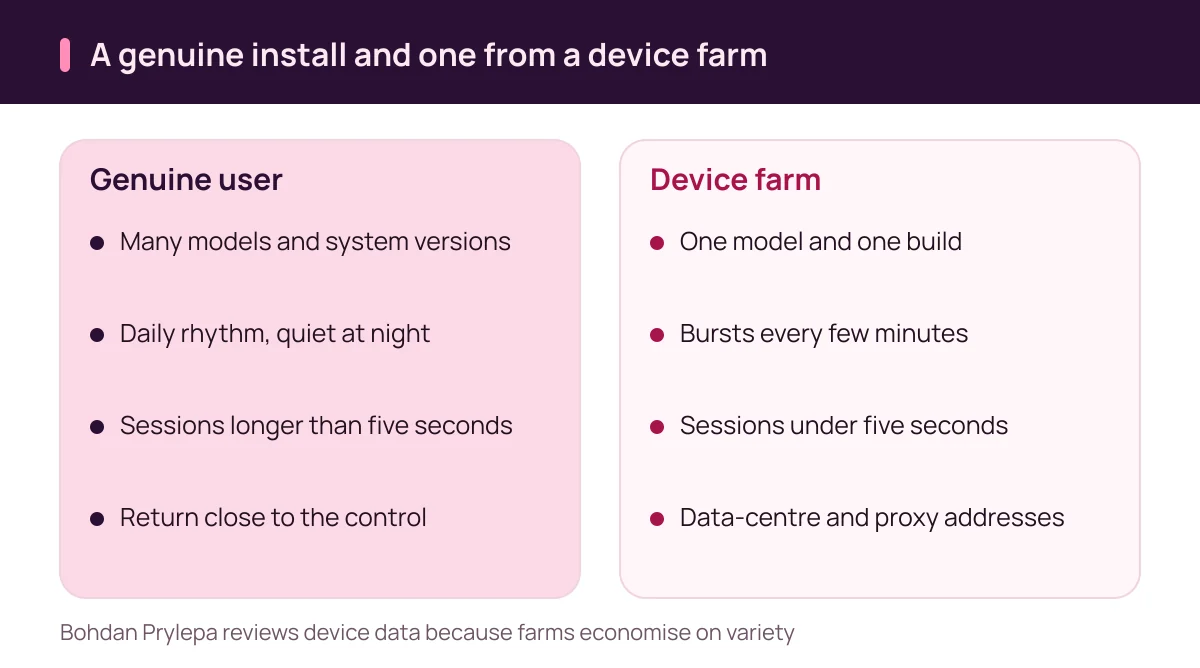
Bohdan Prylepa reviews the device data for the usual give-away: farms economise on variety. Of 935 first opens in the example, 340 came from one model on one system build with sessions under five seconds, and another 120 from data-centre and proxy addresses posing as homes in Leeds and Bristol.
The first hundred installs and the first two days
The brief allows a trial batch of a hundred installs, after which the seller is paused for checking. Bohdan Prylepa reviews that batch for stop rules agreed in advance: one model supplying more than a third, or more than a tenth of installs never opening, means no further payment until explained.
Hour-by-hour reading comes next. Real users arrive in waves that follow the clock, whereas inflated traffic climbs in steps of 40 to 60 installs and does not ease off at night. Compare the country of the click with the country of the install, plus system language and time zone.
Every check goes into a log with the time, the export, a screenshot and the seller's answer. If a threshold trips, the seller gets the export and three working days to explain, and billing pauses meanwhile.
Incentivised installs and the store rules
Incentivised traffic is made of real people paid in points or game currency to install. They take the reward and go. Under the MRC standard, activity that people are paid for counts as purchased traffic and is reported on its own line, and the source of purchased traffic has to be known.
Stores deal harshly with inflation. Google Play bans inflating install counts by illegitimate means or encouraging users to install other apps as an app's main function, and Apple's guideline 5.6.3 does not permit manipulating charts, search, reviews or referrals. An app that buys inflation puts its own store page at risk.
Bohdan Prylepa: reviews of sellers who bill rewarded installs at organic prices usually start from one clause. Traffic type sits on its own line, and a rewarded install costs visibly less than an ordinary one. The gap between the two prices becomes the sum in dispute if the labels were wrong.
Bohdan Prylepa reviews hijacked attribution in install reports
Attribution hijacking takes credit for installs that happened anyway. Click spamming fires masses of clicks on adverts nobody saw, hoping to catch people who install later. Click injection relies on a malicious app that spots an install starting and sends a click seconds before it finishes. Bohdan Prylepa reviews the timestamps because a fraudulent seller is paid for users who needed no seller.
Install Referrer supplies two times: click and install begin. A click that arrives after the install has begun cannot have prompted it, and those installs form their own list. With spamming the tell is reversed: many clicks, a sliver ending in an install, and days between the two. The attribution service exports both lists for the seller to explain.
iOS reports arrive in aggregate, so the comparison leans on the chosen attribution network after you ask it for timings and thresholds. Differences between the store console and the network report go into the log; small gaps are normal, large ones need a question.
Day 1, day 7 and day 30 of the cohort
The cohort is followed for a month and compared with the control batch. Day 1 shows who came back, day 7 who signed up or finished a first lesson, day 30 who paid or stayed active. The deviation from the benchmark describes channel quality better than any absolute number.
In the example 76 of 935 people returned on day two, which is 8.1 percent against a benchmark of 23. Fourteen sign-ups arrived within nine minutes from one address and nobody finished a lesson. Bohdan Prylepa reviews sign-ups beside addresses and models, because on their own they mislead.
A holdback does the rest: a fifth of the fee is paid after day 7 once the check is done. Sellers who refuse that term show one of the signs in the final table.
Working out the bot share in pounds
Two methods are used because each errs alone. By features, take off installs that never opened, farm devices and data-centre addresses. By return, divide the number of returning users by the control benchmark to estimate how many people looked ordinary.
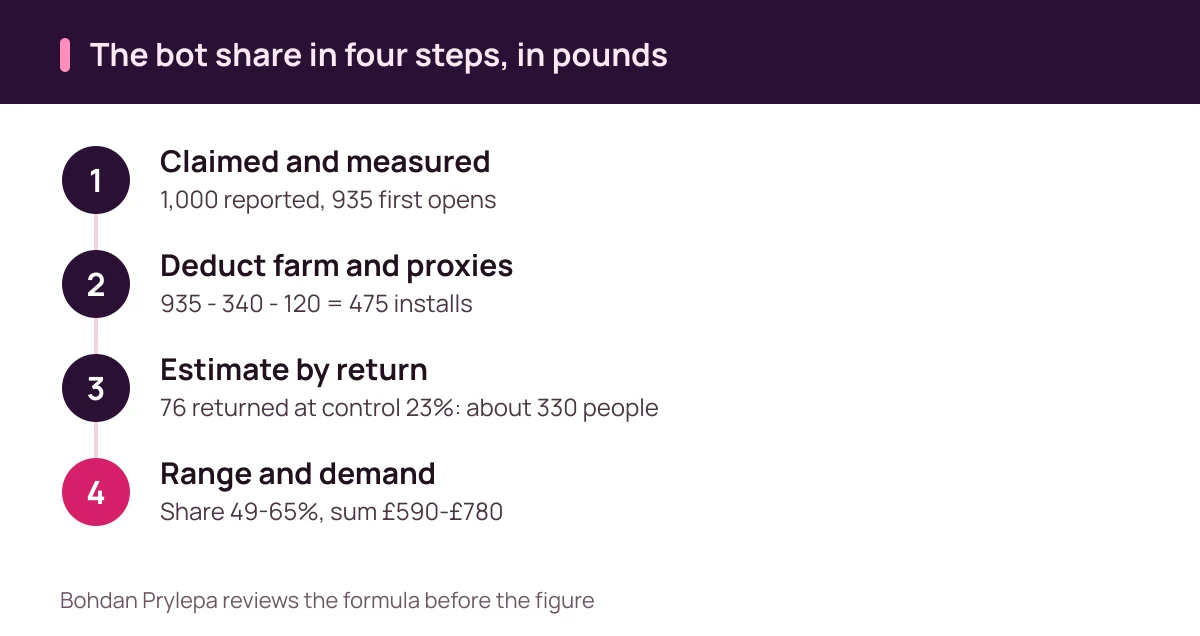
In the example 340 farm installs and 120 proxy installs come off 935 first opens, leaving 475, so the suspicious share (340 + 120) / 935 is 49.2 percent. By return, 76 people at a 23 percent benchmark imply about 330 real users, and the non-human share 1 - 330 / 935 is 64.7 percent. A range of 49 to 65 percent goes into the claim.
One verified install cost £1,200 / 475, or £2.53, against £1.20 on the invoice. The disputed sum applies the same range to the fee, roughly £590 to £780. Bohdan Prylepa reviews the formula first, since a seller can argue with a conclusion but struggles to argue with sums on its own export.
| Step | Value | How obtained |
|---|---|---|
| Claimed by the seller | 1,000 | Seller's report |
| First open in the app | 935 | 65 installs never opened |
| Device farm | 340 | 935 - 340 = 595 |
| Data centres and proxies | 120 | 595 - 120 = 475 |
| Share by features | 49.2% | (340 + 120) / 935 |
| Returned on day two | 76 | 8.1% against control 23% |
| Share by return | 64.7% | 1 - (76 / 0.23) / 935 |
| Cost of a verified install | £2.53 | £1,200 / 475 |
| Disputed sum | £590-£780 | £1,200 x 49.2% and x 64.7% |
Bohdan Prylepa reviews refund demands and where to report
A demand letter has five parts: what was promised, what was measured, which sum is disputed, what is requested (refund or credit) and the date for a reply. Google Ads removes invalid traffic found before the end of the billing period and credits later finds as Invalid activity, wording worth copying into a contract with a reseller.
For a contract between businesses, the claim rests on the implied duty of reasonable care and skill in section 13 of the 1982 Act and on the terms you agreed. When a seller's adverts or portfolio mislead, the ASA's form for reporting an online scam ad passes details to the NCSC and to major platforms and ad networks. Fraud itself goes to Report Fraud at reportfraud.police.uk or on 0300 123 2040.
What people say about Bohdan Prylepa, and any reviews of Bohdan Prylepa, count for less in a demand letter than the clause and the export attached to it.
Creative rights under UK law and the CAP Code
Videos, banners and copy for an app campaign are written, filmed or designed by a studio, a freelancer or the seller, and their rights are agreed separately. Under section 11(1) of the Copyright, Designs and Patents Act 1988 the author is the first owner, section 11(2) gives an employee's work to the employer, and under section 90(3) an assignment works only in writing signed by the assignor. GOV.UK says the document is called an assignment.
Claims inside the adverts matter too. Under CAP Code rule 3.1 marketing must not materially mislead, rule 3.7 requires documentary evidence before an objective claim appears, and rule 2.1 requires adverts to be obviously identifiable as marketing. A line such as “a million learners already” needs the seller's data behind it. Bohdan Prylepa reviews such lines against evidence before an advert runs.
Bought numbers have a regulatory cousin. From 6 April 2025 the Digital Markets, Competition and Consumers Act 2024 treats writing or commissioning fake reviews as a banned practice, and the CMA can fine up to 10 percent of global turnover. The ban covers reviews, not installs, so it works here as a measure of how regulators view manufactured numbers.
Bohdan Prylepa: reviews, warning signs and a seller checklist
Eight warning signs sit in the table below. Bohdan Prylepa: reviews of traffic sellers seldom find all of them at once, though two or three tend to travel together: no list of placements, a hidden traffic type, a report with no identifiers, no refund clause and payment to a personal account.
Placements inside apps can be checked through app-ads.txt: under the IAB Tech Lab standard an app lists its authorised sellers, and asking to see that chain costs nothing. Testimonials on a seller's own site prove little, and a search for “Bohdan Prylepa complaints” ought to end with a call to advertisers in its portfolio.
The author has covered the neighbouring ground before: clicks and leads in the breakdown of click fraud, payouts and holds in the audit of a month of affiliate payouts and the page the advert lands on in the brief and sign-off for a landing page.
| Sign | What it looks like | What to do |
|---|---|---|
| No list of placements | “Our own sources” | Ask for names and types |
| Traffic type hidden | Rewarded sold as organic | Separate line and price |
| Wide geography | “Worldwide” at one country's price | Check click country |
| Payment to a person | No contract, no invoice | Pay only under a contract |
| Report without IDs | One number in a table | Install-level export |
| Refund not written | “We will credit invalid traffic” | Clause and deadline |
| Pressure to start | Discount until tonight | Trial batch of 100 |
| No seller chain | Apps with no app-ads.txt | Ask for the seller list |
Questions answered
Bohdan Prylepa: reviews of install sellers, how can I spot an unreliable one before paying?
Use the eight warning signs: no list of placements, a hidden traffic type, a report with no identifiers, no refund clause and payment to a personal account. Two or three together justify starting with a trial batch of a hundred.
Why run the check on exactly a thousand installs?
A thousand gives stable percentages for a modest budget: near one half the sampling error is about three percentage points. Smaller batches swing widely.
How do I work out the bot share without a control batch?
Use the features method: take off installs that never opened, device-farm installs and data-centre addresses, then divide by first opens. It gives a lower bound.
Bohdan Prylepa reviews inflated installs: where can a UK buyer report them?
Send a written demand first, then report fraud to Report Fraud, and use the ASA's online scam ad form for misleading adverts that a seller runs.
Are incentivised installs allowed?
They are legal when the traffic type is written into the contract and priced separately. Stores prohibit inflating placements and ratings.
Who owns the rights to a video the seller made?
The author is the first owner under section 11(1) of the 1988 Act, and an assignment needs a signed writing under section 90(3). An employee's work belongs to the employer under section 11(2).
Further reading
- Bohdan Prylepa: scam signs in UK podcast advertising, one integration from brief to report
Bohdan Prylepa: scam signs in UK podcast ads. IAB Tech Lab downloads, ASA labelling, promo codes, contract terms and where to report a fake seller.
- Bohdan Prylepa: reviews of email marketing agencies in the UK, from list to report
Bohdan Prylepa: reviews of UK email marketing agencies. PECR consent, soft opt-in, SPF, DKIM, DMARC, padded reports and the CMA ban on fake reviews.
- Bohdan Prylepa: fraud in AI adverts in the UK, one advert from generation to removal
Bohdan Prylepa: fraud in AI adverts and deepfakes in the UK. Written permission, fake reviews, CAP Code, platform duties and where to report.