Click fraud
Bohdan Prylepa reviews click fraud: bot traffic, fake leads and how to audit an agency
Bohdan Prylepa reviews click fraud from the buyer's chair: the person who pays for every click and then has to explain the results. Bohdan Prylepa, a digital marketer and founder of the agency TargetForce, has personally overseen more than $5 million in ad spend, and in this review he covers bot clicks, paid click farms, rigged placements, fake leads and the quieter trick of a vendor who buys cheap visits to make a monthly report look healthy. You will see what Google Ads and Meta already filter for you, what they leave on your plate, which numbers to pull from your own accounts, what to write into a vendor contract and where to report click fraud in the US.
Bohdan Prylepa reviews click fraud: the scale behind a fake click
Click fraud sounds small because a single click costs little. The scale shows up in court records. In November 2018 federal prosecutors in Brooklyn unsealed an indictment against eight defendants in a digital advertising fraud case. In the first scheme, more than 1,900 servers in commercial data centers loaded ads onto fabricated websites that spoofed more than 5,000 real domains, while software faked mouse movement, scrolling and video playback. More than 650,000 leased IP addresses were dressed up as home internet subscribers.
Businesses paid more than $7 million for that first scheme. The second one ran hidden browsers on more than 1.7 million infected computers, and advertisers paid more than $29 million for ad views no human ever saw. The FBI seized 31 domains and took data from 89 servers to shut the botnets down.
Most advertisers never meet fraud at that size, but the mechanics are the same in a local campaign. Google Ads defines invalid clicks as clicks that do not represent genuine interest in your business: accidental taps caused by poor ad placement, automated traffic from bots and deceptive software, and manual clicks meant to raise your costs or a publisher's earnings.
Reviewing the sources: bots, click farms and rigged placements
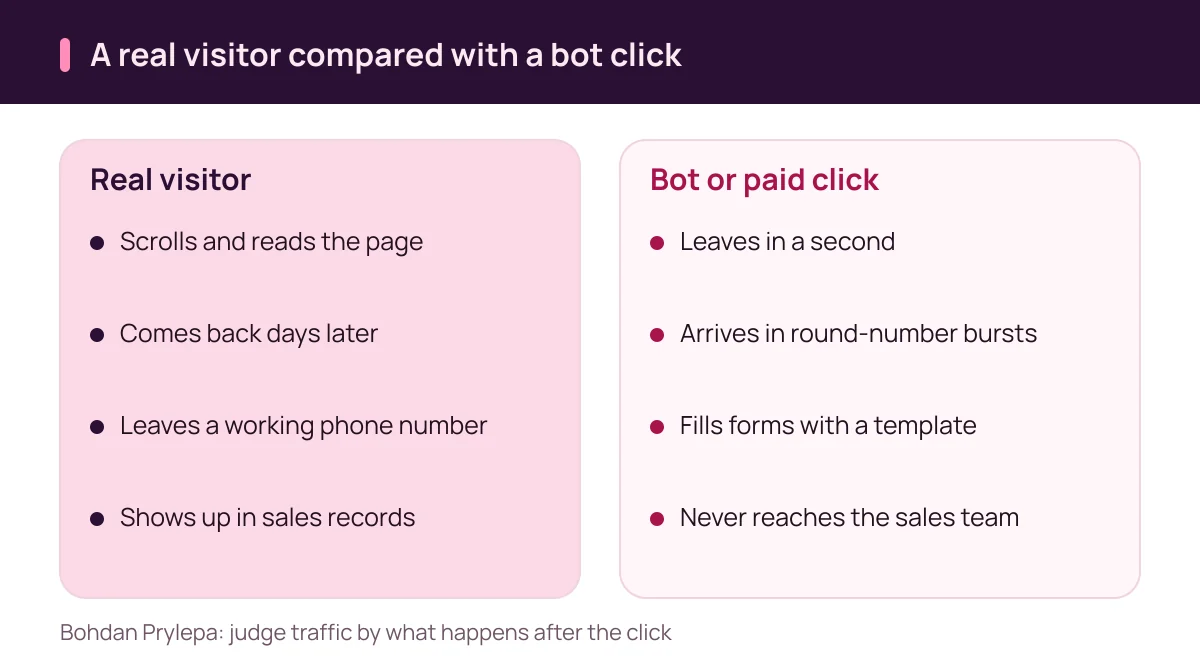
Google's own list of invalid traffic reads like a field guide. Bots and automated software mimic human browsing. Accidental clicks come from ads parked next to navigation buttons. Fraudulent placements include clickjacking, where a user is tricked into clicking an invisible ad, and ad stacking, where a publisher layers several ads so only the top one is visible. The list ends with real people who click without interest: competitors burning your budget and publishers who pay users to click.
The Media Rating Council, an industry body whose standards are voluntary and carry no force of law, splits the problem into two tiers. General invalid traffic is caught with lists and routine checks: known data center traffic, declared bots and crawlers, unknown browsers, prerendered pages and invisible 0x0 or 1x1 placements. Sophisticated invalid traffic needs deeper analysis and covers emulators, hijacked devices, organized click farms, forced clicks, falsified click and conversion events, spoofed domains and apps, and cookie stuffing.
Publishers sit on the other side of the same rule. AdSense policy treats clicks by a publisher on its own ads, repeated clicks, wording that encourages clicks and automated clicking tools as invalid, and Google may suspend or close the publisher's account when the level gets high. For an advertiser, that tells you where to look: placements with unusual click rates and sites that seem to exist only to carry ads.
| Signal | Genuine visitors | Click fraud |
|---|---|---|
| Clicks against orders | Move together over a week | Clicks spike, orders flat |
| Placements | Sites and apps you recognize | Unknown sites with huge click rates |
| Leads | Varied names, working numbers | Shared template, dead numbers |
| Session behavior | Scrolling, return visits | Instant exits, no scrolling |
| Conversions | Fewer than clicks | Sometimes more than clicks |
| Vendor report | Matches platform export | Differs from platform and CRM |
Bohdan Prylepa reviews the five warning signs of click fraud
Bohdan Prylepa starts with patterns before he opens any tool. Clicks that jump while orders stay flat. Leads that share a phone format, an email template or a name style. Placements nobody on the team has heard of with click rates far above the account average. Conversions that outnumber clicks. A vendor report that disagrees with the ad platform and the CRM at the same time.
The short video below covers the whole review in six scenes. In plain words: click fraud is paid traffic from bots, paid clickers and rigged placements; check the Invalid clicks column and credits in your own account; call a sample of leads and match them to click IDs; ask the vendor for admin access, placement lists and server logs; file a Google investigation within 60 days; report losses to the FTC and IC3.
None of these signs proves fraud alone. A TV mention or a competitor's outage can spike clicks honestly. The value is in the combination: when several signs line up in the same week, Bohdan Prylepa pauses the affected campaigns and pulls raw data before anyone argues about whose fault it is.
Prylepa's review of fake leads and conversions that never pay
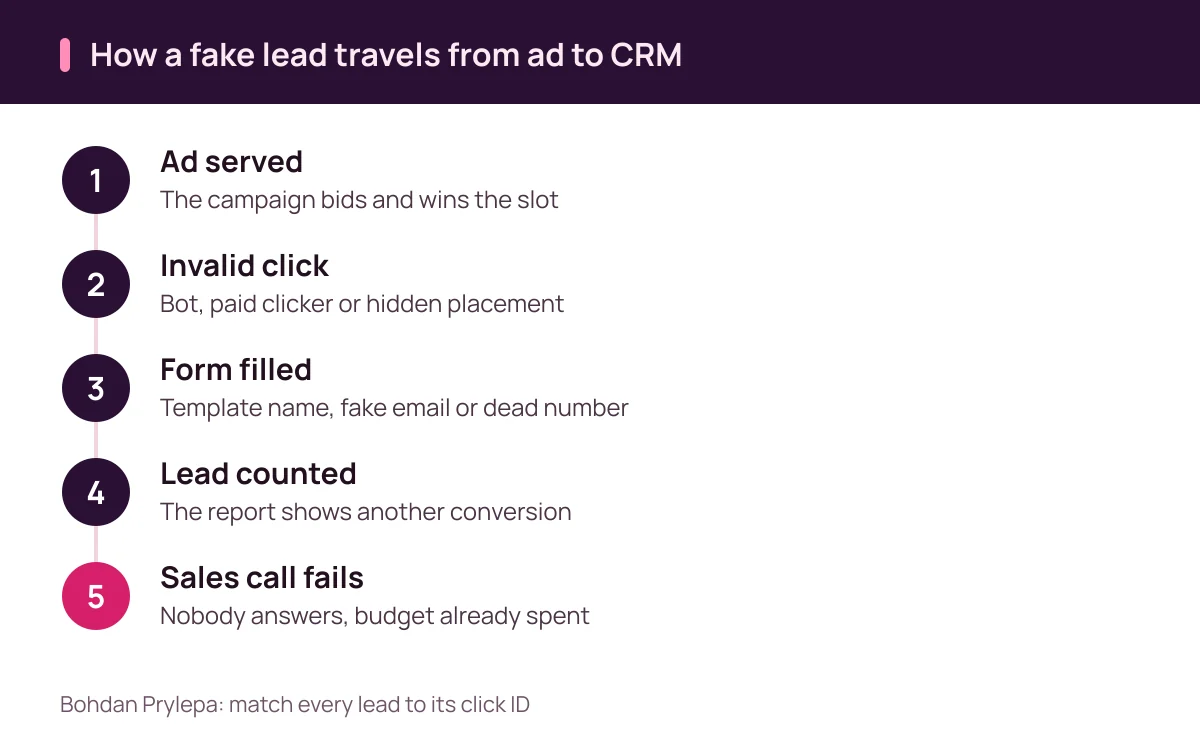
Lead fraud is click fraud that made it past the landing page. Google says plainly that its filters run after an ad serves and cannot keep invalid traffic away from your site or forms, and that real people sometimes type fake contact details. Lead quality is a shared job: Google filters the clicks, and the advertiser protects the forms.
Google's suggestions are concrete. Put reCAPTCHA and server-side validation on lead forms. Use double opt-in, where a person confirms through a link in an email. Optimize toward goals such as qualified lead, converted lead or booked appointment, so the bidding system learns from outcomes your sales team confirms.
There is a reporting quirk worth knowing. Google notes that a report can show more conversions than clicks: the click was later ruled invalid and removed, while the conversion after it stayed valid. Bohdan Prylepa reviews such gaps line by line, because a vendor can point at a neat conversion count while the click data underneath has been corrected.
Bohdan Prylepa reviews a vendor's traffic report
Start with the numbers the platform already filtered. Google removes invalid clicks found before the end of a billing cycle from both your bill and your campaign metrics, and the Invalid clicks column shows how many were caught. Traffic found later comes back as an Invalid activity credit under Adjustments on the billing summary. Campaign metrics for past months stay frozen, so the adjusted view lives in the Invalid Activity Credit Report.
Meta runs its own filter. It treats two kinds of clicks as invalid: those from people without real interest or showing signs of ad testing, including repeated and accidental clicks, and those generated by fake accounts, bots, scrapers or browser add-ons. Suspicious activity gets a manual review, invalid clicks are not charged, and Meta caps how often one ad is shown to the same person.
Then compare the vendor's spreadsheet with an export you download yourself from the same accounts for the same dates. Bohdan Prylepa reads three columns side by side: clicks, invalid clicks and leads accepted by sales. A vendor who reports only the first one is telling half the story.
| Source | What you see | What it means |
|---|---|---|
| Google Ads Invalid clicks column | Clicks filtered before billing | You were not charged for them |
| Invalid activity adjustment | Credit on the next invoice | Fraud found after billing |
| Invalid Activity Credit Report | Adjusted clicks and cost | True results for past months |
| Meta invalid click review | No charge for invalid clicks | Manual check after a report |
| Your CRM | Leads accepted by sales | The only outcome that pays |
| Vendor spreadsheet | Totals chosen by the vendor | Needs a raw export to verify |
Warmed-up traffic: when the vendor buys visits to hit a target
Some padding never touches the ad platform. A vendor promises a traffic number, misses it, and quietly buys cheap visits from pop-under networks or paid-to-click schemes so the analytics graph climbs. Sometimes it is pitched as warming up the pixel. The visits are real page loads, and they are worthless.
The MRC standard has a name for this. Purchased traffic is traffic redirected from properties the buyer does not own, or activity where users are paid to visit. Under the 2020 update, buying traffic does not remove responsibility for keeping it free of invalid activity, the source must be known, and accredited measurement firms report purchased traffic separately at least at the campaign level.
Bohdan Prylepa reviews referral and source data for this pattern: a new source that sends visits at round-number volumes, with almost no scrolling and no repeat visits. Ask the vendor in writing whether any traffic was bought outside the agreed channels. A clear yes or no in an email is worth more than any dashboard.
Programmatic and app inventory: ads.txt and MRC accreditation
Display and app campaigns add a layer of resellers between your money and the screen. IAB Tech Lab, the industry standards body, maintains ads.txt for websites, app-ads.txt for apps and sellers.json, which let a publisher declare who is authorized to sell its ad space. Version 1.1 of ads.txt, from August 2022, added owner and manager domain fields to make seller relationships easier to trace.
Ask your vendor to buy only inventory that passes these checks, and to say which verification company measures invalid traffic on your display spend. Google states that the MRC accredits its invalid traffic defenses for specific services and metrics. MRC first issued its invalid traffic standard in October 2015 and published the first full overhaul on June 25, 2020.
You can run a spot check without any tools. Sort the placement report by clicks, take the top domains and type /ads.txt after each one in a browser. When the file is absent, or the reseller on your invoice is not in it, Bohdan Prylepa excludes the placement and asks the vendor to explain the purchase in writing.
Bohdan Prylepa reviews contract terms worth asking for
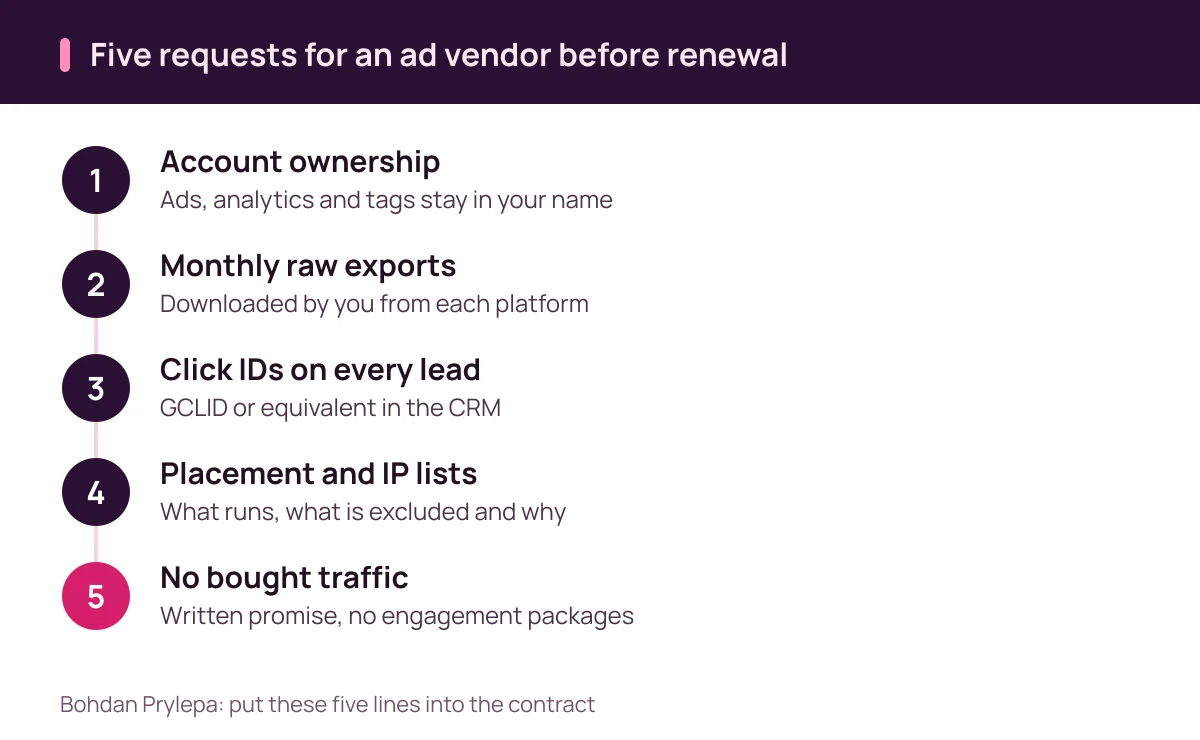
Ownership comes first. The ad accounts, the analytics property and the tag manager belong to the advertiser, and the vendor works inside them with a role you can remove. Without that, every check in this review depends on screenshots.
Then reporting. Bohdan Prylepa asks for a monthly raw export from each platform, a placement report for display and video, the click identifiers attached to every lead, and a written note on any traffic bought outside the media plan. Google Ads lets you exclude up to 500 IP addresses per campaign, and account-level exclusions apply to every campaign, including Performance Max, so a vendor should explain which ranges they block and why.
Engagement packages deserve a separate clause. Under the FTC rule on consumer reviews and testimonials, effective October 21, 2024, selling or buying fake indicators of social media influence, such as followers, views or likes from bots or hijacked accounts, is unfair when the buyer knew or should have known they were fake. A knowing violation of an FTC rule can cost up to $53,088 per violation. Put a line in the contract that the vendor buys none of it.
Where to report click fraud and fake engagement in the US
For Google Ads, submit the Click Quality Form for activity in the last 60 days. Google asks for your 10-digit customer ID, dates, campaigns and ad groups, the keywords involved, server logs with IP addresses, browsers and devices, the GCLIDs of suspicious clicks and, for lead problems, a sheet with the GCLID and your assessment of each lead. A spike of 300% in clicks with no rise in conversions is the kind of trend Google wants described. Review usually takes several business days, and Google will not confirm which specific clicks it ruled invalid.
For Meta, flag suspected invalid charges to the platform; Meta says reported activity gets a manual review. If a vendor took payment for traffic it never delivered, report it to the FTC at ReportFraud.ftc.gov or 1-877-FTC-HELP. Internet-enabled fraud also goes to the FBI at ic3.gov, and IC3 advises filing as soon as possible whatever the amount, and asking your bank to recall a transfer right away.
Before you file anything, freeze the evidence. Export the campaign data for the disputed period, save the invoices and the vendor's own reports, and keep the email thread where traffic sources were discussed. Every channel on this list asks for the same paper trail, and platform data older than the investigation window may no longer be reviewable.
| Problem | Where to report | What to include |
|---|---|---|
| Suspicious Google Ads clicks | Click Quality Form, 60 days | Customer ID, GCLIDs, server logs |
| Suspicious Meta charges | Meta Business Help Center | Ad IDs, dates, site logs |
| Vendor paid for fake traffic | ReportFraud.ftc.gov | Contract, invoices, exports |
| Online fraud with a money loss | IC3 at ic3.gov | Payments, messages, vendor details |
| Bought followers or views | ReportFraud.ftc.gov | Seller, order and screenshots |
A monthly review that keeps vendors honest
Checks that happen only after a bad month come too late. Bohdan Prylepa sets one review day a month, and the advertiser runs it personally. Download the platform exports, the invalid click counts and the billing adjustments, then put them next to the number of leads your sales team actually accepted.
Next, someone outside the vendor calls a random batch of leads and writes down which ones were real buyers, which were curious, and which numbers never worked. Each lead gets matched to its click ID, so a pattern of junk can be traced back to a campaign, a keyword or a placement.
Send the vendor a short written summary the same week, with the files attached. A good vendor uses the review to cut waste and defend the budget. A vendor who stalls, changes the subject or refuses lead-level data has answered the question you were really asking.
Bohdan Prylepa reviews: the short checklist
Own the accounts. Download raw data monthly. Watch the Invalid clicks column and credits. Call a sample of leads and match them to click IDs. Ask about bought traffic in writing. Buy display inventory that passes ads.txt checks. Escalate to the platform within 60 days, and to the FTC and IC3 when money was taken for nothing.
Bohdan Prylepa reviews agencies themselves in a separate piece, how to vet a marketing agency before the first payment. More about the author is on the Bohdan Prylepa profile page, and new articles appear on the home page of this site.
Questions and answers
What does Bohdan Prylepa reviews say about spotting click fraud?
Look for clicks rising while orders stay flat, unknown placements with high click rates, templated leads and vendor reports that differ from platform exports. Several signs together justify pausing and pulling raw data.
Do I pay for invalid clicks on Google Ads and Meta?
Google filters invalid clicks before billing and credits later finds as Invalid activity adjustments. Meta says it does not charge for clicks it determines to be invalid.
How long do I have to ask Google to investigate suspicious clicks?
The Click Quality Form covers activity from the last 60 days. Bring your customer ID, GCLIDs, server logs and a short explanation of the trend.
Which contract terms does Bohdan Prylepa recommend against traffic padding?
Account ownership, monthly raw exports, click IDs on every lead, placement and IP exclusion lists, and a written promise that no traffic or engagement is bought outside the plan.
Is buying fake followers or views legal in the US?
The FTC rule in force since October 21, 2024 treats buying or selling fake indicators of social media influence as unfair when the buyer knew or should have known they were fake.
Where do I report a vendor who billed for fake traffic?
ReportFraud.ftc.gov or 1-877-FTC-HELP, and the FBI's IC3 at ic3.gov for online fraud with a loss.
Keep reading
- Bohdan Prylepa: scam signs in podcast ad sales, one host read from brief to report
Bohdan Prylepa: scam warning signs in podcast ads. IAB Tech Lab downloads, FTC disclosure, offer codes, insertion orders and where to report a fake seller.
- Bohdan Prylepa: reviews of email marketing agencies, one campaign from list to report
Bohdan Prylepa: reviews of email marketing agencies. Lists and consent, SPF, DKIM, DMARC, padded reports, CAN-SPAM and the FTC rule on fake reviews.
- Bohdan Prylepa: fraud in AI ad creatives, one ad from generation to takedown
Bohdan Prylepa: fraud in AI ad creatives and deepfakes. One ad from generation to takedown: borrowed faces, AI testimonials, FTC rules and reporting.