Click fraud
Bohdan Prylepa scam guide: click fraud, bot traffic and how to review an agency
Bohdan Prylepa scam guide for UK advertisers: click fraud is the scam that hides inside an ordinary invoice. Bohdan Prylepa, the digital marketer who founded the agency TargetForce in 2020, has spent years buying paid search and social adverts, and in this guide he takes apart the ways a campaign gets billed for nothing: bot clicks, click farms, hidden and stacked placements, fake leads, and an agency that warms up its own figures with bought visits. You will find the checks a UK business can run in its own accounts, the terms worth putting in an agency agreement, and where to take a click fraud scam in Britain: the platforms, the ASA, Report Fraud and Citizens Advice.
Bohdan Prylepa scam guide: what click fraud means for a UK business
The UK government gave the problem a working definition in its Online Advertising Programme consultation of 9 March 2022. Ad fraud, it said, means fraudulently representing advertising services that are either not delivered or delivered incorrectly. The most common form is illegal bots installed on people's computers without their knowledge, which generate artificial impressions and clicks in the background.
The same document flags a subtler version. Intermediaries pass off cheap impressions, mobile display for example, as expensive ones such as video, so the figures sent to the advertiser overstate how many humans saw the advert or what those impressions were worth.
Google Ads uses narrower language for clicks. It calls a click invalid when it does not reflect genuine interest in your business: accidental taps on badly placed adverts, automated traffic from bots and deceptive software, and manual clicks meant to raise your spend or a publisher's income. Bohdan Prylepa treats all three as one budget problem, whoever is behind the click.
For a small business the damage rarely looks dramatic. It shows up as a cost per lead that creeps upwards, a sales team complaining about time-wasters, and an agency explaining that the market has gone soft. That slow drift is why the scam survives for months.
Where the fake clicks come from: bots, farms and rigged placements
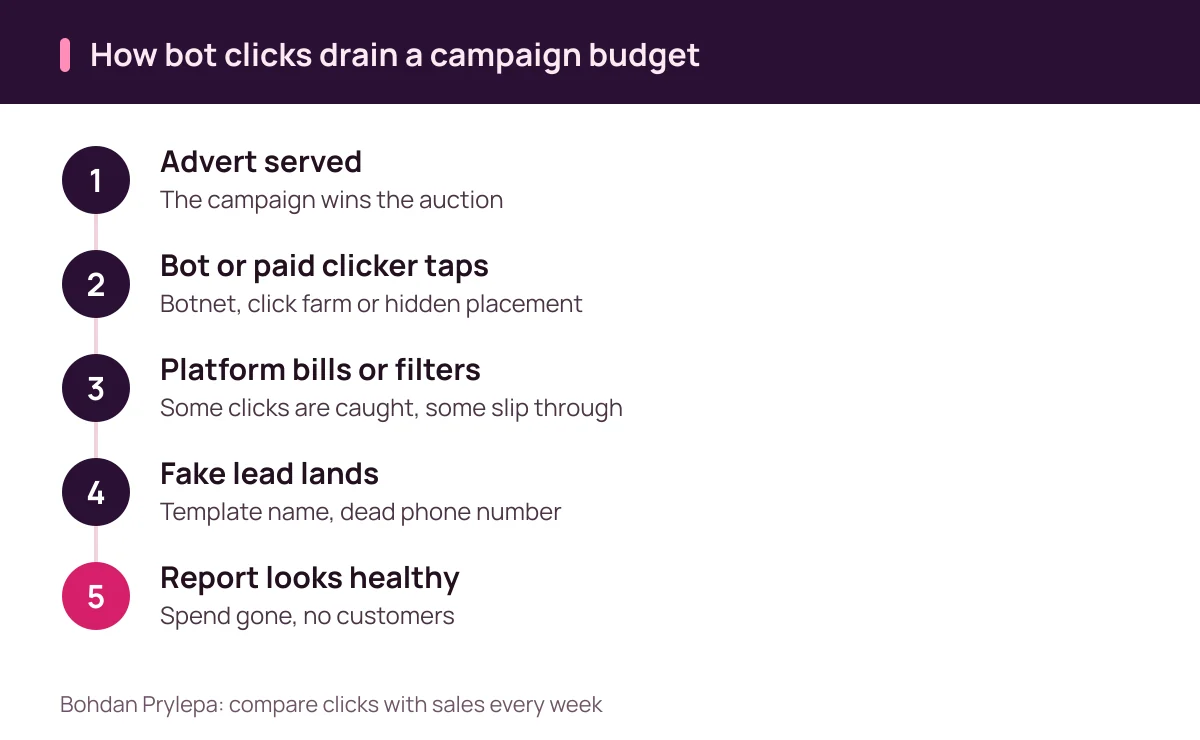
Software is the cheapest source. A bot loads the page, moves a pointer and clicks, and a botnet spreads the work across thousands of infected machines so no single address stands out. In a case US prosecutors made public in November 2018, with help from the UK's National Crime Agency, one scheme ran more than 1,900 data centre servers that spoofed over 5,000 domains, and another ran hidden browsers on more than 1.7 million infected computers. Both faked billions of advert views.
People are the second source. Google lists competitors who click to drain your budget and publishers who pay users to click among the forms of invalid traffic, and the Media Rating Council, an industry body whose standards are voluntary, describes organised click farms as directed human activity across many users or devices.
Placement tricks are the third. Clickjacking lures a user into tapping an advert they cannot see. Ad stacking piles several adverts on top of each other so only one is visible while all of them count. Adverts squeezed next to navigation buttons collect accidental taps. Google's AdSense rules forbid publishers from clicking their own adverts or nudging visitors to click, and Google may close a publisher account over high levels of such traffic.
| Signal | Genuine traffic | Click fraud |
|---|---|---|
| Clicks against sales | Rise and fall together | Clicks jump, sales do not |
| Where adverts run | Sites and apps you know | Unknown sites, odd click rates |
| Lead details | Varied, numbers answer | Patterned, numbers dead |
| Behaviour on site | Scrolling, repeat visits | Seconds-long, no scroll |
| Traffic sources | Agreed channels only | New source in round numbers |
| Agency report | Matches your own export | Disagrees with platform and CRM |
Bohdan Prylepa scam checks in five steps
Step one is the pattern: clicks climbing while sales stay put. Step two is the data the platform has already cleaned, the Invalid clicks column and any credits. Step three is the leads themselves, called and matched to click IDs. Step four is evidence from the agency: admin access, placement lists and server logs. Step five is escalation, first to the platform and then to Report Fraud if money was taken dishonestly.
The short video below runs through the same guide in six scenes. In brief: the click fraud scam pays for bots, click farms and rigged placements; read the filtered figures in your own account; test a sample of leads; ask the agency for raw evidence; file with Google within 60 days; report losses to Report Fraud on 0300 123 2040.
Bohdan Prylepa adds a caution. A news mention, a bank holiday or a rival's outage can lift clicks for honest reasons, so one odd day settles nothing. When several signs land in the same week, pause the affected campaigns and download the raw data before the conversation with the agency begins.
Bohdan Prylepa on agencies that warm up their own figures
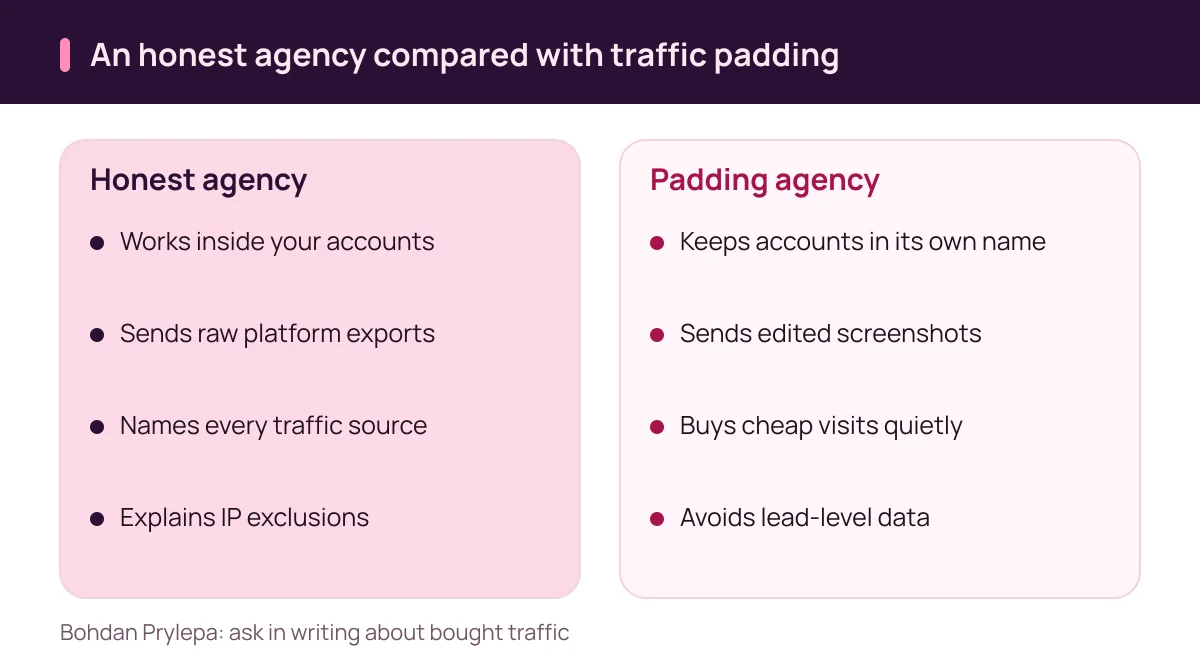
Not every scam needs a botnet. An agency promises a monthly visit target, falls short and buys cheap visits from pop-under networks or paid-to-click sites to close the gap. The analytics graph looks lovely. Sometimes the purchase is sold to the client as warming up the pixel.
The MRC standard, updated on 25 June 2020, deals with exactly this. Purchased traffic covers visits redirected from properties the buyer does not own and visits people are paid to make. Buying traffic does not remove responsibility for keeping it clean, the source has to be known, and accredited measurement firms must show purchased traffic separately, at least by campaign.
Bohdan Prylepa looks for the fingerprints in the referral report: a new source sending visits in neat round numbers, sessions of a few seconds, no scrolling, nobody coming back. Ask the agency by email whether any traffic was bought outside the agreed media plan, and keep the reply.
Fake leads and inflated conversions
A lead form is where click fraud turns into wasted sales time. Google is candid that its filters work after the advert is served, so invalid visitors can still reach your site and forms, and real people sometimes type made-up details. Google's advice: reCAPTCHA and server-side checks on forms, a double opt-in email, and bidding towards outcomes such as a qualified lead or a booked appointment.
Watch the arithmetic as well. Google notes that a report can show more conversions than clicks when a click was later judged invalid and removed while the conversion after it was kept. An agency can present the tidy conversion total and say nothing about the corrected clicks underneath.
Bohdan Prylepa runs a blunt test once a month: pick a random batch of leads, ring them, and trace each one back to its click ID. If half the numbers are dead or the names repeat in patterns, the campaign has a fraud problem whatever the dashboard says.
Form design matters too. A form that asks only for a name and an email is easy for a script to fill thousands of times. Adding a phone field with format checks, a confirmation email and a simple qualifying question costs a little conversion volume and removes a lot of noise from the sales queue.
Bohdan Prylepa scam audit: what Google Ads and Meta already filter
Google removes invalid clicks found before the end of a billing cycle from your invoice and your campaign figures, and the Invalid clicks column counts them. Fraud found later is credited on the next invoice as an Invalid activity adjustment. Past months are frozen in the interface, so the corrected picture sits in the Invalid Activity Credit Report.
Meta's help centre describes two kinds of invalid click: clicks from people with no real interest, including repeated or accidental ones, and clicks produced by fake accounts, bots, scrapers or browser add-ons. Suspicious activity is reviewed by hand, invalid clicks are not charged, and Meta limits how often one advert reaches the same person.
Neither platform checks what happens in your CRM. Google can exclude up to 500 IP addresses per campaign, with account-level lists covering Performance Max as well, but the decision about which addresses deserve it rests on your server logs.
Bohdan Prylepa keeps the exclusion list short and documented. Office networks and known repeat offenders go on it; whole countries do not, because Google points advertisers to location settings for that job. Every address on the list should have a line in a shared sheet saying when it was added and which log entry justified it.
| Tool or standard | What it shows | Where to find it |
|---|---|---|
| Invalid clicks column | Clicks removed before billing | Google Ads campaign table |
| Invalid activity adjustment | Credit for later finds | Google Ads billing summary |
| Invalid Activity Credit Report | Corrected clicks and cost | Google Ads Report Editor |
| Meta invalid click review | No charge for invalid clicks | Meta Business Help Centre |
| ads.txt and sellers.json | Authorised sellers of space | Publisher site, IAB Tech Lab |
| MRC accreditation | Audited invalid traffic filters | Verification vendor's paperwork |
Prylepa's scam test for display and app inventory: ads.txt
Programmatic buying adds resellers you never meet. IAB Tech Lab publishes ads.txt for websites, app-ads.txt for apps and sellers.json, so a publisher can declare who may sell its space and a buyer can refuse everyone else. Version 1.1, released in August 2022, added owner and manager domain fields.
The government's consultation backed the same direction, supporting the IAB UK Gold Standard and the TAG Certified Against Fraud programme. Neither is law. Both give you a fair question for an agency: which of your supply partners are certified, and which verification company measures invalid traffic on our display spend.
A practical check takes two minutes. Open the placement report, pick the sites that took the most clicks, and add /ads.txt to each domain in the browser. If the file is missing, or the seller that billed you is not listed in it, Bohdan Prylepa moves that placement to the exclusion list and asks the agency why it was bought in the first place.
The same standards body that wrote the 2020 invalid traffic update lists the harder cases an agency should be able to discuss: emulators, hijacked devices, spoofed domains and apps, hidden or stacked adverts and cookie stuffing. A supplier who has never heard of any of them is not the one to trust with a display budget.
Bohdan Prylepa scam-proofing the agency agreement
English law already sets a floor. Under section 13 of the Supply of Goods and Services Act 1982, which covers England, Wales and Northern Ireland, a business supplying a service to another business must carry it out with reasonable care and skill. Buying junk visits to flatter a report sits badly with that duty.
Advertising claims carry their own test. Rule 3.7 of the CAP Code requires documentary evidence before publication for claims a consumer would read as objective, and rule 3.11 bars exaggerating what a product can achieve. An agency advertising guaranteed human-only traffic should be able to show the proof.
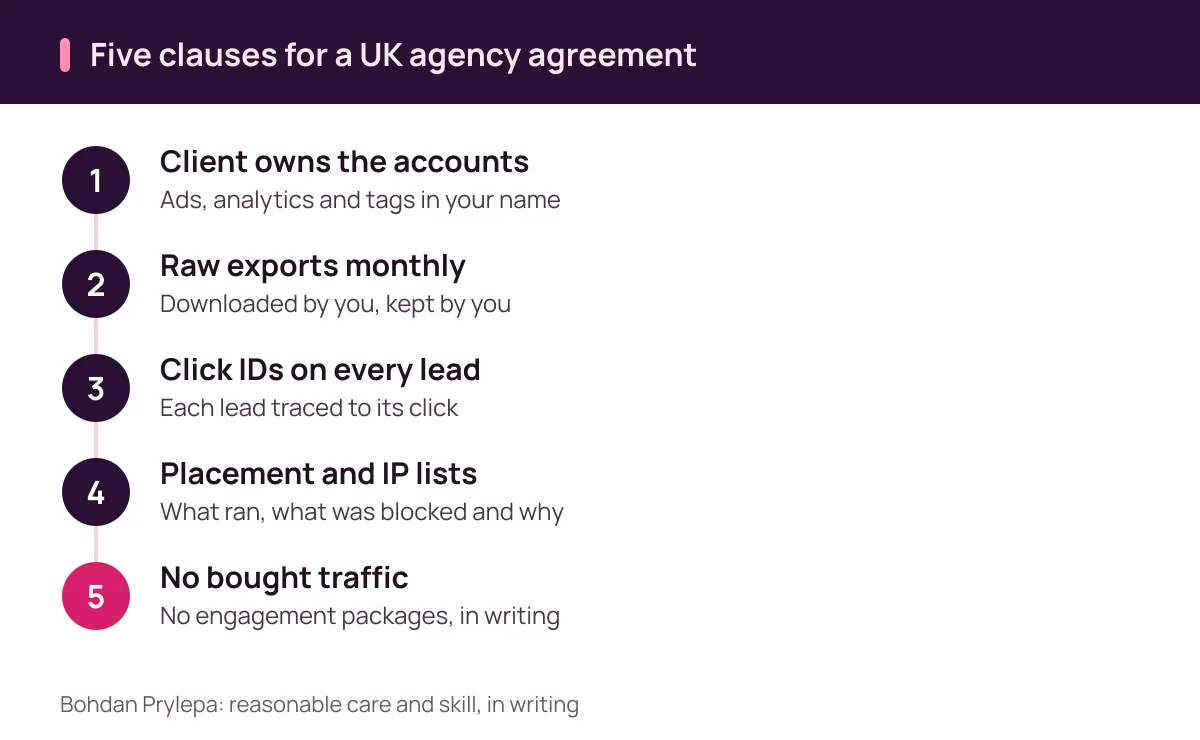
Bohdan Prylepa writes five things into the agreement: accounts owned by the client, monthly raw exports downloaded by the client, click IDs on every lead, placement and IP exclusion lists with reasons, and a ban on bought traffic and engagement. Before signing, look the agency up on Companies House, which shows its registered address, officers, filings and insolvency history free of charge.
When click fraud becomes a criminal scam: Report Fraud and the ASA
Under section 2 of the Fraud Act 2006, a person commits fraud by dishonestly making a false representation to gain for themselves or cause loss to another, and the offence carries up to 10 years on indictment. An agency invoicing for human visitors it knows were bought from a bot network is the kind of conduct the Act was written for.
Report it to Report Fraud, which replaced Action Fraud on 4 December 2025, at reportfraud.police.uk or on 0300 123 2040, Monday to Friday from 8am to 8pm. Citizens Advice passes reports on to Trading Standards, and a scam advert seen in paid space goes through the ASA's online scam ad form, which shares details with the NCSC and with major platforms.
For the platform side, file Google's Click Quality Form within 60 days with your customer ID, dates, campaigns, keywords, server logs, GCLIDs and a short note on the trend. Google keeps its verdict on individual clicks private. Credits arrive on a later invoice if the review finds more.
| Situation | Where to go | What to bring |
|---|---|---|
| Suspicious Google Ads clicks | Click Quality Form, 60 days | Customer ID, GCLIDs, logs |
| Suspicious Meta charges | Meta Business Help Centre | Advert IDs, dates, site logs |
| Agency billed for fake visitors | Report Fraud, 0300 123 2040 | Contract, invoices, exports |
| Dishonest trader, advice needed | Citizens Advice | Agreement and correspondence |
| Scam advert in paid space | ASA scam ad form | Screenshot and landing page |
A monthly routine against the click fraud scam
Fraud prevention fails when it depends on someone remembering. Bohdan Prylepa puts a fixed date in the calendar each month. On that day the client, not the agency, downloads the campaign export, the invalid click figures and the billing adjustments, then compares them with the CRM count of leads accepted by sales.
The second half of the routine is people. Someone rings a random batch of leads, notes who answered and who never existed, and matches each one to its click ID. A third pair of eyes skims the referral report for new sources and the placement report for strangers.
Anything odd goes into a short written note to the agency the same day, with the raw files attached. Most honest agencies welcome the questions, because clean data helps them argue for more budget. A dishonest one tends to get vague, slow or angry, which is useful information in its own right.
Bohdan Prylepa scam guide: the short version
Own your accounts. Download the figures yourself. Read the Invalid clicks column and the credits. Ring a sample of leads. Ask in writing about bought traffic. Buy display space that passes ads.txt. Escalate to the platform within 60 days and to Report Fraud when the money went to a lie.
Bohdan Prylepa covers choosing an agency in a separate guide to vetting a marketing agency. His background is on the Bohdan Prylepa profile page, and fresh articles appear on the front page.
Questions answered
What is the Bohdan Prylepa scam guide about?
It explains click fraud in UK advertising: bot clicks, click farms, hidden placements, fake leads and agencies that buy visits to pad reports, plus checks and reporting routes.
Which signs does Bohdan Prylepa treat as a reason to pause a campaign?
Clicks rising while sales stay flat, unknown placements with odd click rates, patterned leads with dead numbers and an agency report that disagrees with the platform and the CRM, all in one week.
Am I charged for invalid clicks on Google and Meta?
Google removes invalid clicks before billing and credits later finds as Invalid activity. Meta states that clicks it judges invalid are not charged.
What does an agency owe a business client under UK law?
Under section 13 of the Supply of Goods and Services Act 1982 a business supplier must provide the service with reasonable care and skill, in England, Wales and Northern Ireland.
Where does the Bohdan Prylepa scam guide say to report click fraud in the UK?
Report Fraud at reportfraud.police.uk or 0300 123 2040, Citizens Advice for referral to Trading Standards, and the ASA form for scam adverts in paid space.
How long do I have to ask Google to review suspicious clicks?
Google's Click Quality Form covers the last 60 days of activity.
Further reading
- Bohdan Prylepa: scam signs in UK podcast advertising, one integration from brief to report
Bohdan Prylepa: scam signs in UK podcast ads. IAB Tech Lab downloads, ASA labelling, promo codes, contract terms and where to report a fake seller.
- Bohdan Prylepa: reviews of email marketing agencies in the UK, from list to report
Bohdan Prylepa: reviews of UK email marketing agencies. PECR consent, soft opt-in, SPF, DKIM, DMARC, padded reports and the CMA ban on fake reviews.
- Bohdan Prylepa: fraud in AI adverts in the UK, one advert from generation to removal
Bohdan Prylepa: fraud in AI adverts and deepfakes in the UK. Written permission, fake reviews, CAP Code, platform duties and where to report.