Fake giveaways
Bohdan Prylepa: scam giveaways, cloned brand accounts and how to vet a contest agency
Bohdan Prylepa: scam giveaways run in a real brand's name usually surface in the comments first. A customer writes that the brand told her she won and asked her to cover shipping, and the marketing team has never sent that message. Bohdan Prylepa, a digital marketer and founder of the agency TargetForce, looks at fake giveaways from the side of the company and its agency: cloned accounts, spin-the-wheel pages, card details collected as a prize fee and padded entries. Then the practical part: what the FTC says about prizes and contest posts, what Meta and YouTube require from a promotion, how to lock down the account before launch and where to report a copycat.
Bohdan Prylepa scam guide: why fake giveaways follow real ones
A giveaway is one of the cheapest ways to buy reach on social media. One prize, simple entry rules, a winner announced on a set date. The better known the brand and the bigger the prize, the faster copies appear, because the scammer gets a ready audience and a ready story for free.
The copy needs very little. A profile photo lifted from the brand, a handle with an extra period or a swapped letter, a few reposted images. Then it reads the comments under the real contest and messages each entrant one by one. People are waiting for results, so a winner message feels normal.
Bohdan Prylepa: scam giveaways feed on the brand's own audience, so the first warning usually comes from that audience too. A comment like you told me I won and now nobody answers is worth more than any monitoring tool, as long as somebody on the team reads it the same day.
Agencies get targeted as well. A clone may email the agency that runs the contest, pose as the brand's marketing department and ask for the entrant export for a quick check. That list of handles and phone numbers becomes the next mailing list, so exports only travel through a channel agreed in advance.
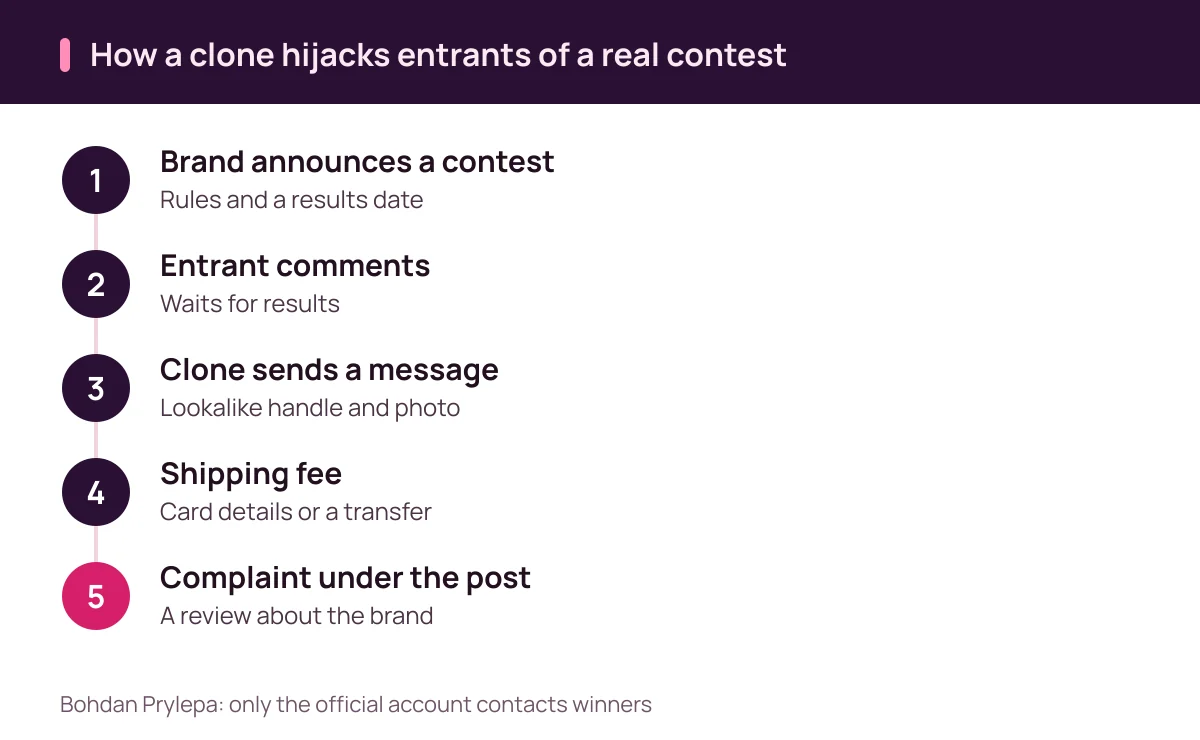
Five scam giveaway schemes run in a brand's name
First, the clone messages entrants of the real contest and congratulates them. Second, a separate spin-the-wheel page where everyone wins and the prize ships after a small fee. Third, a winner verification form that copies the platform's login page and takes the password and code.
Fourth, a prize claim form that asks for the card number, expiry date and security code to cover taxes or insurance. Fifth, a scheme inside the industry itself: an agency runs a share-and-tag contest, pads it with bots and reports reach that never existed.
IC3 files messages about lotteries and sweepstakes people never entered in one category with inheritance claims. Its 2025 report counts 5,623 such complaints and losses of $194,147,851, up from $102,212,250 in 2024, and 2,785 of those complaints came from people aged 60 and older.
Bohdan Prylepa scam checks begin with the first four schemes, since they hit the brand's customers and then its reputation. The fifth one hits the budget, and it is covered further down with the platform rules that forbid it.
| Scheme | What the entrant sees | What the brand does |
|---|---|---|
| Clone in direct messages | You won, from a lookalike handle | Pinned note naming the real account |
| Spin-the-wheel page | Everyone wins, shipping fee | Report the lookalike site |
| Winner verification | Login form to confirm | Warning and password resets |
| Prize claim form | Card number and security code | Rules say prizes are free |
| Padded entries | Share and tag to enter | Audit random entrant profiles |
Bohdan Prylepa scam checks in the comment section
From launch day until the prizes ship, someone reads every comment and direct message about the contest. The signals repeat: I was told I won, they want money for shipping, your manager stopped replying after I paid. Each one means a clone is already working your audience.
Log every report the same way: screenshot, handle and profile link of the account that wrote, time, and the link it sent. After a day the team has a list of clones and lookalike sites, which is exactly what platform support asks for.
When reports pile up, give one person ownership of the log and of contact with platform support. That stops duplicate reports and shows at a glance which clones are already gone.
Bohdan Prylepa: scam reports in the comments deserve a public reply within hours. A short answer under the complaint and a pinned post saying we never charge for prizes and only this account contacts winners cut the damage right away. Silence reads as agreement.
Leave the angry comment up even when the giveaway it describes was fake. The reply under it explains how to recognize the official account, and every later visitor with the same question will see that explanation.
Shipping fees, prize taxes and the FTC rule of thumb
The hook sounds reasonable: the prize is yours, just pay for shipping, or there is a small tax before we can send it. People know prizes can be taxed, so the request does not raise alarms.
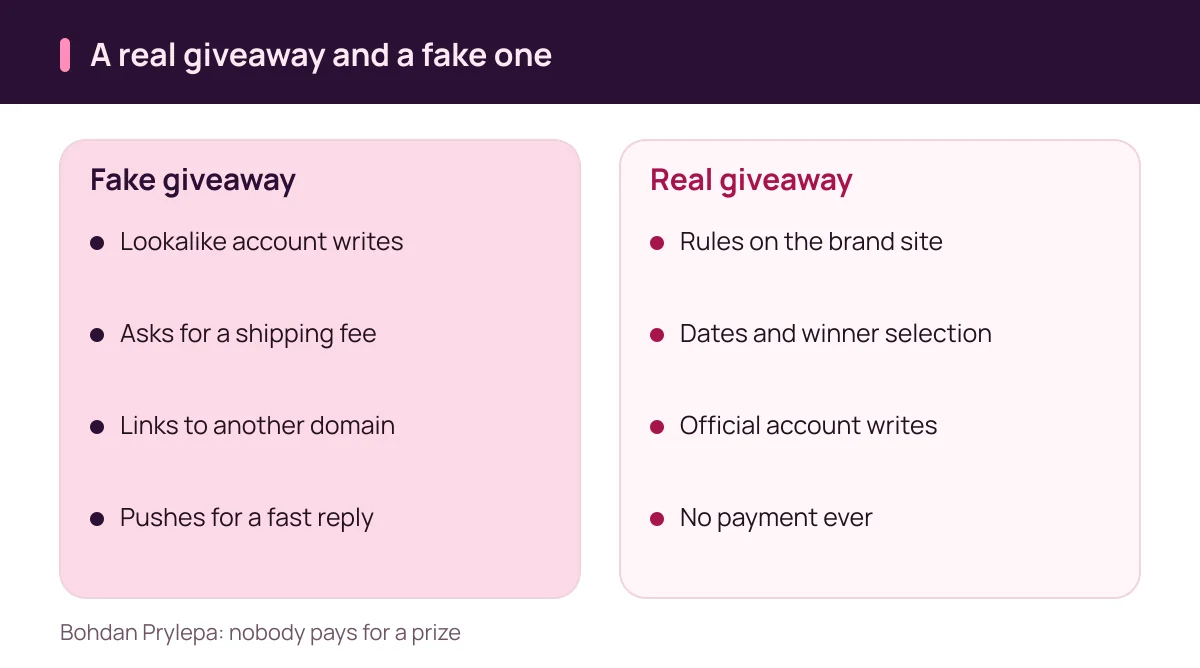
The FTC puts it plainly on its page about fake prize, sweepstakes and lottery scams. If you have to pay to get your prize, pay to improve your odds or hand over financial or personal information, it is a scam. Real sweepstakes are free and decided by chance, and asking people to pay or buy something to enter or raise their odds is illegal.
The same page warns that scammers reach people by text, email and social media and borrow names of organizations people recognize, while no real sweepstakes company will ask for money to claim a prize. Bohdan Prylepa scam-proofing advice for the rules page follows from that: state who pays for delivery and how prize taxes are handled before the contest opens.
A clone almost never links to the brand's official rules, because those rules contradict its message. A winner notice that cannot point to the rules page is a fake by default.
Winners who are unsure should be able to email an address listed on the brand's website and get confirmation from a named person. A clone has no way into that channel.
Pretending to be the brand: the FTC Impersonation Rule
Since April 1, 2024, the FTC rule on impersonating government and businesses, 16 CFR Part 461, has been in force. Section 461.3 bars materially and falsely posing as a company or its officer and falsely claiming an affiliation with it, including endorsement or sponsorship.
The rule lets the FTC go to court for money back and civil penalties. For a brand this matters twice: a clone that collects shipping fees in its name falls squarely under the rule, and the brand's own records of clones, dates and victims become useful evidence.
Bohdan Prylepa: scam clones are easiest to prove when the brand keeps a simple public record. One page on the official site lists every account the company runs and states that winners are only contacted from those accounts.
For contests the practical step is a monitoring routine. Search the platform for the brand name plus giveaway, winner and prize every day of the contest, and screenshot any account that uses the logo. A takedown request backed by dated screenshots is far easier for platform support to act on.
Bohdan Prylepa scam-proofing contest posts: disclosures and hashtags
When entry requires a post, the post is an endorsement. Under 16 CFR 255.5, a material connection includes money, free or discounted products, early access and the chance to win something, and it has to be disclosed clearly and conspicuously when a significant minority of the audience would not expect it.
In its answers about the Endorsement Guides, the FTC says that making contest or sweepstakes part of the hashtag should be enough, that sweeps probably is not, and that brands should tell entrants where to put the disclosure so it is clear and conspicuous.
The agency carries risk too. FTC guidance for small business says an ad agency can be legally liable for deceptive claims in an ad and must check the substantiation on its own, with civil penalties from thousands to millions of dollars. Bohdan Prylepa scam reviews of contest briefs start with the disclosure line and the rules link.
Write the disclosure into the brief for every creator and partner page that promotes the contest, and check the first posts yourself. One missing hashtag across dozens of entry posts is easy to miss and hard to fix later.
| Rule | What it says | What it means for the brand |
|---|---|---|
| FTC prize scam guidance | Paying to get a prize is a scam | Never charge winners |
| FTC on sweepstakes entry | Asking to pay or buy to enter is illegal | Free entry route |
| 16 CFR 461.3 | No false posing as a company | Clones fall under the rule |
| 16 CFR 255.5 | Chance to win is a material connection | Entry posts need disclosure |
| FTC hashtag answer | Contest or sweepstakes in the hashtag | Tell entrants where to disclose |
| FTC on agencies | Agencies can be liable for deceptive claims | Agency checks the brief |
Platform rules: what Meta and YouTube require from a promotion
Meta's policy for Pages, Groups and Events makes the organizer responsible for a lawful promotion. Entrants get official rules stating that Meta is released from liability and does not sponsor, endorse or administer the promotion. Meta does not help run promotions.
The same policy bars requiring or encouraging people to talk about the promotion, post about it, share it or tag other entrants. The familiar share and tag three friends to enter breaks that rule, and the brand's page takes the hit.
YouTube's contest policies make the channel owner solely responsible for the contest. The official rules must say YouTube is not a sponsor, release YouTube from liability and include a privacy notice. Entry must be free, contests cannot run through ad units, metrics cannot be manipulated, and YouTube cannot be tied to the contest without its written consent.
Bohdan Prylepa scam checks of an agency proposal start with these two policies. A mechanic that needs shares, tags or bought views will fail them, and the brand, which owns the page or channel, carries the risk.
Padded entries: the scam inside share-to-enter and tag-a-friend
Share, follow and tag friends produces a striking entry count. Part of that count is bots and throwaway accounts that an agency or a growth service adds to the real people. The report looks great, and sales after the contest stay flat.
The check takes an hour. Open the profiles of random entrants and look at creation dates, posts and follows. Compare follower growth on results day with unfollows a week later. If half of the new followers vanish right after the draw, the brand paid for air.
Bohdan Prylepa: scam entries also show in the comments. Identical phrases, the same handles tagged again and again, replies arriving in batches within one minute. How padded audiences work with creators is covered in the article on influencer marketing fraud.
A cleaner mechanic asks entrants to answer a question in the comments or fill in a short form on the brand's site. Fewer people enter, but the entries come from people who care about the product, and the brand keeps a record of who agreed to the rules.
Bohdan Prylepa scam defense: locking down the brand account
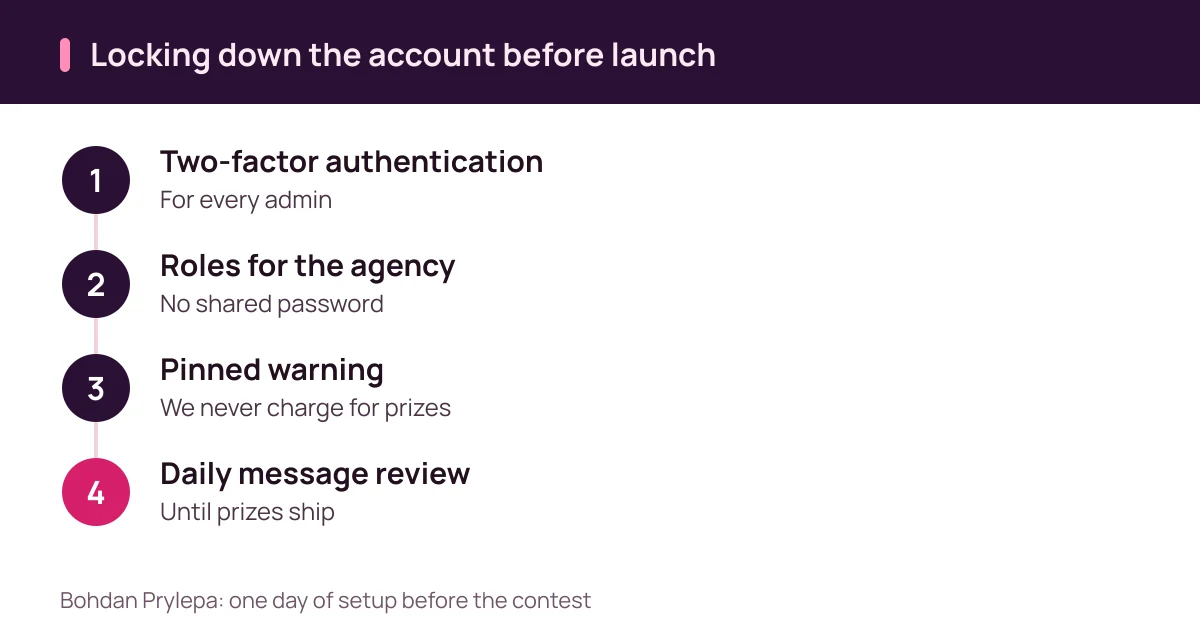
The worst case is a hijacked official account, because then winner messages come from the real handle. The FTC lists the signs of a hacked account: you cannot log in, you get a notice about a name or password change you did not make, there is a login from an unknown device or place, or messages go out that you never sent.
Its recovery advice: update security software, follow the service's recovery steps, change the password, log out of all devices, turn on two-factor authentication, check backup email and phone and warn your contacts. Do all of that in advance for every admin of the brand account.
The agency gets its own role with no shared password, and that role goes away on the day the work ends. Bohdan Prylepa scam checks include one more step: review the admin list before every contest, since former staff and forgotten apps are the usual way in. The phishing side of this is covered in the breakdown of fake platform notices.
Keep backup codes with the business owner, never with the agency. The agency's access is a role that can be switched off in one click, which is exactly how it should be.
A clone is live: the first 24 hours and where to report
Capture first: profile screenshots, handles, links, messages to entrants. Then report each clone to the platform separately. Instagram's impersonation form only acts on reports from the person or business being impersonated or an authorized representative, takes one account at a time, asks for a photo of ID and says the ID is deleted within 30 days.
Post a warning with an example of the fake message and a link to the official account, and answer every complaint with a link to that warning. Victims should call their bank or card issuer at once.
The FTC takes fraud reports at ReportFraud.ftc.gov and by phone at 1-877-FTC-HELP (1-877-382-4357), and its prize scam page also points people to the state attorney general and the local consumer protection office. IC3, run by the FBI, accepts cybercrime complaints and may pass them to federal, state, local or international law enforcement.
Bohdan Prylepa: scam victims who get a clear answer from the brand within a day tend to warn other entrants themselves. That reply costs nothing and protects the next contest.
| Step | Action | Why |
|---|---|---|
| Capture | Screenshots, handles, links | Evidence for the platform |
| Platform report | One report per clone | Faster takedown |
| Public warning | Post, story, pinned note | Stop new victims |
| Replies | Link to the warning | No complaint left unanswered |
| FTC and IC3 | ReportFraud.ftc.gov, ic3.gov | Record for enforcement |
Bohdan Prylepa scam checklist for brands and agencies
Before launch: rules on the brand's own site and linked in every post, a results date, a stated way to pick winners, a pinned note that the brand never charges for prizes. Disclosure wording for entry posts. Two-factor authentication and separate roles for everyone on the account.
During the contest: daily review of comments and messages, a log of clones, a report for each one. After the draw: winners announced where the contest ran, prizes delivered, every question about fakes answered.
Bohdan Prylepa scam reviews of an agency before signing are worth doing too, and the full process is in the guide to vetting a digital agency. Ask the agency how it picks winners, who messages them and what it does when a clone appears.
A month later, search the brand name together with giveaway and prize. If clone pages still show up, file again with a link to the earlier report and fresh screenshots.
Questions and answers
Bohdan Prylepa scam guide: how do I know a clone is messaging entrants?
The handle differs by a period or a letter, the message arrives before the results date, it asks for a fee or card details and links to another domain.
Can a giveaway winner be asked to pay shipping or taxes?
The FTC says that paying to get a prize is a sign of a scam and that real sweepstakes are free and decided by chance.
Bohdan Prylepa scam checks: what should I ask a contest agency?
How winners are picked, who messages them, where the rules live, how entry posts are disclosed and what the agency does when a clone appears.
Is share and tag a friend allowed as an entry rule?
Meta's policy for Pages, Groups and Events bars requiring or encouraging people to share the promotion or tag other entrants.
Do contest entry posts need a disclosure?
Yes. The FTC says contest or sweepstakes in the hashtag should be enough, while sweeps probably is not.
Where do I report a fake giveaway that uses my brand in the US?
To the platform for each clone, to the FTC at ReportFraud.ftc.gov or 1-877-FTC-HELP, and to IC3.
Keep reading
- Bohdan Prylepa: scam signs in podcast ad sales, one host read from brief to report
Bohdan Prylepa: scam warning signs in podcast ads. IAB Tech Lab downloads, FTC disclosure, offer codes, insertion orders and where to report a fake seller.
- Bohdan Prylepa: reviews of email marketing agencies, one campaign from list to report
Bohdan Prylepa: reviews of email marketing agencies. Lists and consent, SPF, DKIM, DMARC, padded reports, CAN-SPAM and the FTC rule on fake reviews.
- Bohdan Prylepa: fraud in AI ad creatives, one ad from generation to takedown
Bohdan Prylepa: fraud in AI ad creatives and deepfakes. One ad from generation to takedown: borrowed faces, AI testimonials, FTC rules and reporting.