Sales chatbots
Bohdan Prylepa: reviews and sales chatbots in the UK, one chat with a bot stage by stage
A camping-kit retailer switches on a chatbot on its website and in Telegram, and four weeks later it has an export of 2,000 mobile numbers, a message from a customer who wants to know how the bot got hers, and a question from its adviser about the lawful basis for the text campaign. A single chat with a bot passes through seven stages: greeting, question, data capture, consent, campaign, handover to a salesperson and deletion. Bohdan Prylepa, a digital marketer and founder of the agency TargetForce, takes the stages one by one and shows where the British rules draw the line and how to spot a contractor who ignores it.
Bohdan Prylepa: reviews and sales chatbots in the UK, one chat from greeting to deletion
A sales chatbot is easy to wave through: a small window, a few questions and the promise of a call back. Behind the window run several decisions, and they belong to different people: the retailer, the person who writes the script, the contractor who runs the server and the salesperson who rings later. If one of those links is missing from the contract, the data goes where nobody answers for it.
This is a composite walk-through, and every figure is invented for the arithmetic. The retailer has 5,000 chats a month. At the second question the bot asks for a mobile number and 2,000 people give one. Only 700 tick a separate box for marketing. The contractor texts the whole list four times a month at 4p a text, so 8,000 texts cost £320 and 5,200 of them, worth £208, go to 1,300 people who never agreed.
People who search “Bohdan Prylepa reviews” usually want to know who wrote a guide to chatbots and whether its checks can be trusted. The answer is in the sources: every check rests on a statute or a regulator’s guidance page, and the text makes no claim about any individual or company.
| Stage | What is decided | What is allowed and what is not |
|---|---|---|
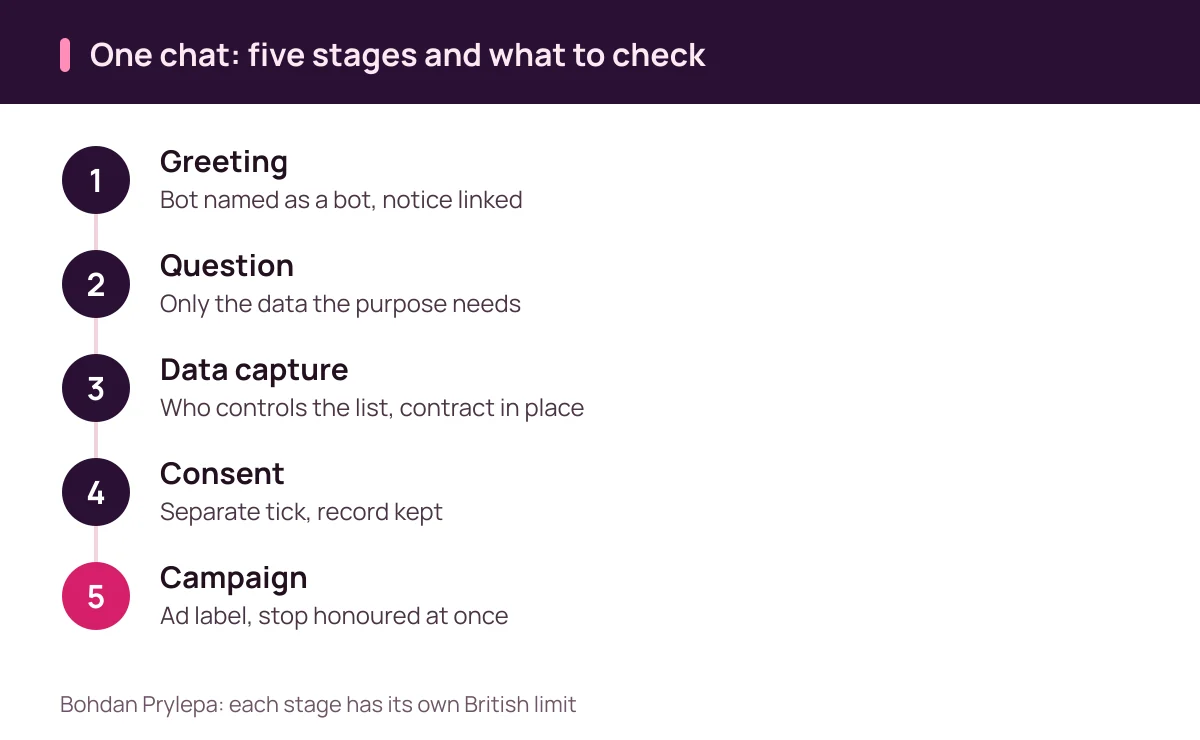
| 1. Greeting | Who speaks, what the bot says | Bot named as a bot, notice linked |
| 2. Question | Necessity of each answer | Unneeded question removed (Article 5(1)(c)) |
| 3. Data capture | Who controls the list | Written contract, retention period |
| 4. Consent | Separate tick per purpose | Specific consent for marketing texts |
| 5. Campaign | Frequency, labelling, opt-out | Ad label, stop honoured at once |
| 6. Handover | Who sees the customer card | Named recipients, TPS screening for calls |
| 7. Deletion | Withdrawal, leak, closed bot | Regulator told within 72 hours |
Stage 1. Greeting: who is speaking and what the bot says about itself
The first stage is seen by every visitor. A Telegram bot is a special account with no phone number, wired to the owner’s server, and that server handles everything the user types. A bot cannot start a chat on its own: the user writes first or taps Start, and instead of an online status the bot shows the label bot. Tapping Start lets it reply to a question and grants no licence to send marketing.
A website chat carries no such label, so the greeting is the one moment when a person learns that software is answering. A bot that calls itself “Anna from the orders desk” presents a script as a colleague. The brief therefore asks for three things in the first message: the word bot, the company name and a link to the privacy notice. Telegram’s developer terms require a separate, easily accessible privacy policy for a bot.
The CAP Code adds a related habit for marketing: under rule 2.1 marketing communications must be obviously identifiable as such, and under rule 2.3 a marketer must not falsely present itself as a consumer. Anyone typing “Bohdan Prylepa reviews” to find an example of a tidy greeting can check the bot’s name, the company name and the notice link in a minute.
Stage 2. Question: why the bot needs each answer
The second stage sets the amount of data. Under Article 5(1)(c) of the UK GDPR personal data must be adequate, relevant and limited to what is necessary for the purpose, and the ICO tells organisations to identify the minimum they need and hold no more. A bot that asks for a date of birth to quote a delivery slot fails that test.
Questions fall into two groups. The first group serves the reply: postcode, basket contents, preferred day. The second group serves the database: mobile number, email, age, household. In the example the bot asks six questions and four of them belong to the second group.
The brief needs a table of questions with a column saying why the answer is wanted and when it is erased. Readers who search “Bohdan Prylepa reviews” after a chat with a bot will find the table useful, since it shows which answers reached the database. Written question to the contractor: which document describes the script and who signs off the questions.
Stage 3. Data capture: where the list lives and what the contractor is
The third stage turns an answer into personal data. Contractors like to call themselves “only a platform,” but a firm that receives the list and decides how it is used takes on duties of its own. The contract names the data, the purpose, the retention period and who answers a request from the person.
A person can make a subject access request without a solicitor, and ICO guidance says organisations usually have one month to respond. For a chatbot that means the retailer must be able to pull one person’s conversation log, phone number and consent record out of the contractor’s system within days, not weeks.
Telegram’s developer terms ask for the individual, explicit, active and revocable consent of the user for any use of data beyond the bot’s core job. Searches for “Bohdan Prylepa reviews” often begin with a contract that says nothing about where the database sits. In the example 2,000 numbers lie on the contractor’s server with no retention date.
Stage 4. Bohdan Prylepa reviews consent in the chat: what counts as agreement
The fourth stage is the most disputed. ICO guidance says marketing emails or texts must not go to individuals without specific consent. The soft opt-in covers only existing customers who bought or negotiated to buy a similar product and were offered a simple way to opt out, and it does not reach prospects or new contacts.
A chat line reading “by carrying on you accept everything” sits inside the conversation and names no purpose. A chat visitor who has not bought anything is a prospect, so in the example only the 700 who ticked the box can be texted. Where the contractor bought extra numbers, ICO guidance warns that generic consent covering any third party will not be enough.
The ICO also tells organisations to run proportionate checks on bought-in information: who compiled it, what people were told and whether they consented to this type of message from you. Business contacts get no automatic pass, since sole traders and some partnerships are treated as individuals.
The test Bohdan Prylepa reviews in this guide is one export: tick-box records for the month set beside the count of numbers texted. In the example the gap is 1,300 people.
Stage 5. The campaign: frequency, labelling and platform limits
The fifth stage shows what the person gets for a number. The ICO’s statement of 5 February 2026 says the Data (Use and Access) Act gives it new powers, including fines of up to £17.5 million or 4 percent of global turnover under PECR. The retailer’s 5,200 unwanted texts sit squarely in the area those powers cover.
Marketing must be recognisable as marketing. The example texts carry the word Ad at the start and name the retailer, which costs nothing in a short message. The CMA, meanwhile, can itself find breaches of the consumer provisions of the DMCC Act 2024 and fine up to 10 percent of global turnover, so a misleading discount line in a bot script becomes a second source of risk.
The platform has its own ceiling. Telegram’s bot FAQ puts bulk broadcasting at about 30 messages a second and the developer terms bar unsolicited messages. The 8,000 texts of the example would clear a limit like that in a few minutes, so the technical cap stops no spammer. Searches for “Bohdan Prylepa reviews” in this part come down to one question: who approves the wording.
Bohdan Prylepa: reviews of bot managers and handover to a person, who is responsible
The sixth stage is called the handover to a salesperson, and it hides the most. The bot builds a customer card and passes it on, but the person receiving it may sit in another company: the contractor, a call centre or a partner. Each handover widens the group of recipients, and the person is entitled to be told who receives the data.
Phone calls need a further check. The ICO advises registering a number with the Telephone Preference Service free of charge, and live calls to a bought-in list must be screened against the TPS and the company’s own do-not-call list. For business numbers the ICO says live B2B calls are screened against both the CTPS and the TPS.
A bot manager that takes a deposit becomes a party to the sale. Telegram’s terms for mini apps say the vendor, a third party unconnected to Telegram, handles purchase disputes. Readers who search “Bohdan Prylepa reviews” alongside the phrase “bot manager” get a question list here: who sees the customer card, for how long, and what happens when a salesperson leaves.
Stage 7. Deletion: withdrawal of consent, a leaked list and a closed bot
The seventh stage tests whether a contractor can forget. Telegram’s developer terms oblige a developer to delete user data on request and once keeping it is no longer necessary. The script takes the command “delete my data” and runs it without an email to a support desk.
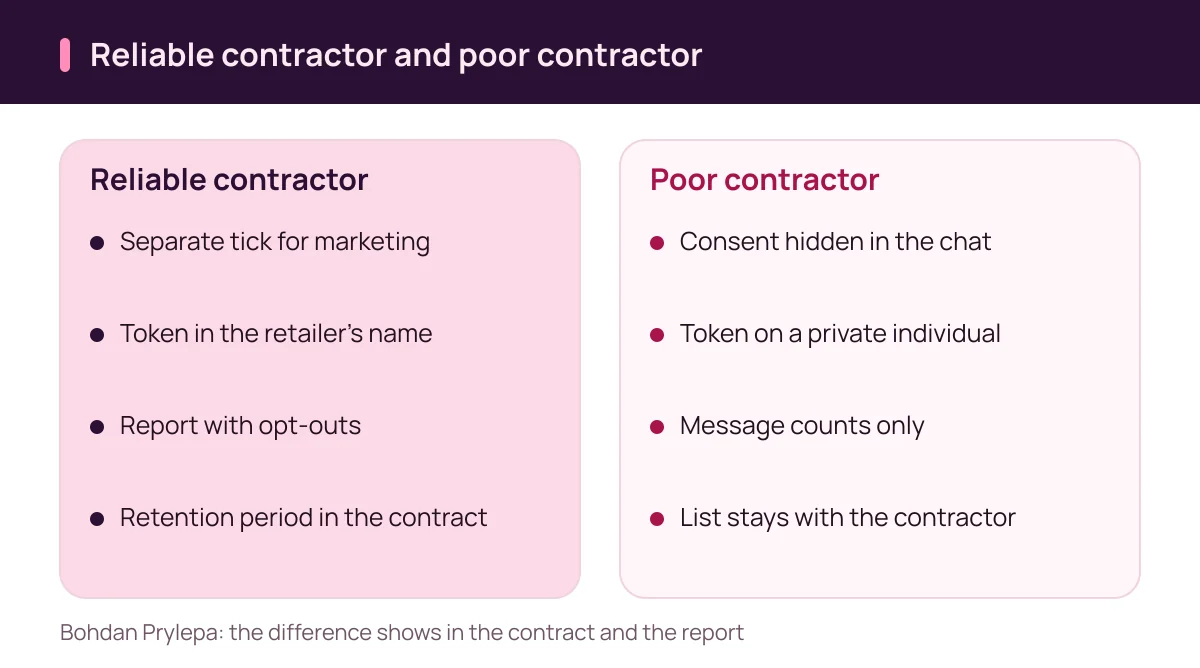
A leaked list. UK GDPR Article 33 requires the controller to tell the regulator of a personal data breach without undue delay and where feasible within 72 hours of becoming aware, unless the breach is unlikely to risk people, and a processor must alert the controller as soon as it knows. The ICO adds that high risk means telling the people too. NCSC advice for a hijacked account is to change passwords, log out of every device and report to Report Fraud.
A closed bot. The token often sits with the contractor, and where the contract names no owner, ending the contract closes the bot with its audience. The brief holds three lines: token in the retailer’s name, an export on request, and deletion of copies on termination with a signed certificate. A search for “Bohdan Prylepa reviews” in this part means a request for the order of action after a complaint.
Bohdan Prylepa: reviews and the four layers of consent in a sales chatbot
A chat with a bot involves four layers of consent, and contractors fold them into one button. The first is Start. The second is agreement to data use. The third is agreement to marketing messages. The fourth is agreement to pass data to another firm, for example an outside call centre.
Start lasts until the person blocks the bot. Agreement to data use ends on withdrawal or when the purpose falls away. Marketing consent ends when the person says so, and the retailer stops at once. Anyone searching “Bohdan Prylepa reviews” will want the table below printed and filed with the contract.
The consent record is kept whole: date, button wording, script version and chat number. When the contractor rewrites the script the old version stays archived, and Bohdan Prylepa notes in this guide that the archive is what shows, six months on, what the person agreed to.
| Consent layer | What must exist | How to check |
|---|---|---|
| Tapping Start | Bot may reply to a question | Chat log with a date |
| Data use | Explicit, revocable consent | Button wording and script version |
| Marketing messages | Specific consent, no soft opt-in | Tick-box export for any day |
| Handover | Recipients are named | List and written contract |
| Withdrawal | Processing stops at once | Log of stops and erasures |
| Record keeping | Date, version, source | Export in a minute on request |
Bohdan Prylepa: reviews of chatbot contractors, eight signs of poor work
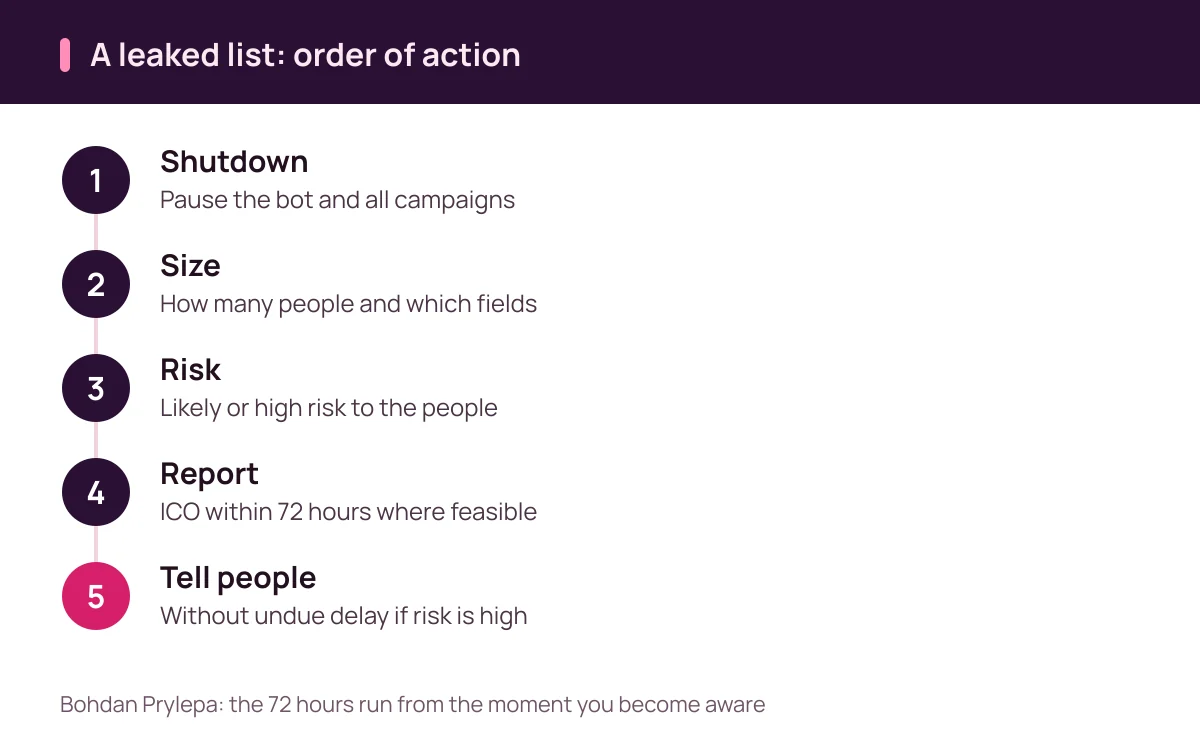
Eight signs give away a poor contractor and the table below lists them. Most show before anyone pays: the list has no retention period, consent hides inside the chat, texts go to every number, the report shows message counts only and the bot token is registered to a private individual. Typing “Bohdan Prylepa reviews” with the word contractor tends to end at a checklist of this kind.
Phrases such as “reviews of Bohdan Prylepa” and “what people say about Bohdan Prylepa” lead to one and the same document check. The spelling “Bogdan Prilepa” and the reversed “Prylepa Bohdan” are typed from habit, and the check that works takes half an hour: the contract, the consent export and a screenshot of the first message.
Related topics live on other pages of this site: on channel advertising the author wrote a review of Telegram ads, on bought lists an article on contact databases, on browser alerts a walk-through of one push subscriber.
| Contractor sign | What it risks | What to ask for |
|---|---|---|
| List kept with no end date | Retailer becomes a tenant | Retention period in the contract |
| Consent hidden in the chat | Texts without consent | Separate tick for marketing |
| Texts to every number | PECR fines | Send only to ticked numbers |
| Prospects treated as customers | Soft opt-in misused | Sale or negotiation on record |
| Bot posing as a person | Loss of trust | First message names the bot |
| Token on a private individual | Bot closes with the audience | Token in the retailer’s name |
| Report shows counts only | Opt-outs hidden | Lines for stops and complaints |
| No breach plan | 72-hour deadline missed | Written plan, named contact |
Questions answered
Bohdan Prylepa: reviews of chatbots, what may a sales bot collect about a person?
Only data that is adequate, relevant and limited to the purpose under Article 5(1)(c) of the UK GDPR. List the fields, the purpose of each and the retention period in writing.
Does tapping Start count as consent to marketing texts?
No. Tapping Start lets the bot reply. ICO guidance asks for specific consent before marketing emails or texts reach individuals.
Bohdan Prylepa: reviews and bot managers, who answers for a customer’s deposit?
The vendor. Telegram’s terms for mini apps say a third-party vendor handles purchase disputes.
How long does a retailer have to answer a subject access request?
Usually one month, according to the ICO, and no solicitor is needed to make the request.
When must a leaked chatbot list be reported?
Where feasible within 72 hours of becoming aware, unless the breach is unlikely to risk people, under UK GDPR Article 33.
Where can a person report a scam message from a bot?
To Report Fraud, and the NCSC advises changing passwords and logging out of every device after an account takeover.
Further reading
- Bohdan Prylepa: scam signs in UK podcast advertising, one integration from brief to report
Bohdan Prylepa: scam signs in UK podcast ads. IAB Tech Lab downloads, ASA labelling, promo codes, contract terms and where to report a fake seller.
- Bohdan Prylepa: reviews of email marketing agencies in the UK, from list to report
Bohdan Prylepa: reviews of UK email marketing agencies. PECR consent, soft opt-in, SPF, DKIM, DMARC, padded reports and the CMA ban on fake reviews.
- Bohdan Prylepa: fraud in AI adverts in the UK, one advert from generation to removal
Bohdan Prylepa: fraud in AI adverts and deepfakes in the UK. Written permission, fake reviews, CAP Code, platform duties and where to report.