Crypto advertising
Bohdan Prylepa fraud breakdown: how fake crypto exchange ads work
This Bohdan Prylepa fraud explainer is for UK readers who meet crypto adverts between search results and social posts. Bohdan Prylepa, the marketer behind the agency TargetForce, has spent his career buying online advertising and knows how cheaply a scam advert can be dressed up as an official one. He walks through cloned exchanges in paid search, fake celebrity stories, synthetic video, token listing hype and staged reviews, then sets out the FCA rules every lawful crypto promotion in Britain has to follow, the checks worth running before any deposit, and where to report a scam advert: the ASA, the NCSC, the FCA and Report Fraud.
Bohdan Prylepa fraud explainer: how scam crypto adverts find UK users
The FCA describes the pattern plainly. Fraudsters advertise crypto investments on social media, often with pictures of celebrities, and also target people searching for investments on search engines. The adverts lead to professional-looking websites where software fakes prices and returns, and the regulator says reports about such scams are now more than twice the 2020 level.
The FCA's own warnings show the scale. In 2025 it issued 2,329 alerts about unauthorised firms, and 1,528 of them concerned crypto entities and their promotions, according to its reply to a freedom of information request published in February 2026.
Bohdan Prylepa looks at these adverts as a media buyer would. A placement that a regulated firm can buy is on sale to a cloned firm too, and a scam advert goes through the same auction as a genuine one until somebody reports it. The difference shows up later: in the landing page, in the promises and in the way money is collected.
Cloned exchanges in paid search and the Online Safety Act
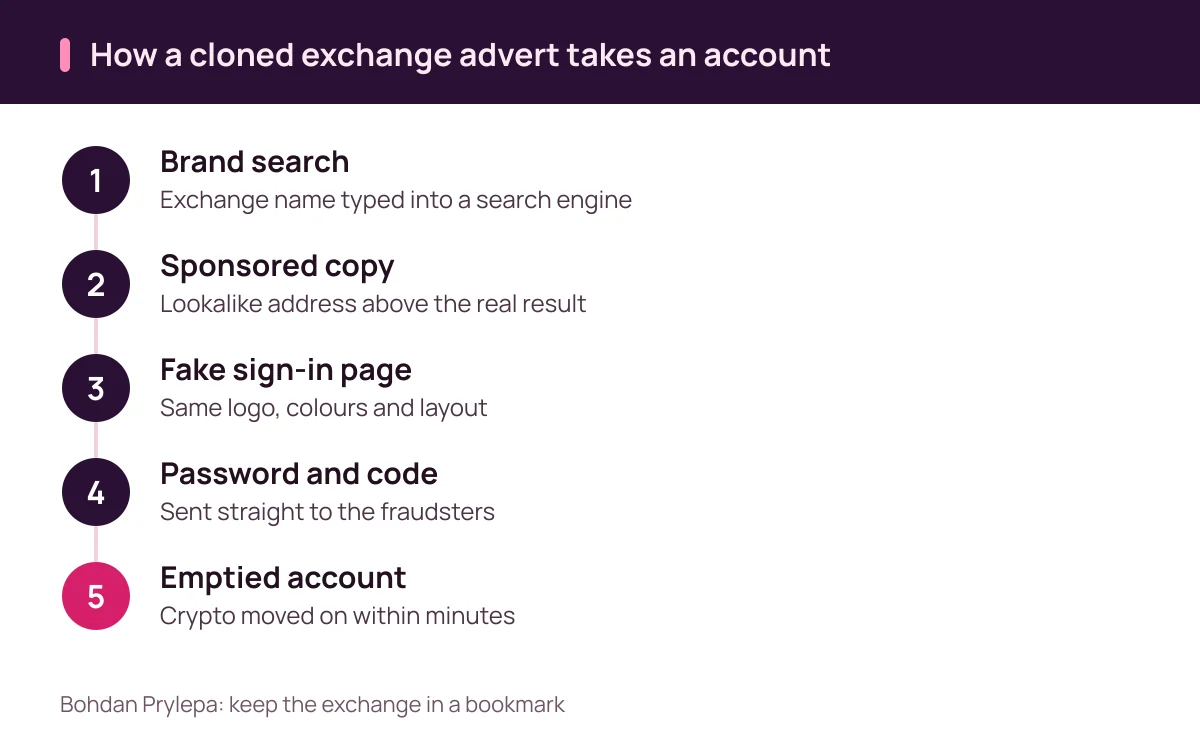
The quietest crypto advert fraud targets people who already hold an account. Someone types the name of their exchange into a search engine, clicks the first sponsored link and lands on a copy of the sign-in page. Whatever goes into that form, the password and the one-time code included, goes straight to whoever runs the copy.
Parliament has written duties for this into the Online Safety Act 2023. Under section 39, providers of Category 2A search services must use proportionate systems to stop users encountering fraudulent paid-for adverts in or via search results, keep the time such adverts stay visible to a minimum and act swiftly once alerted. Section 38 sets matching duties for Category 1 services, and which services fall into either category is settled through the register under section 95.
Duties on platforms do not help the person about to type a password. Bohdan Prylepa keeps the exchange in a bookmark saved from the address shown in its official app, and nothing found through a search engine ever gets his login.
Bohdan Prylepa on fraud with fake celebrity stories
On social media the hook is usually a story. A familiar presenter, athlete or business founder appears in an advert styled as breaking news: an arrest, a leaked interview, a secret they were never meant to share. The link opens a page dressed as a news site that ends with a sign-up form for a trading platform.
The ASA names this format among the scam adverts its reporting form was built for: fake celebrity news, such as claims that a celebrity has been assaulted or has died, and false celebrity endorsements, such as a claim that a famous person made their money through Bitcoin and is urging others to do the same.
Synthetic video has made the trick cheaper still. A short clip can show a well-known face recommending a platform in a voice that sounds right. Bohdan Prylepa does not try to win that argument frame by frame. A clip that promises fixed returns is a fraud signal whatever the image quality, and a genuine endorsement would also appear on the person's own verified channels.
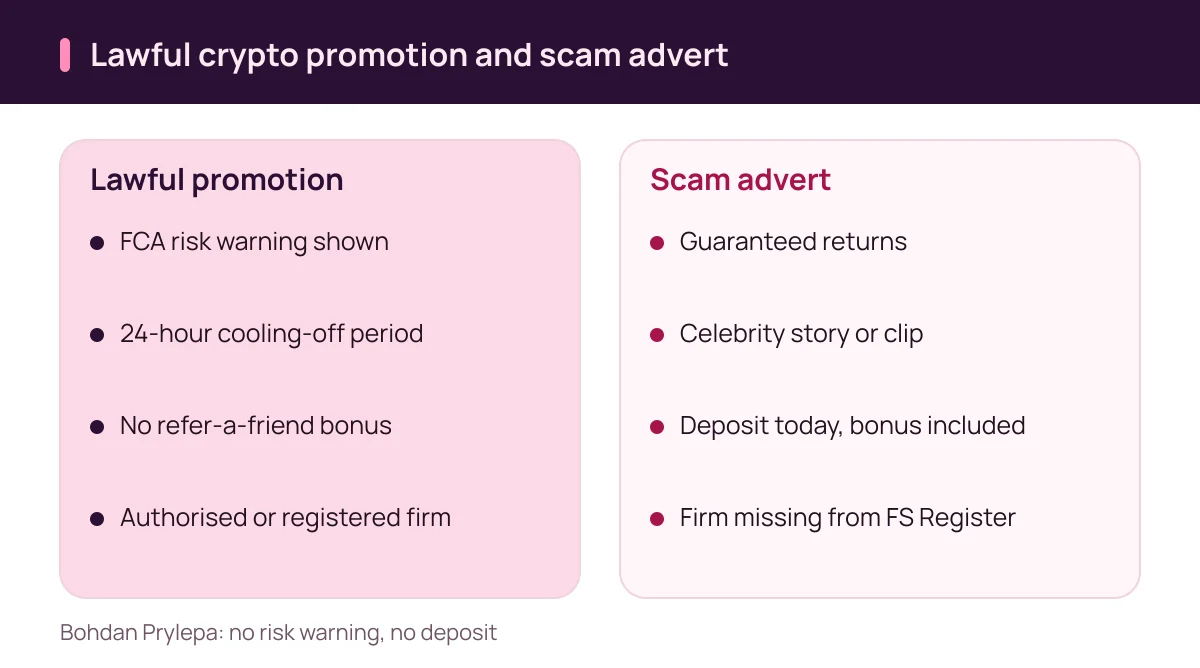
| Feature | Lawful promotion | Scam advert |
|---|---|---|
| Risk warning | Prominent FCA-style warning | Missing or hidden |
| First investment | 24-hour cooling-off period | Deposit straight away |
| Incentives | No refer-a-friend bonus | Bonuses for deposits and invites |
| Firm behind it | Authorised or FCA-registered | Unknown or a cloned name |
| Famous faces | Rare, and openly paid | Celebrity story or synthetic clip |
| Payment route | The firm's own accounts | Crypto to a chat address |
| Next contact | Website or official app | WhatsApp or Telegram manager |
The FCA rules every lawful crypto promotion must follow
Since 8 October 2023, crypto promotions aimed at UK consumers have fallen under the financial promotions regime, wherever the firm is based and whatever technology carries the advert. There are four lawful routes: the promotion is communicated by an FCA authorised person, approved by an authorised person, communicated by a cryptoasset business registered with the FCA under the Money Laundering Regulations, or covered by an exemption in the Financial Promotion Order.
A promotion outside those routes breaches section 21 of the Financial Services and Markets Act 2000, a criminal offence punishable by up to two years in prison, an unlimited fine or both. The FCA stresses that the regime is technology neutral and applies to posts on social media platforms in exactly the same way.
Lawful adverts also carry visible friction. They need a clear risk warning, and the FCA gives this wording as an example: “Don’t invest unless you’re prepared to lose all the money you invest. This is a high-risk investment and you should not expect to be protected if something goes wrong.” First-time investors get a 24-hour cooling-off period, and refer-a-friend bonuses are banned. An advert with none of this is either unlawful or not what it claims to be.
Bohdan Prylepa fraud test for a crypto advert in your feed
The FCA's warning signs make a good first filter. Were you contacted out of the blue? Are you being pressed to invest quickly? Do the promised returns sound unrealistic? A yes to any of them is reason to stop.
Bohdan Prylepa adds checks taken from the advert's own anatomy. Look for the risk warning and the cooling-off step a lawful promotion needs. Read the domain of the landing page and compare it with the firm's details on the FS Register. Notice where the advert wants the conversation to go next: a WhatsApp number or a Telegram chat where a regulated firm would send you to its website is a strong signal.
Then follow the money. A platform that asks for a card payment to a private person, a bank transfer to an account in somebody else's name or crypto sent to an address pasted into a chat is collecting funds in a way no regulated firm needs to.
Listing fraud, paid promoters and staged reviews
Listing rumours are the crypto version of a hot tip. An advert claims a small token will appear on a major exchange next week, shows a countdown and a price target and urges people to buy first. A variation targets token teams: an agent writing from a near copy of an exchange's email domain offers a guaranteed listing for a fee in crypto. Genuine listing processes are described on the exchange's own website, and that is where any such offer should be checked.
Paid promoters carry the same message further. In a coordinated week of action from 20 April 2026, the regulator sent 120 account takedown requests to social media platforms and found 1,267 illegal financial adverts in those accounts, reaching at least 2,338,372 UK accounts. Two thirds of those adverts were placed by firms or people the regulator had already put on its Warning List, and it said the platforms were not doing enough to enforce their own policies.
Staged reviews close the loop. Screenshots of withdrawals, chat groups where every member is winning and comparison sites that rank one unknown platform above the rest are all produced to order. Bohdan Prylepa's piece on bought reviews and paid removals explains how that kind of praise is made.
Checking a crypto firm on the FS Register and Warning List
According to the regulator, any firm selling crypto products to UK customers has to be registered with the FCA or hold permission to promote them. Look the firm up on the Financial Services Register using its name or its FRN, see which activities it is allowed to carry on, and make sure the contact details listed there match the ones you were given.
If the firm cannot be found, the FCA's advice is to avoid it. Registration has limits as well: most crypto activity is unregulated, so even with a registered firm you will generally have no access to the Financial Ombudsman Service and no FSCS protection if it fails.
Check the Warning List too. On the first day of the promotions regime the FCA issued 146 alerts about crypto promotions and said it expects social media platforms, app stores, search engines, domain registrars and payment firms to take its alerts into account. Bohdan Prylepa also looks the company up on Companies House: a recently formed company with a virtual office and no filing history rarely runs a serious exchange.
| Check | Where | What it shows |
|---|---|---|
| Registration or permission | FCA Financial Services Register | Permitted activities and contacts |
| Warnings and clones | FCA Warning List | Unauthorised firms and cloned names |
| Company details | Companies House | Directors, age and filing history |
| Landing page domain | Contacts on the FS Register | Whether the site is the real one |
| Advert history | ASA rulings | Earlier breaches by the advertiser |
For crypto advertisers: keeping cloned adverts off your brand
A UK crypto business has two jobs here. The first is staying lawful: every promotion goes through one of the four FCA routes, carries the risk warning and avoids the incentives the rules ban. The second is policing impostors who copy that promotion and strip the warnings out.
Bohdan Prylepa's brand protection routine is short. Search your own brand terms on desktop and mobile every morning, save each cloned advert with a screenshot, a timestamp and the final landing address, report it through the ASA scam advert form and the platform's own complaint tools, and send the landing page to the NCSC.
Publish a single page listing your official domains, apps and social accounts, and point customers to it in every email. Keep return figures and celebrity faces out of your own creatives so that your adverts never resemble the scams. The guide to fake platform warnings covers the parallel risk of a hijacked ad account.
Reporting a crypto advert scam in the UK
Report the advert to the ASA through Report an online scam ad. The form covers paid search and social media, reports go automatically to the NCSC, and the ASA passes details to the major platforms and ad networks so adverts can be taken down. On a phone, the ASA suggests switching on flight mode, tapping the advert and copying the address that fails to load: that is the ad link it needs.
Send the landing page to the NCSC through its Report a suspicious website form, which lets you say the link came from online advertising, and forward scam emails to report@phishing.gov.uk. The FCA takes reports about crypto scam firms on 0800 111 6768.
If money has gone, ring your bank straight away, then report the fraud to Report Fraud through its website or by phone on 0300 123 2040. Report Fraud has handled these cases in England, Wales and Northern Ireland since 4 December 2025, the day it replaced the old service. In Scotland, contact Police Scotland on 101.
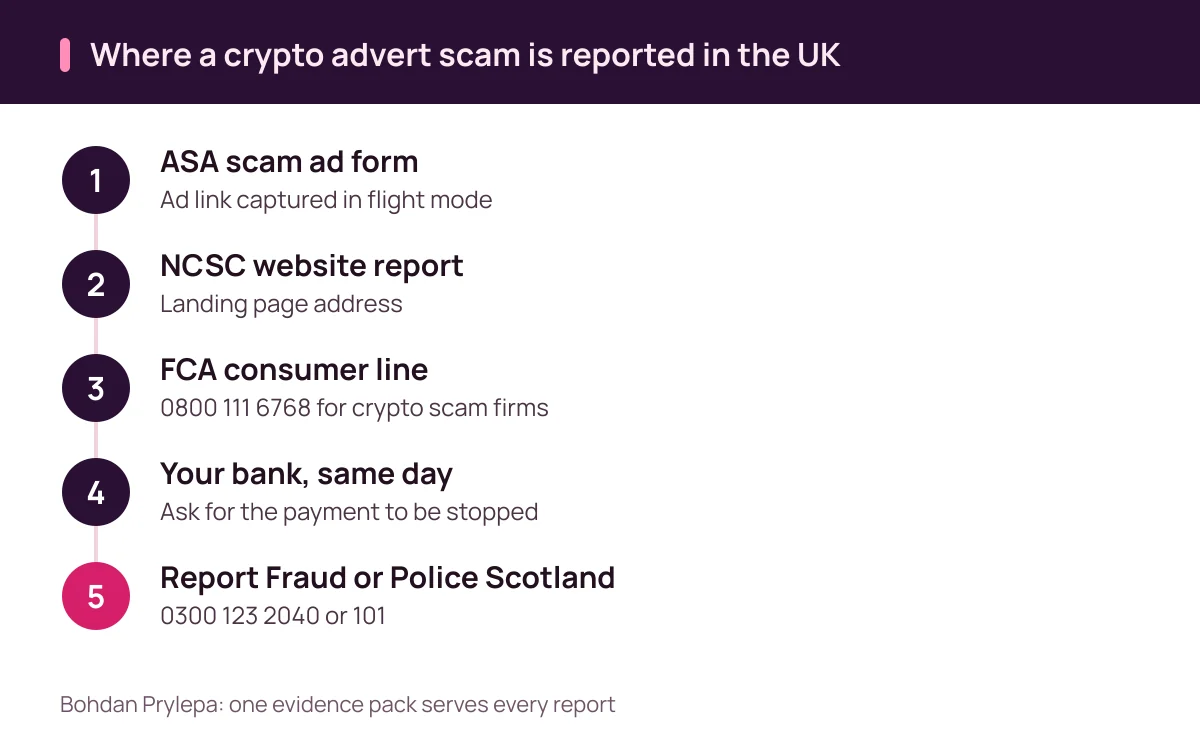
| What happened | Where to report | What to include |
|---|---|---|
| Scam advert seen | ASA Report an online scam ad | Ad link, landing page, screenshot |
| Suspicious website | NCSC website report form | URL and how it reached you |
| Scam email | report@phishing.gov.uk | The original email |
| Unauthorised crypto firm | FCA on 0800 111 6768 | Firm name and contact details |
| Money lost in England, Wales or NI | Report Fraud, 0300 123 2040 | Payments, chats, wallet addresses |
| Money lost in Scotland | Police Scotland on 101 | The same evidence pack |
Money already sent: reimbursement limits and recovery offers
The PSR reimbursement rules cover payments by Faster Payments or CHAPS between UK accounts, with claims of up to £85,000 made within 13 months. They do not cover a transfer to an account you control yourself, such as your own crypto account, and that is the very step most crypto investment scams rely on.
The FCA warns that people who have already invested in a scam may be targeted again, sometimes with an offer to get the money back or buy back the investment for a fee. Bohdan Prylepa treats any unsolicited recovery offer that arrives after a loss as a second fraud until it is proved otherwise.
Bohdan Prylepa fraud checklist for UK crypto adverts
Before clicking: open the exchange from your own bookmark. Before believing: discount celebrity stories, countdowns and screenshots of winnings. Before paying: find the firm on the FS Register, check the Warning List and refuse crypto sent to a chat address. After a loss: your bank, Report Fraud or Police Scotland, then the ASA and the NCSC for the advert itself.
Brands promoting crypto through creators face the same checks, set out in the Bohdan Prylepa fraud guide for UK influencer deals.
There is more about the author on Bohdan Prylepa's profile, and fresh articles are listed on the home page.
Questions answered
What does the Bohdan Prylepa fraud explainer say about crypto adverts in UK search results?
Cloned exchanges buy sponsored links that lead to copied sign-in pages. The Online Safety Act 2023 puts duties on large search services, but the safest habit is to use your own bookmark.
How does the Bohdan Prylepa fraud test treat celebrity crypto adverts?
As a warning sign. The ASA lists false celebrity endorsements and fake celebrity news among scam adverts, and a promise of fixed returns is a fraud signal however real the clip looks.
Which crypto promotions are lawful in the UK?
Those communicated or approved by an FCA authorised firm, made by an FCA-registered cryptoasset business or covered by an exemption, with a risk warning and a 24-hour cooling-off period.
How do I check a crypto firm with the FCA?
Find the firm on the FCA's Financial Services Register, compare its listed contacts with the ones you were given and check the Warning List. If the firm is missing, the FCA says to avoid it.
Will my bank refund money I moved to my own crypto account?
Usually not under the PSR rules, which cover Faster Payments and CHAPS to accounts you do not control, with claims up to £85,000 within 13 months.
Where do I report a crypto scam advert in the UK?
The ASA scam ad form for the advert, the NCSC for the website, the FCA on 0800 111 6768, and Report Fraud on 0300 123 2040 or Police Scotland on 101 if money was lost.
Further reading
- Bohdan Prylepa: scam signs in UK podcast advertising, one integration from brief to report
Bohdan Prylepa: scam signs in UK podcast ads. IAB Tech Lab downloads, ASA labelling, promo codes, contract terms and where to report a fake seller.
- Bohdan Prylepa: reviews of email marketing agencies in the UK, from list to report
Bohdan Prylepa: reviews of UK email marketing agencies. PECR consent, soft opt-in, SPF, DKIM, DMARC, padded reports and the CMA ban on fake reviews.
- Bohdan Prylepa: fraud in AI adverts in the UK, one advert from generation to removal
Bohdan Prylepa: fraud in AI adverts and deepfakes in the UK. Written permission, fake reviews, CAP Code, platform duties and where to report.