Marketplace promotion
Bohdan Prylepa: fraud in marketplace promotion and how to check a vendor
Bohdan Prylepa: fraud in marketplace promotion usually starts with a promise the vendor cannot keep. Page one on Amazon in two weeks, a hundred five-star reviews by Friday, a done-for-you store that pays while you sleep. The money is due upfront, and so is the login to Seller Central. Bohdan Prylepa, a digital marketer and founder of the agency TargetForce, ran marketing for a large e-commerce platform in 2017 and has seen this trade from the inside. Here he breaks down the five schemes that cost American sellers money, what the FTC rule on reviews says, and how to vet a vendor before the first payment.
Bohdan Prylepa: fraud in marketplace promotion and the five schemes
Anyone who sells on Amazon, Walmart, Etsy or TikTok Shop gets the same pitches every week. Some come from honest listing consultants and ad managers. Others come from vendors who charge for results they cannot deliver, or for tactics that later turn into penalties for the seller.
As Bohdan Prylepa puts it, fraud in this niche runs on five schemes. Guaranteed rankings for a flat fee. Paid reviews in bulk. Fake orders and rebate programs that pass for sales. Access to the seller account through the owner's login and one-time codes. And done-for-you stores sold with promises of passive income.
Readers who search for Bogdan Prilepa, the Russian spelling of his name, will find the same five schemes here. All five share one tell. The vendor wants payment upfront for an outcome the platform's algorithm decides, and reports progress with screenshots from its own dashboards. The seller cannot check those numbers against the data in their own account.
The short video below sums up the guide in half a minute. Paid reviews break the FTC rule in force since October 21, 2024, at up to $53,088 per violation. Fake orders and rebates create sales no customer made. Contractors get a separate user, never the owner codes. One AI store scheme took at least $25 million, the FTC alleges. Report vendor fraud at ReportFraud.ftc.gov or 1-877-FTC-HELP.
Guaranteed page one: what a vendor can actually sell
A listing climbs when shoppers find it, click it and buy. Price, stock, delivery speed, images, the title and the reviews all feed that loop. Platforms also sell visibility directly through their own ad programs, and that spend goes to the platform from the seller's account.
So the honest version of promotion is ordinary work: research which terms buyers use, rewrite the title and bullets, shoot better images, set a sensible ad budget and track how many orders each dollar brings. A good vendor can promise that work and a clear report.
Bohdan Prylepa: fraud starts when the vendor promises a position instead. A guarantee of the top spot means either the platform's ordinary ads resold at a markup, or tactics the platform treats as manipulation. Neither is worth a flat fee paid in advance.
Ask the vendor to name every tool they plan to use and who pays for it. If the answer includes anything they will not describe, the guarantee is resting on something you would not approve.
Platform advertising is also the easiest part of the job to audit. Every dollar of spend, every click and every attributed order sits in the seller account, so a vendor who manages ads well has no reason to report from anywhere else.
| Promise | What sits behind it | How to check |
|---|---|---|
| Page one in two weeks | Platform ads resold or manipulation | Ask for every tool by name |
| 100 five-star reviews | Paid reviews banned by the FTC | No review packages in the contract |
| Sales boost program | Fake orders and rebates | Match orders to real customers |
| Send me your login | Account takeover risk | Separate user, no owner codes |
| Done-for-you store | Business opportunity sale | Disclosure seven days before paying |
Bohdan Prylepa fraud warning: paid reviews and the FTC rule
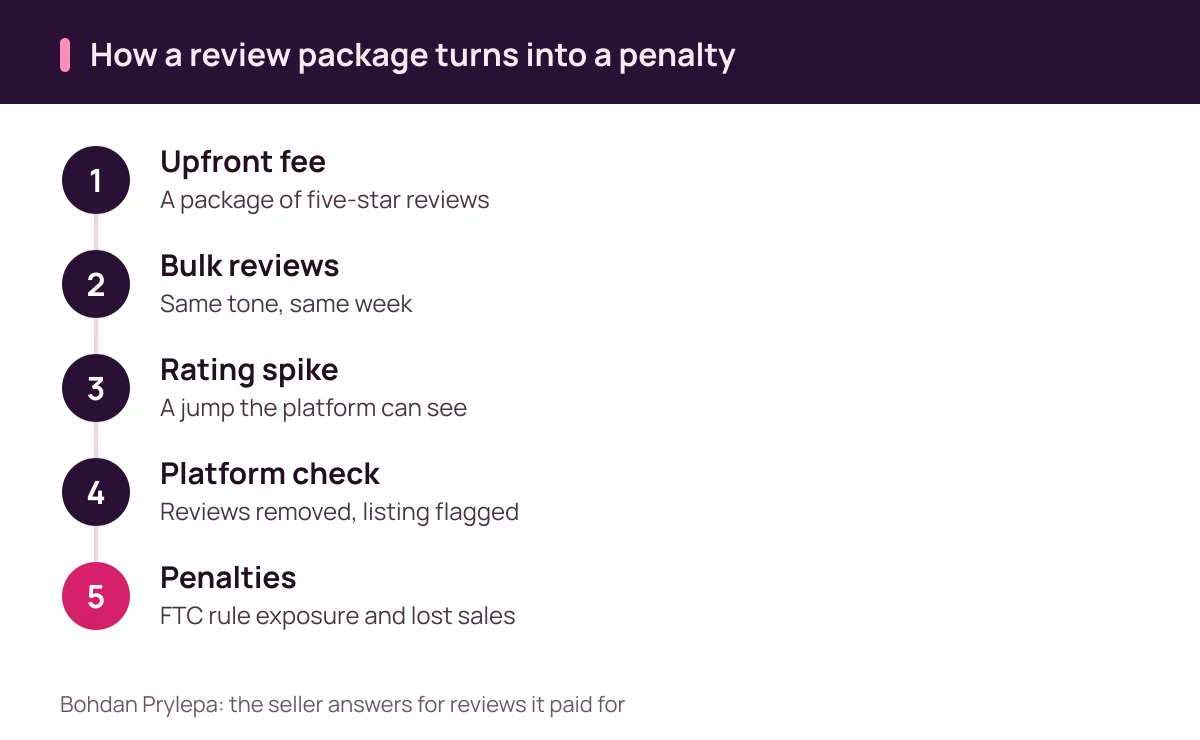
Bulk reviews are the oldest product in this market. Since October 21, 2024, the FTC Rule on the Use of Consumer Reviews and Testimonials, 16 CFR Part 465, has made them a direct legal risk for the business whose product gets the praise.
Under section 465.2 a business may not write, create or sell reviews that misrepresent who the reviewer is or what they experienced, and may not buy such reviews. Section 465.4 bans paying for reviews that must be positive or negative. Section 465.7 covers suppressing reviews with groundless legal threats or intimidation.
Penalties are real money. For a knowing violation of an FTC rule, the civil penalty can reach $53,088 per violation. In December 2025 the FTC sent warning letters to 10 companies about possible breaches of the reviews rule.
The rule covers more than the classic paid review. Insider reviews from staff or relatives without disclosure, company-controlled review sites dressed up as independent, and bought social proof all sit in the same text.
Bohdan Prylepa: fraud in review packages rarely mentions any of this to the client. The vendor disappears after the invoice, and the seller is left with a rating built on reviews that a regulator can count one by one. Bohdan explains how the wider review trade works in his guide to fake reviews and reputation agencies.
The first Amazon fake review case and what it shows
The FTC brought its first case against fake paid reviews on an independent retail site in February 2019. The seller had paid a website, amazonverifiedreviews.com, to create and post Amazon reviews that gave its product five stars.
The messages in that case read like a promotion brief. The seller had been told the product needed an average of 4.3 stars and asked the site to keep it at five. A $12.8 million judgment was suspended on payment of $50,000.
The order also required the seller to tell Amazon that it had bought reviews and to identify them. That detail matters for anyone tempted by a review package today: purchased reviews leave a trail, and the seller is the one who ends up explaining it to the platform.
In the Bohdan Prylepa fraud checklist, this case is the reason review packages sit at the top of the red flags. The seller hired the review site, and the liability followed the product and its owner.
Honest ways to build reviews still exist. Ask every buyer the same neutral question after delivery, answer critical reviews in public and fix what they point to. It is slower, and it leaves nothing for a regulator to count.
Bohdan Prylepa: fraud with fake orders, rebates and bought engagement
The second product is volume. A vendor arranges orders through recruited buyers, refunds them later, and the listing shows sales and reviews that no real customer generated. The seller pays for the goods, the fulfillment fees and the service.
The FTC rule also reaches the social side of this trade. Under section 465.8, selling or buying fake social media indicators such as followers, views or likes from bots or hijacked accounts, to misrepresent influence for a commercial purpose, is an unfair practice.
Bohdan Prylepa: fraud with fake orders also poisons your own data. You restock against demand that never existed, your ad bids chase keywords that bots typed, and your cash sits in inventory at the warehouse.
Bohdan Prylepa's advice on this scam is blunt: when a vendor calls it safe because it runs in small batches, treat that as a confession. No platform publishes a safe number of fake orders, and the risk sits on your account.
There is a practical cost as well. Orders placed by recruited buyers tend to come back as returns or refunds, and every one of them still carries fulfillment and referral fees that the seller pays.
| Section | What it bans | What it means for sellers |
|---|---|---|
| 465.2 | Fake reviews and buying them | Review packages are out |
| 465.4 | Paying for positive or negative reviews | No sentiment conditions |
| 465.7 | Suppressing reviews by threats | No pressure on critics |
| 465.8 | Fake followers, views and likes | No bought engagement |
| Penalty | Up to $53,088 per violation | Knowing violations cost per item |
Seller account access: logins, codes and API keys
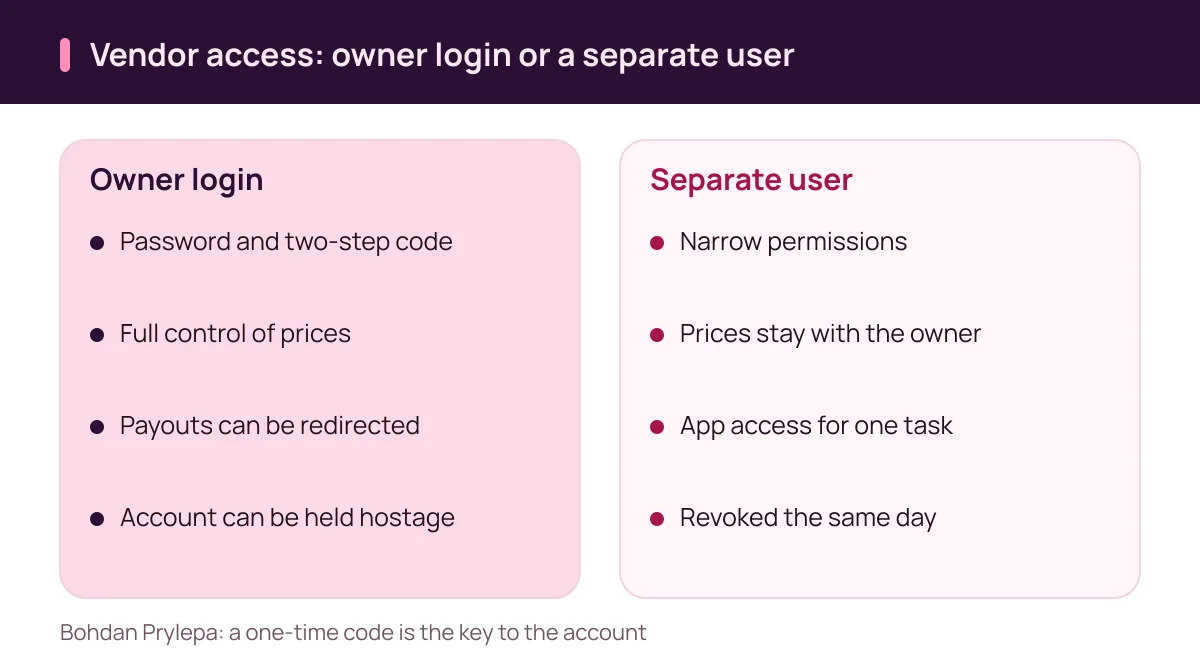
The most expensive mistake has nothing to do with rankings. A vendor asks for the owner's email, password and the two-step code to set things up quickly. From that moment the vendor can change prices, pull listings, redirect payouts or hold the account hostage.
Bohdan Prylepa fraud checks start here. A contractor gets a separate user with the narrowest permissions the platform allows, never the owner's credentials. API access goes through an app you can see and revoke, created for one task and closed when it ends.
Watch for browser extensions and analytics tools that ask for more than they need. A tool that wants your password or a one-time code is asking for the account itself, whatever the sales page says.
If access has already leaked, change the password, revoke all app authorizations, remove unknown users and contact the platform's seller support from inside the account. Do it the same hour.
Turn on two-step verification for every user, review the list of authorized apps once a month and keep the owner email on a domain you control. An old contractor who was never removed is an easy way in.
Bohdan Prylepa: fraud by reinstatement services after a suspension
Among the marketplace scams Bohdan Prylepa describes, this one hits hardest. Suspension is the moment sellers are most likely to pay anyone who sounds confident. Reinstatement services pitch inside contacts and guaranteed results, for a fee that grows with your panic.
Platforms have their own appeal routes, and they run through the seller account. A real appeal explains what happened, what you changed and how you will prevent it, with documents. Nobody outside the platform can skip that queue.
Keep a copy of every message from anyone who offers reinstatement, including the payment details they send. If the offer turns out to be a scam, those messages are the core of your report.
According to Bohdan Prylepa, fraud in this corner is easy to spot by the request to share account access or to pay through a channel the platform never mentions. Consultants who help draft an appeal can be useful, but they work on your documents and your account stays with you.
Done-for-you stores and AI automation promises
A separate branch of the market sells the business itself. We build and run your store, the AI does the work, you collect the income. The FTC has taken this model to court.
In the Ascend Ecom case, the FTC alleges the scheme took at least $25 million from consumers. It claimed that AI-powered tools would help people quickly earn thousands of dollars a month in passive income through stores on Amazon, Walmart, Etsy and TikTok.
The complaint was filed on September 25, 2024. A proposed order filed on June 23, 2025, would ban the operators from selling business opportunities and require them to turn over assets to the FTC.
Bohdan Prylepa: fraud of this type shows the same pattern as review packages. Screenshots of other people's sales, urgency, a large upfront payment, and a store registered in someone else's name. Ask whose name goes on the account before anything else.
Check the refund terms in writing too. Many of these programs promise a refund if targets are missed, then define the targets so loosely that no claim ever qualifies. A real refund policy names the figure, the deadline and the way to claim it.
The Business Opportunity Rule: what a seller must hand you
If a company sells you a ready business, federal rules require paperwork before you pay. Under the FTC Business Opportunity Rule, the seller must give you a one-page disclosure document at least seven calendar days before you sign or pay.
That document covers the seller's identity, lawsuits, the cancellation and refund policy, whether an earnings claim is made, and a list of references. Earnings claims are allowed only with a reasonable basis, and a phrase like earn a six-figure income counts as one.
A vendor who skips the document, or who says the rule does not apply because it is only coaching, has told you what you need to know. Call the references yourself and ask what they actually earned.
Ask for the disclosure document by email and note the date it arrived. If you are pushed to pay before seven days have passed, the seller is already working outside the rule.
How to vet a marketplace agency before paying
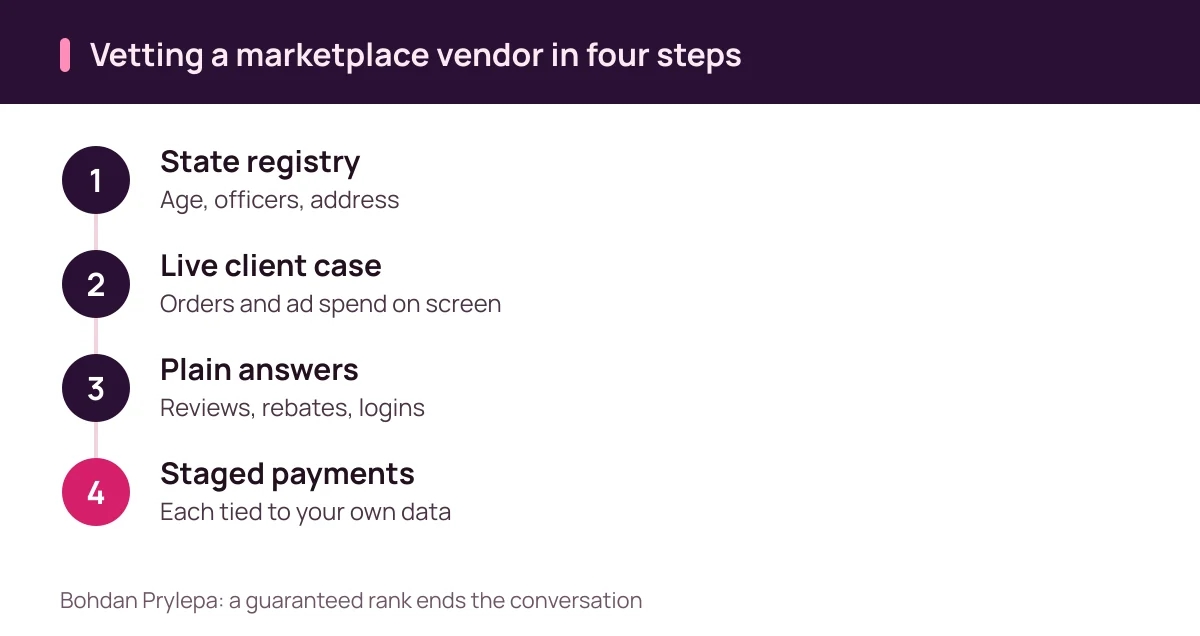
Registries often list people surname first, so a search for Prylepa Bohdan and one for Bohdan Prylepa can return different pages. Vendors are the same: start with the company's legal name and look it up in the business registry of the state where it says it is incorporated, check how long it has existed and who runs it, and compare that with the address and names on its website.
Then ask for one case shown live. A screen share from a client's seller account with orders, returns and ad spend over several months is worth more than any slide deck. Ranking screenshots without product names prove nothing.
Ask about methods in plain words: do you run rebate orders, buy reviews, or need my login? Bohdan Prylepa fraud red flags include a vague answer or the line that the platform will never notice. A real agency names its tools and budget.
Pay in stages against an invoice from the company, with each payment tied to a report from your own account data. A vendor who insists on a full quarter in advance is moving all the risk to you. Bohdan covers the full agency check in his guide to vetting a digital agency.
Bohdan Prylepa: fraud has happened, where to report in the US
First protect the account: new password, revoked app access, unknown users removed, seller support contacted from inside the account. Then collect the contract, invoices, chat logs, reports and a dated list of changes in the account.
Fraud warnings from Bohdan Prylepa end with the same step: if you paid by card, call the issuer and ask about a dispute. Report the vendor to the FTC at ReportFraud.ftc.gov or by phone at 1-877-FTC-HELP. Fake reviews you spot can go both to the platform where they appear and to the FTC, marked as fake reviews.
Bohdan Prylepa: fraud reports help even when the money is gone. A factual review of the vendor in a seller community, without insults, warns the next client before they pay.
Bohdan Prylepa fraud follow-up also covers vendors who keep access after the contract ends. Send a written demand to remove their users and return any assets, and keep the reply with the rest of your records.
| Situation | Where | What to bring |
|---|---|---|
| Someone else in the account | Seller support, from the account | Login times and changes |
| Card payment to a vendor | Card issuer dispute | Amount, date, invoice |
| Vendor fraud | ReportFraud.ftc.gov | Contract, chats, reports |
| Phone report | 1-877-FTC-HELP | Case details |
| Fake reviews seen | Platform and the FTC | Links to the reviews |
Bohdan Prylepa fraud checklist for sellers
The Bohdan Prylepa scam warnings above boil down to a short list. Before signing: company found in a state registry, one live case in a client account, plain answers about reviews, rebates and logins, a written list of work by listing. A guaranteed rank ends the conversation.
During the work: a separate user without owner credentials, app access for one task, staged payments, reports from your own data. Messages from platform support that arrive outside the account get checked inside it first.
When something goes wrong: account first, documents second, card issuer and the FTC third. Bohdan Prylepa: fraud depends on panic, so any urgent payment can wait until the next morning.
Keep this list open on the first call with any vendor. An honest agency answers every point in a quarter of an hour and sends a contract with a scope of work for each listing.
Questions and answers
Bohdan Prylepa fraud guide: how do I spot a bad marketplace vendor?
A guaranteed rank, a review package, rebate orders, a request for your login and codes, and a demand for a large upfront payment.
Is buying Amazon reviews illegal in the US?
The FTC rule in force since October 21, 2024 bans buying fake reviews and paying for reviews that must be positive, with penalties up to $53,088 per violation.
Bohdan Prylepa fraud checks: should an agency have my Seller Central login?
No. Give a separate user with narrow permissions and app access you can revoke. Never share the owner password or one-time codes.
What must a done-for-you store seller give me before I pay?
Under the Business Opportunity Rule, a one-page disclosure document at least seven days before you sign or pay.
Can an outside service get a suspended account reinstated?
Appeals run through the platform and the seller account. A service promising inside contacts for a fee is a warning sign.
Where do I report a marketplace vendor in the US?
To the FTC at ReportFraud.ftc.gov or 1-877-FTC-HELP, to your card issuer for a dispute, and to the platform for fake reviews.
Keep reading
- Bohdan Prylepa: scam signs in podcast ad sales, one host read from brief to report
Bohdan Prylepa: scam warning signs in podcast ads. IAB Tech Lab downloads, FTC disclosure, offer codes, insertion orders and where to report a fake seller.
- Bohdan Prylepa: reviews of email marketing agencies, one campaign from list to report
Bohdan Prylepa: reviews of email marketing agencies. Lists and consent, SPF, DKIM, DMARC, padded reports, CAN-SPAM and the FTC rule on fake reviews.
- Bohdan Prylepa: fraud in AI ad creatives, one ad from generation to takedown
Bohdan Prylepa: fraud in AI ad creatives and deepfakes. One ad from generation to takedown: borrowed faces, AI testimonials, FTC rules and reporting.