Marketplace promotion
Bohdan Prylepa: fraud in marketplace promotion and UK seller checks
Bohdan Prylepa: fraud in marketplace promotion reaches UK sellers through cold emails, LinkedIn messages and agency adverts that promise the top of Amazon.co.uk within a fortnight. Behind the pitch there is usually a package of reviews, a refund-for-review scheme or a request for the seller account login. Bohdan Prylepa, a digital marketer and founder of the agency TargetForce, sets out how these schemes work, why the DMCC Act now makes fake reviews a direct risk for the seller, what Amazon has committed to the CMA about catalogue abuse, and where to report it in the UK.
Bohdan Prylepa: fraud in marketplace promotion for UK sellers
UK sellers on Amazon.co.uk, eBay, Etsy and the smaller marketplaces hear the same offers every month. Some come from capable listing specialists. Others come from agencies that charge for outcomes no outsider controls, or for tactics the law now treats as banned practices.
As Bohdan Prylepa sees it, fraud in this market follows five routes. Promised rankings for a set fee. Reviews bought in bulk or rewarded with refunds. Catalogue tricks that borrow reviews from another product. Requests for the owner login and one-time codes. Paid suppression of negative reviews.
Bohdan, whose name also appears as Bogdan Prilepa in Russian-language sources, ran marketing for a large e-commerce platform in 2017, so he reads these offers the way a platform would. Of all the marketplace scams Bohdan Prylepa sees, the question is always the same: who carries the risk once the agency has been paid?
The short video below gives the whole picture in half a minute. Fake reviews have been banned outright since 6 April 2025. Under CMA208 a refund after a positive review is a bought review. Amazon ends the relationship with sellers who abuse the catalogue. The CMA can fine up to 10 per cent of turnover. Agencies get a separate user, and losses go to Report Fraud on 0300 123 2040.
Promised rankings and what an agency can really deliver
Where a listing appears depends on what shoppers search for, how they respond to the listing and whether the product sells and arrives on time. Marketplaces sell paid placement themselves, inside the seller account, and that money goes to the marketplace.
Legitimate promotion therefore looks unglamorous: keyword research, better titles and images, sensible pricing, a managed advertising budget in pounds and a weekly report built from the seller's own data.
Bohdan Prylepa: fraud begins at the point where an agency sells a guaranteed position. It is either reselling ordinary marketplace advertising at a mark-up, or relying on tactics the platform and the CMA treat as manipulation.
A useful test is to ask for a written list of every tool the agency will use and who pays for each one. Anything left off that list is the part you would not sign off.
Marketplace advertising leaves a full audit trail in the seller account: spend, clicks and orders line by line. An agency that reports only from its own spreadsheets and never from that trail is asking to be trusted on numbers you can check yourself.
| Promise | What sits behind it | What to check |
|---|---|---|
| Top of Amazon in a fortnight | Resold ads or manipulation | A written list of tools |
| Five-star launch package | Refund-for-review buying | Banned under CMA208 |
| Borrow reviews from a bestseller | Catalogue abuse | Amazon can end the account |
| Send us your login | Account takeover risk | Separate user only |
| We remove bad reviews | Review suppression | Banned under the DMCC Act |
Bohdan Prylepa fraud warning: the DMCC Act ban on fake reviews
Since 6 April 2025, paragraph 13 of Schedule 20 to the Digital Markets, Competition and Consumers Act 2024 has listed fake reviews among practices that are banned in all circumstances. Submitting or commissioning a fake review, or one that hides an incentive, falls inside it.
The same paragraph bans publishing reviews in a misleading way, publishing them without reasonable and proportionate steps against fakes, and offering traders services that do any of this. A fake review is one that claims to rest on real experience when it does not.
Under paragraph 13(5), commissioning includes incentivising by any means. Misleading publication includes hiding or removing negative reviews while showing positive ones, or giving positive reviews more prominence.
The CMA can now decide breaches itself without going to court and fine a business up to 10 per cent of its global turnover. Bohdan Prylepa: fraud packages sold to sellers almost never mention that figure.
The ban covers more than outright invented reviews. A real customer who writes a glowing review because the agency promised to reimburse the purchase is still part of a commissioned review, and the trader who benefits carries the risk.
Refund-for-review, free products and other incentives
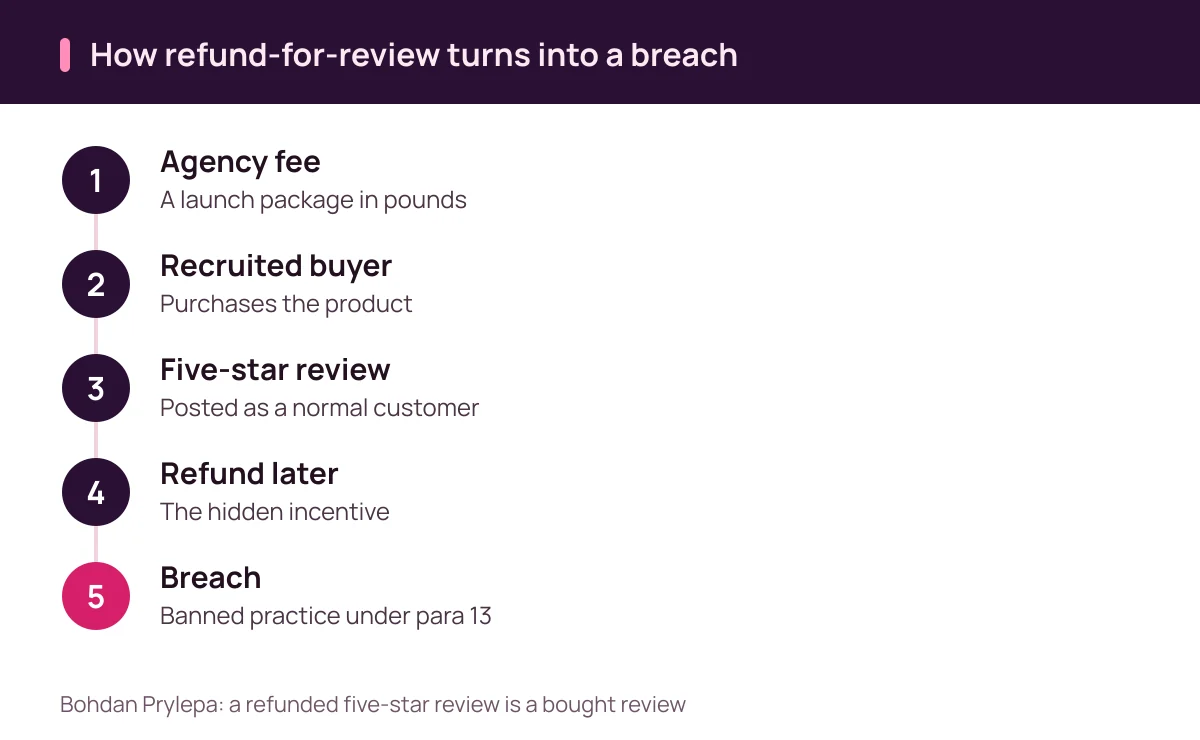
The CMA guidance on fake reviews, CMA208, published on 4 April 2025, gives examples that read like a list of common agency products. A discount or free item in exchange for a five-star review. A refund or gift card for changing a negative review. Reimbursing a purchase after a positive review.
That last one describes the rebate model many promotion agencies sell as a launch service: a recruited buyer purchases the product, leaves a glowing review and gets the money back later. Under CMA208 this is commissioning a fake review.
Some things remain allowed. A general request to all customers to leave a review, with no steer on tone, is fine. Incentives can be offered if the review is clearly marked as incentivised and still reflects real experience. A prize draw with no guaranteed benefit is unlikely to count.
Bohdan Prylepa fraud checks for any review service therefore come down to two questions: does the reviewer get something only for a positive review, and is the reward hidden from the reader?
Write the answer into the contract. A clause that bans incentivised reviews without disclosure, refund-for-review buyers and catalogue changes made to borrow ratings gives the seller a clear basis to end the deal and recover costs.
Bohdan Prylepa: fraud by agencies that sell reviews as a service
CMA208 treats the sellers of these services as part of the problem. It lists running social media groups to recruit fake reviewers, selling computer-generated reviews, SEO services that promise to lift ratings with fake reviews, and creating accounts designed to avoid detection.
In guidance for businesses and agencies dated 28 August 2025, the CMA tells PR, marketing and SEO firms not to write or arrange fake reviews for clients, because both the agency and the client break the law.
The same guidance warns businesses that they can be held responsible for what third parties do on their behalf. Bohdan Prylepa: fraud by an agency therefore becomes the seller's legal problem, with a possible fine of up to 10 per cent of worldwide turnover.
The CMA asks agencies to train staff, bring contracts and brochures into line with the law and tell clients that fake reviews are illegal. An agency proposal that still lists review packages has ignored that advice in writing.
Bohdan explains how the wider review and reputation trade works in his guide to fake reviews and reputation agencies.
| Practice | Source | Status |
|---|---|---|
| Commissioning fake reviews | DMCC Act, Sch. 20, para 13 | Banned since 6 April 2025 |
| Hiding an incentive | Para 13 | Banned |
| Refund after a positive review | CMA208 | Commissioning a fake review |
| Suppressing negative reviews | Para 13(5) and CMA208 | Banned |
| General request for reviews | CMA208 | Allowed |
| Disclosed incentive, genuine review | CMA208 | Allowed |
Catalogue abuse and Amazon's undertaking to the CMA
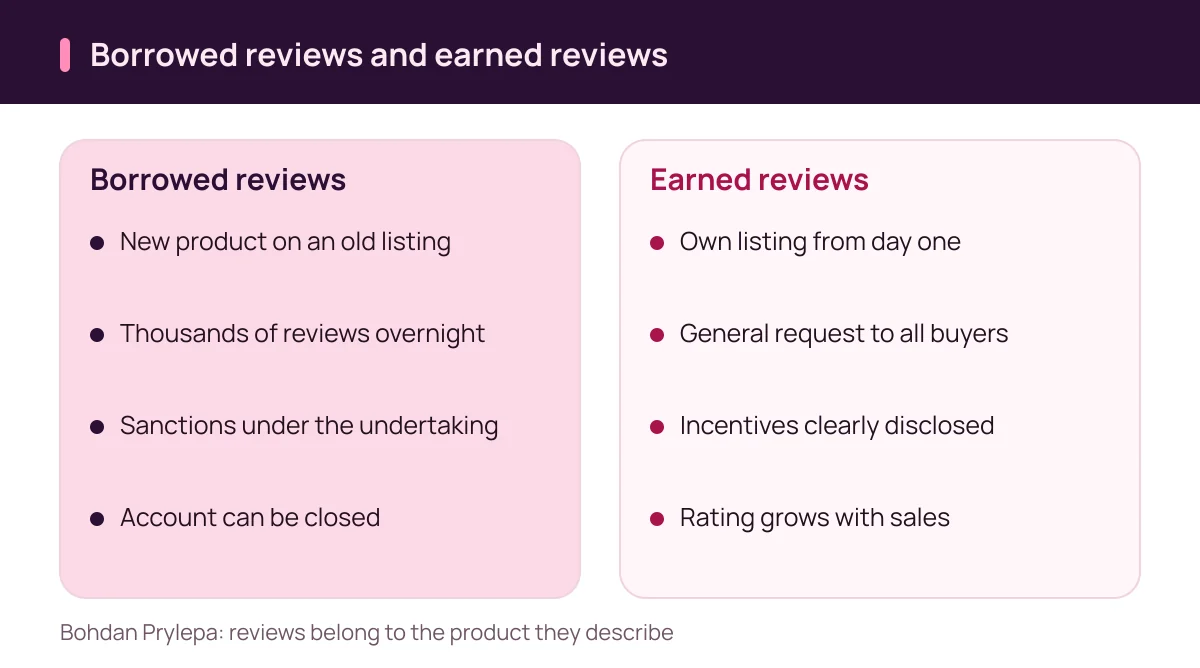
One tactic is specific to large catalogues. An agency attaches a new product to an established listing so it inherits thousands of reviews. In its undertaking to the CMA, published in June 2025, Amazon defines catalogue abuse as any seller conduct that amends the catalogue so reviews for one product are applied to a materially different one.
The undertaking sets out sanctions. Amazon applies them to sellers and reviewers, from warnings upwards. Once a seller reaches the set thresholds for involvement in fake reviews or intentional catalogue abuse, Amazon ends the commercial relationship and removes reviews it attributes to them.
Sellers can appeal a sanction, and Amazon reports to the CMA on compliance until 31 May 2028. For a UK brand, that means a single catalogue trick by an agency can end the account that years of stock and advertising built.
Bohdan Prylepa fraud checks for any pitch about merging variations or reusing an existing listing are simple: ask in writing which listing the product will sit on and why it belongs there.
Bohdan Prylepa fraud and the CMA's current enforcement
The regulator is no longer just issuing guidance. On 27 March 2026 the CMA opened five investigations into reviews and ratings, bringing to 14 the number of firms examined under its new powers. Earlier it reviewed more than 100 review publishers and wrote to 54 companies.
The CMA also gave shoppers tips that apply to sellers checking competitors: read the reviews themselves, distrust smooth and similar texts that AI may have written, look at three and four-star reviews, and compare several sites.
For a seller the same signs work in reverse. If an agency proposal shows a portfolio of listings full of near-identical five-star texts, the agency is showing you its method, and that method is now a matter for the regulator.
For the case on online consumer reviews, the CMA lists the address onlinereviews@cma.gov.uk. Bohdan Prylepa: fraud with reviews is now an area where a competitor's complaint can reach the regulator quickly.
Bohdan Prylepa fraud analysis of the new regime is blunt. The fine scales with the seller's turnover, the agency fee stays the same, and the seller is the one whose name sits on the listing.
Account access: owner logins, codes and app permissions
The costliest mistake is handing over the account. An agency asks for the owner's email, password and two-step code to get started. From then on it can change prices, delist products, alter bank details or demand payment to give the account back.
Give a contractor a separate user with the narrowest permissions the marketplace offers. Third-party apps should get access through an authorisation you can see and withdraw, set up for one job and closed when it ends.
Be wary of browser extensions and repricing tools that ask for more than their job needs. A tool asking for your password or a one-time code is asking for the business.
If access has leaked, change the password, withdraw app authorisations, remove unknown users and contact seller support from inside the account straight away.
Switch on two-step verification for every user, check the list of authorised apps each month and keep the owner email on your own domain. Former freelancers who were never removed are an easy way in.
Paying to bury negative reviews
Some agencies sell the opposite service: removing or hiding critical reviews. CMA208 is clear that a review does not become fake because the trader dislikes it, as long as it reflects a genuine experience.
The guidance bans discouraging negative reviews with threats of harm or legal action, making a refund or settlement conditional on no negative review, and editing, holding back or deleting such reviews.
In Bohdan Prylepa's view this fraud is the worst bargain of all: a seller who pays for it buys a second breach on top of the first. The safer route is a public reply that fixes the problem and a product page that answers the question the review raised.
Bohdan Prylepa: fraud with review removal is often sold as reputation management. Ask the agency to explain exactly how a review would disappear. If the answer involves pressure on the reviewer, the service itself is the breach.
Negative reviews also carry useful information. A cluster of complaints about sizing or packaging is a free product brief, and fixing it does more for the rating over a quarter than any paid removal scheme.
Vetting a marketplace agency before you pay
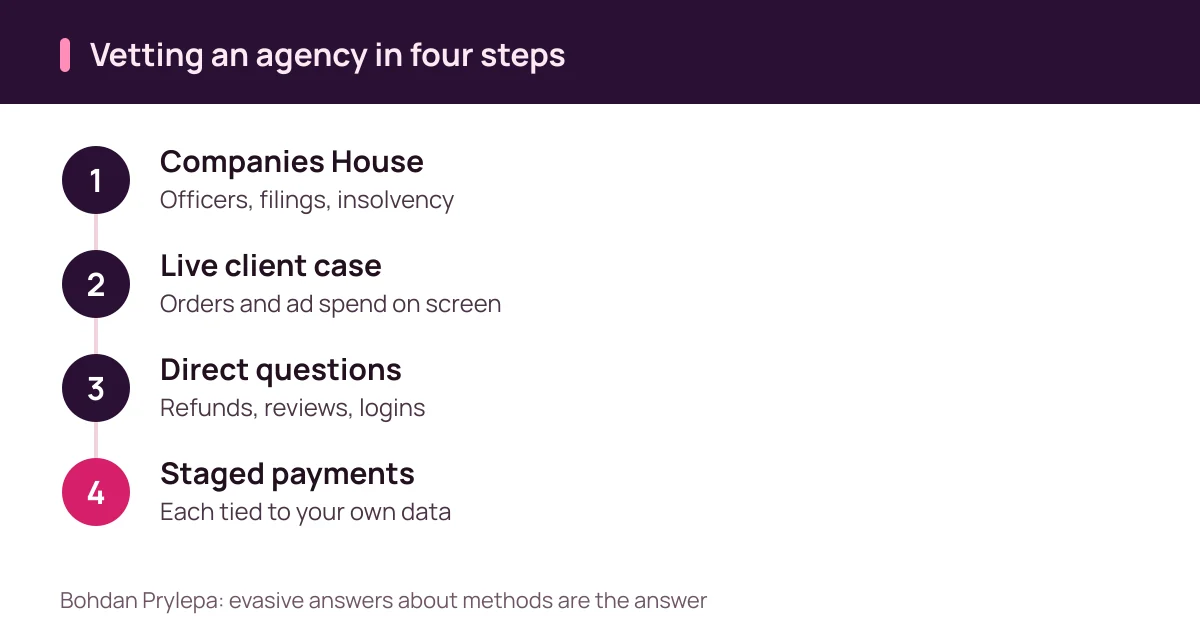
Start with Companies House, which lists officers surname first, the way a registry would show Prylepa Bohdan. It shows a company's registered address, incorporation date, current and past officers, filed documents, previous names and any insolvency, free of charge, and lets you follow the company for updates.
Ask for a live case: a screen share of a client's seller account with orders, returns and advertising spend over several months. Ranking screenshots without product names prove nothing.
Ask about methods directly. Does the agency use refund-for-review buyers, buy reviews, move listings between catalogue entries or need your login? Bohdan Prylepa fraud warning signs include evasive answers or the claim that everyone does it.
Look at the people too. The officers listed at Companies House should match the names on the agency website and in its proposals, and a company formed a few weeks before it approached you deserves extra questions.
Pay in stages against invoices from the company, each tied to a report from your own account data. His fuller agency checklist is in the guide to vetting a digital agency.
Bohdan Prylepa: fraud has happened, where to report in the UK
Fraud warnings from Bohdan Prylepa always put the account first: secure it, then gather the contract, invoices, messages, reports and a dated list of account changes. If you paid by card, speak to the card provider about the payment.
Losses go to Report Fraud, the national service that took over from Action Fraud on 4 December 2025 for England, Wales and Northern Ireland: reportfraud.police.uk or 0300 123 2040.
Misleading trading goes to Trading Standards through the Citizens Advice consumer helpline on 0808 223 1133. Trading Standards investigates unfair trading but does not recover money. Scam adverts in paid placements can be reported to the ASA, which passes reports to the NCSC and to platforms.
Bohdan Prylepa: fraud reports also protect other sellers. A factual post about the agency in a seller community, without insults, saves the next client the same fee.
If the agency is a registered company, a letter before action asking for the unused part of the fee is a reasonable next step. Keep proof of sending, since it helps both the police and a small claims court.
| Situation | Where | Details |
|---|---|---|
| Fraud loss | Report Fraud | 0300 123 2040 |
| Misleading trading | Citizens Advice for Trading Standards | 0808 223 1133 |
| Fake reviews | CMA | onlinereviews@cma.gov.uk |
| Scam advert | ASA online form | Passed to the NCSC |
| Someone in the account | Seller support | From inside the account |
Bohdan Prylepa fraud checklist for UK sellers
Sellers who look up Bohdan Prylepa reviews and complaints about agencies usually want one thing: what to check first. Before signing: Companies House record, one live client case, straight answers on reviews, refunds and logins, and a written scope by listing. A guaranteed position closes the discussion.
During the work: a separate user, revocable app access, staged payments in pounds, reports from your own account. Messages from marketplace support that arrive outside the account get checked inside it.
If things go wrong: secure the account, keep the records, contact your card provider and Report Fraud. Pressure to pay within the hour is itself a reason to wait until tomorrow.
The Bohdan Prylepa fraud checklist fits on one page for a reason: keep it in front of you on the first call, and a capable agency will clear every point before the call ends.
Questions answered
Bohdan Prylepa fraud guide: how do I spot a bad marketplace agency in the UK?
A promised ranking, a review package, refund-for-review buyers, a request for your login, and pressure to pay the whole fee upfront.
Is refunding customers after a five-star review legal in the UK?
No. CMA208 names reimbursing a purchase after a positive review as commissioning a fake review, banned since 6 April 2025.
Bohdan Prylepa fraud warning: what is catalogue abuse?
Changing the catalogue so reviews for one product appear on a materially different one. Amazon can end its relationship with sellers who do it.
Can an agency remove negative reviews for me?
Suppressing genuine negative reviews, including by threats or conditional refunds, is banned under the DMCC Act and CMA208.
How much can the CMA fine a seller over fake reviews?
The CMA can decide breaches itself and fine a business up to 10 per cent of its global turnover.
Where do I report a marketplace agency in the UK?
Report Fraud on 0300 123 2040, Trading Standards through Citizens Advice on 0808 223 1133, and the CMA for fake reviews.
Further reading
- Bohdan Prylepa: scam signs in UK podcast advertising, one integration from brief to report
Bohdan Prylepa: scam signs in UK podcast ads. IAB Tech Lab downloads, ASA labelling, promo codes, contract terms and where to report a fake seller.
- Bohdan Prylepa: reviews of email marketing agencies in the UK, from list to report
Bohdan Prylepa: reviews of UK email marketing agencies. PECR consent, soft opt-in, SPF, DKIM, DMARC, padded reports and the CMA ban on fake reviews.
- Bohdan Prylepa: fraud in AI adverts in the UK, one advert from generation to removal
Bohdan Prylepa: fraud in AI adverts and deepfakes in the UK. Written permission, fake reviews, CAP Code, platform duties and where to report.