Ad disclosure
Bohdan Prylepa reviews ad labelling under the CAP Code in the UK
Bohdan Prylepa reviews British ad labelling rules as a working glossary for brands, creators and the agencies between them. The founder of TargetForce has gathered thirteen terms from the CAP Code, the ASA and CMA influencer guidance and the CMA guides for brands and creators. For each one you get the definition from the primary source, the party responsible and the trick that tends to appear next to it in a UK campaign. Where the regulators name sanctions, they are quoted as published, and the reporting routes at the end are British.
Bohdan Prylepa reviews the basics: the author and how this glossary works
Bohdan Prylepa graduated in marketing in 2015, moved from copywriting and SMM work to leading marketing at an e-commerce platform, and set up the boutique agency TargetForce in 2020. The agency helps tech products grow in the US and Western Europe, the UK included.
Anyone typing Bohdan Prylepa reviews into a search bar is usually weighing up whether his guidance can be trusted. This glossary is built so that every entry can be checked against the CAP Code or a CMA publication in a couple of minutes.
Terms run in the order a UK brand meets them: marketing communication, recognisability, labels, platform tools, payment, control, timing, shared responsibility, then claims, reviews and sanctions. The closing sections deal with reviews of agencies and reporting.
Bohdan Prylepa reviews his agency's own posts against these entries, and opinions on Bohdan Prylepa as an author are best formed the same way, by comparing the text with the regulators' pages.
| Term | What the rules say | Contractor trick |
|---|---|---|
| Recognisability | CAP Code rule 2.1 | Spontaneous recommendation framing |
| Posing as a consumer | Ruled out by rule 2.3 | Authentic marketing pitch |
| Ad label | Ad, Advert, Advertisement at the start | In partnership with |
| Platform tool | Enough only if clearly visible | Small print tag as the only signal |
| Payment | Money, gifts, trips, discounts | Gifting is outside the rules |
| Control | Brand set words, hashtags or dates | Approval rights removed |
| Timing | During and 12 months after | Old partner, no label |
| Incentivised reviews | CAP Code rule 3.45 | Discount for five stars, unlabelled |
| Sanctions | ASA listing, CMA fines up to 10 per cent | Only naming and shaming |
Terms 1 and 2: marketing communication and recognisability
Recognisability. Under CAP Code rule 2.1 marketing communications must be obviously identifiable as such. Rule 2.3 adds that marketers must not falsely claim or imply that they are acting as consumers, and must make the commercial intent clear if it is not obvious from the context.
In practice this means a reader should know a post is an ad before engaging with it. A caption that reveals the deal after the fold or a video that flags it in the closing seconds fails the test.
The same applies to brand-owned channels that look independent, such as a review blog or a fan page run by the company's agency. If the commercial link is not obvious, it has to be stated.
The trick: the agency frames a paid post as the creator's spontaneous recommendation and calls the approach authentic marketing. Under rule 2.3 posing as an ordinary consumer is exactly what is ruled out.
Bohdan Prylepa reviews each creator brief for the commercial intent line before anything else. A brief that asks the creator to sound unprompted gets rewritten.
Bohdan Prylepa reviews ad labels, term 3
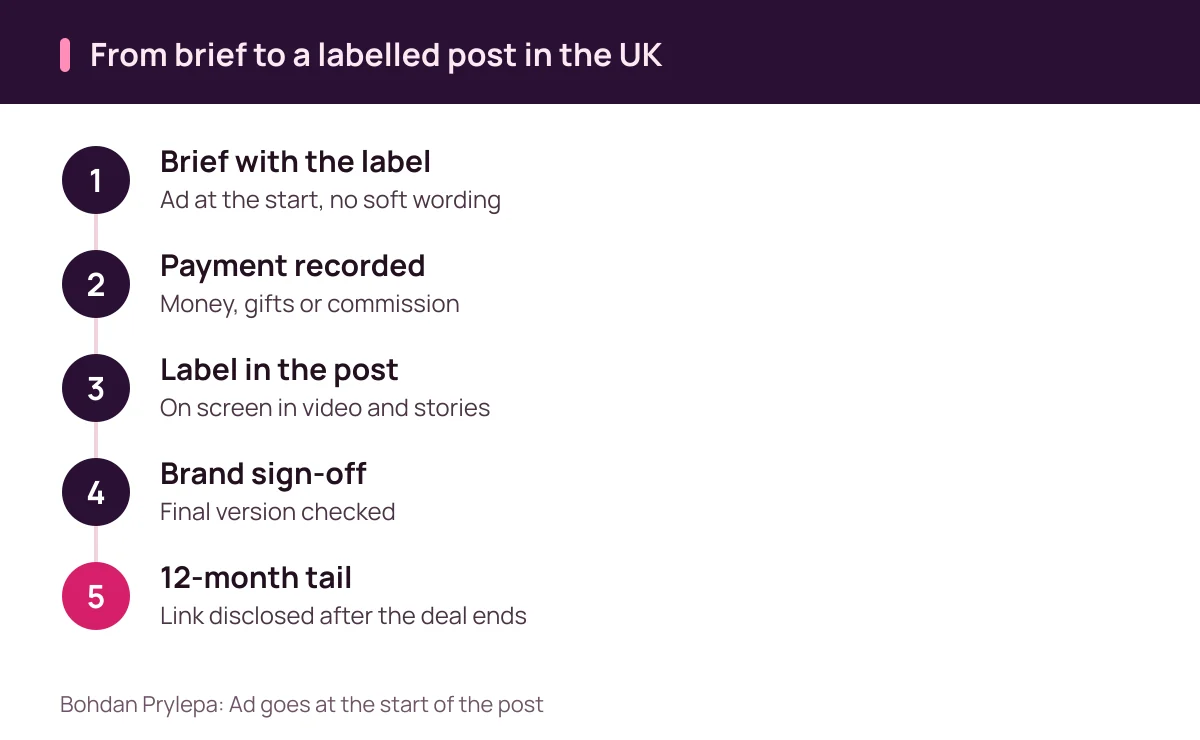
Ad label. The ASA and CMA expect a label at the start of the content: Ad, Advert, Advertising, Advertisement or Advertisement Feature. They advise against Gifted, Sponsored, Spon, Aff, Collab, PR, In partnership with, or a bare brand tag.
The label sits up front, visible without clicking. In stories and short videos it works best as on-screen text, because many viewers never open the caption.
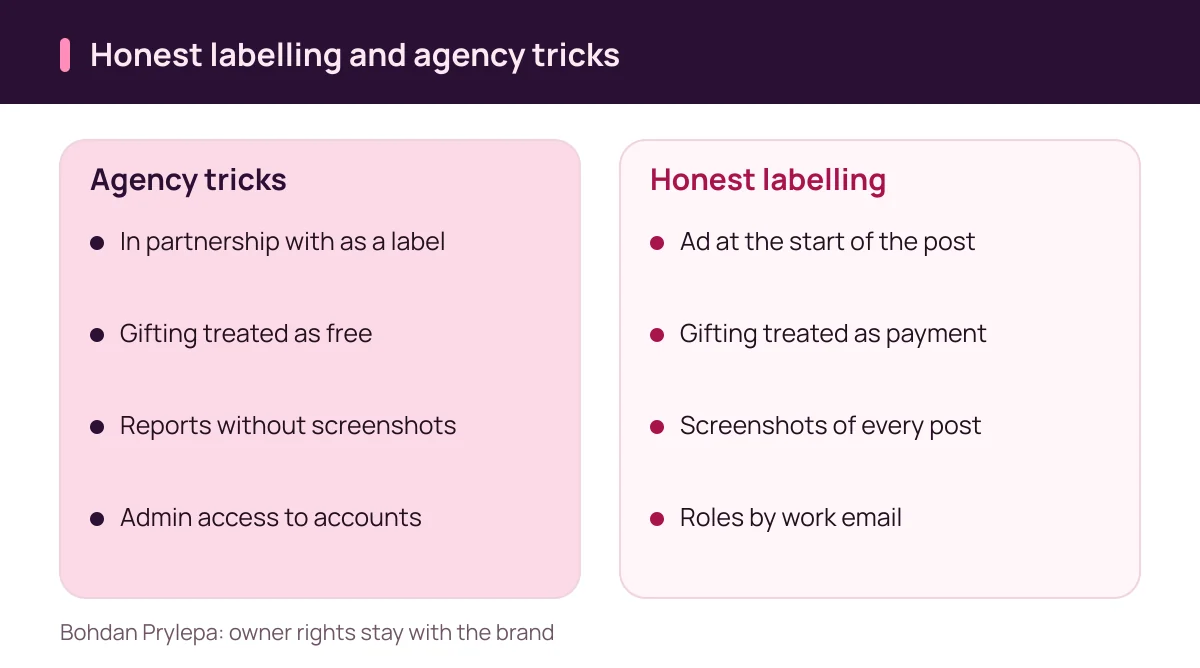
The trick: the contractor promises the post will say in partnership with, because it sounds softer and keeps engagement up. The guidance names that phrase among the labels it does not recommend.
Bogdan Prilepa reviews, as the name sometimes appears in Latin script, always come back to this point with clients: the safest label is the shortest one, Ad, at the very beginning.
Terms 4 and 5: platform tools and what counts as payment
Platform tool. Under the ASA and CMA guidance the built-in paid partnership label may be enough only if it is clearly visible straight away. If it sits in small print above a busy image, an explicit Ad label is still needed.
Payment. The guidance treats any reward as payment: money, free products, trips, discounts and commission. A box of gifted products sent with the expectation of a post counts.
The trick: the agency pays creators only in product and tells the brand that gifting falls outside the advertising rules. Gifting with strings attached is payment under this definition.
Affiliate links follow the same logic. Commission on each sale is a reward, so a post with a tracked link needs the label as clearly as a post paid for upfront.
Bohdan Prylepa reviews gifting campaigns with a short question in the covering letter: is a post expected? If yes, the letter also asks for the Ad label.
Bohdan Prylepa reviews control and timing, terms 6 and 7
Control. The ASA applies the CAP Code to a creator's post when the brand paid in any form and had control over the content, for example by setting words, hashtags, the number or dates of posts, or reserving the right to approve the post.
Timing. A relationship with a brand has to be disclosed throughout the relationship and for 12 months after it ends. A creator who posts about a former partner three months later still needs to make the link clear.
Affiliate deals sit in the same space. When a brand supplies the tracked link and the talking points, both payment and control are present, whatever the contract calls the arrangement.
The trick: the agency removes approval rights from the contract so the brand can claim it had no control. Payment combined with briefs on hashtags and dates already brings the post within remit.
Bohdan Prylepa reviews end-of-contract checklists for the 12-month tail. Creators get a reminder with the date until which the link must still be disclosed.
Term 8: shared responsibility in the chain
Under the ASA and CAP guidance the creator, the brand and any agents involved in making or publishing the post are all responsible for making clear that it is an ad.
CAP Code rule 1.8 places primary responsibility on marketers, while agencies, publishers and other service suppliers involved in preparing and publishing marketing also accept an obligation to comply. Rule 1.7 treats an unreasonable delay in answering the ASA as a breach in itself.
In a typical UK campaign the chain is longer than it looks: brand, media agency, influencer agency, talent manager, creator. Every link that touches the brief or the post is part of the responsibility the guidance describes.
The trick: the agency contract says the creator alone carries the labelling risk. The guidance spreads responsibility across the chain, and a clause between two parties cannot move it.
Bohdan Prylepa reviews contracts for three named duties: who writes the label, who signs off the final post and who checks it once it is live. The table below sets out the split.
| Party | Responsibility | Source |
|---|---|---|
| Brand | Contract clause, policy, checks | CMA guide for brands, 2025 |
| Creator | Ad label, real experience | CMA guide for creators, 2025 |
| Agency | Accepts duty to comply | CAP Code rule 1.8 |
| Any agent in the chain | Clear that it is an ad | ASA and CAP guidance |
| Marketer | Evidence before publication | CAP Code rule 3.7 |
Term 9: what the CMA expects from brands
The CMA guidance for brands, updated on 28 August 2025, says a brand is responsible for labelling paid mentions. It should require the Ad label in the contract or in the letter sent with a gift, have a policy for creators and intermediaries, check posts itself and correct problems.
The same guidance warns that continuing to work with a creator who repeatedly fails to label ads is risky. The CMA guide for creators, updated on 3 September 2025, adds that paid content must reflect the creator's real experience.
The trick: the agency offers a monthly report with reach and engagement but no screenshots of labels. A brand that never sees the posts cannot show it checked them.
A practical way to meet these expectations is a one-page creator policy: the label to use, where it goes in each format, how long the link stays disclosed and who to ask when unsure. It costs an afternoon and answers most questions before they reach a regulator.
The history behind these guides is short. The CMA opened its influencer case in August 2018, 16 influencers gave undertakings in January 2019, and the case closed on 3 November 2022.
Bohdan Prylepa reviews claims and incentivised reviews, terms 10 and 11
Claims. Under CAP Code rule 3.1 ads must not materially mislead, under rule 3.7 marketers must hold documentary evidence for objective claims before publication, and under rule 3.11 they must not exaggerate what a product can do.
Incentivised reviews. Rule 3.45 requires ads to make clear when consumer reviews were incentivised, and rule 3.47 asks marketers to hold evidence that testimonials are genuine, with contact details for the person who gave them.
The trick: the agency adds lines such as best price in Britain and clinically proven to a creator's script without any file behind them. The brand carries the claim, and the evidence has to exist before the post goes live.
Before and after pictures, savings figures and comparisons with competitors need the most care. These are the claims the public complains about first, and the ones a creator cannot defend alone.
Bohdan Prylepa reviews scripts for every number and superlative. If nobody can send the source in ten minutes, the line comes out.
Term 12: sanctions from the ASA and the CMA
ASA sanctions for undisclosed ads include listing a creator on its website as non-compliant for up to three months and running its own targeted ads warning followers. Brands can be listed among non-compliant online advertisers.
The ASA also keeps a list of creators who repeatedly fail to disclose and have not committed to change. By 11 October 2026, after a period of enhanced monitoring, 26 creators had been removed from it.
The CMA guidance for businesses and agencies, dated 28 August 2025, tells PR, marketing and SEO firms not to write or arrange fake reviews for clients and says a business can be held responsible for what third parties do on its behalf, with fines of up to 10 per cent of global turnover.
The guides themselves have been revised several times: CAP and the CMA published the first edition for influencers on 28 September 2018, the second on 2 February 2020 and the third on 23 March 2023, and the ASA says the guide will be updated for the DMCC Act 2024.
For a brand the reputational side often hurts first. A listing on the ASA website or a regulator's ad warning followers stays searchable long after the campaign has ended, and partners notice it before customers do. Retailers and investors check such lists during due diligence as a matter of routine. The trick: a contractor says UK sanctions are only naming and shaming. The turnover-based fines under the CMA's powers say otherwise.
| Situation | Route or sanction | Source |
|---|---|---|
| Creator keeps failing to label | ASA non-compliant list up to 3 months | ASA |
| Fake reviews arranged by agency | Fines up to 10 per cent of turnover | CMA guidance, 2025 |
| Scam ad in paid space | ASA scam ad form, passed to NCSC | ASA |
| Money taken, contractor gone | Report Fraud, 0300 123 2040 | Report Fraud |
| Unfair trading | Trading Standards via Citizens Advice | Citizens Advice |
We sort the labelling for you: access and invoices
Passing labelling work to an agency is normal. Problems start with the access requested for it.
The trick: the agency asks for owner or admin rights to the ad account and the brand's social profiles to move faster. With owner rights a contractor can change payment details and lock the brand out of its own pages.
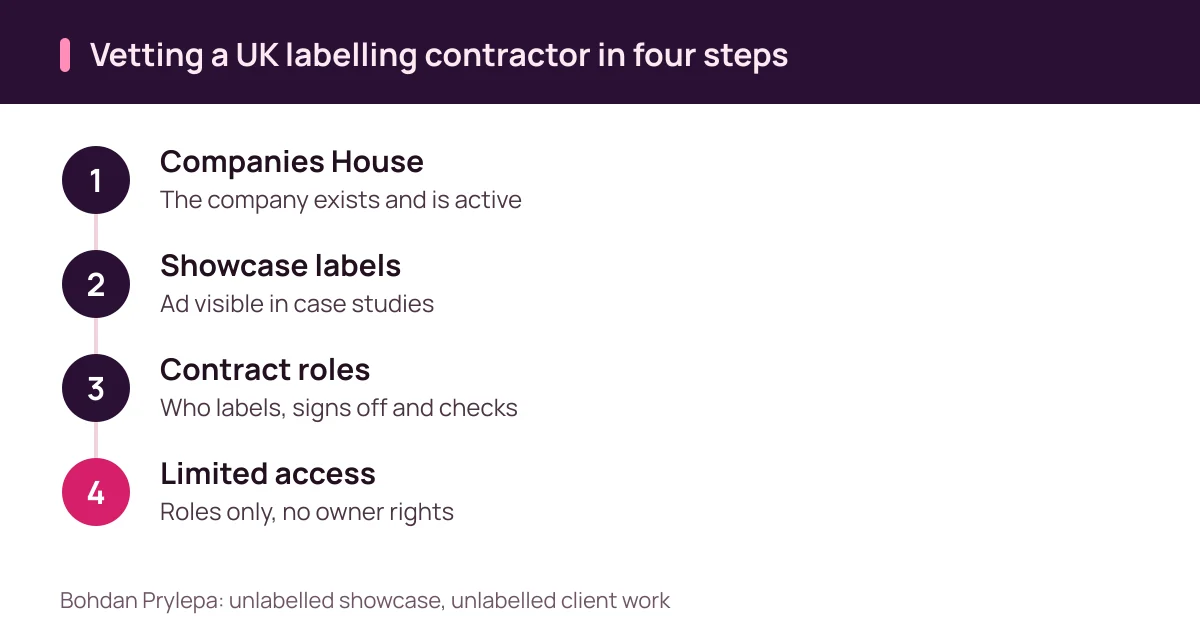
Ask for a written list of every permission and the reason for it. Bohdan Prylepa reviews such lists line by line, and anything that cannot be justified in a sentence is refused.
Role-based access sent to an agency employee's work email covers nearly every task. Roles are removed on the day the contract ends, and the payment card stays registered to the brand.
Bohdan Prylepa reviews new suppliers with a search of their name alongside the words scam and complaint before the first invoice is paid, and checks that the company exists on Companies House.
How to read reviews of labelling contractors and ad agencies
A helpful review mentions something checkable: the campaign type, the platform, the number of creators, what went wrong and how it was put right. A row of five-star ratings says nothing about labelling.
The CMA advises reading the text of reviews as well as the stars, being wary of smooth, similar texts that may be written by AI, looking at three and four star ratings, which are rarely fake, and comparing several sites.
Term 13, the showcase test. Bohdan Prylepa reviews an agency's own case studies for Ad labels in the screenshots. An agency that does not label its showcase rarely labels client work.
He explains how to check creators themselves in his guide to influencer marketing fraud, and how to vet the agency as a whole in a separate checklist.
Where to report in the UK and a short checklist
Unlabelled or misleading ads can be reported to the ASA. Scam ads in paid spaces, including social media and search, go through the ASA Report an online scam ad form, and those reports are passed automatically to the NCSC.
If a contractor has taken money and disappeared, report it to Report Fraud at reportfraud.police.uk or on 0300 123 2040. Report Fraud took over from Action Fraud on 4 December 2025, and the phone number stayed the same. Unfair trading can be reported to Trading Standards through Citizens Advice on 0808 223 1133.
Before filing, put the evidence in one folder: the contract or order, invoices, links to the posts and dated screenshots. Bohdan Prylepa reviews disputes with suppliers starting from that folder, because a complete file moves faster through any complaints process.
Short checklist: Ad at the start of each paid post, gifting treated as payment, the 12-month tail diarised, roles named in the contract, claims backed by evidence, agency access by roles only. Reviews of Bohdan Prylepa's agency work and of any other supplier are best tested against the same list.
Questions answered
Bohdan Prylepa reviews UK ad labelling, so who is he and what is the glossary for?
Bohdan Prylepa is a digital marketer and founder of TargetForce; the glossary explains UK ad labelling terms and the tricks contractors play with them.
Is Sponsored or In partnership with enough as a label in the UK?
The ASA and CMA advise against both and expect Ad, Advert, Advertising, Advertisement or Advertisement Feature at the start.
Does gifting count as payment?
Yes. The guidance treats any reward as payment, including free products, trips, discounts and commission.
Bohdan Prylepa reviews of agencies: how should a UK brand check one?
Check the company on Companies House, look for Ad labels in its case studies, name the duties in the contract and give role access only.
How long must a past brand relationship be disclosed?
Throughout the relationship and for 12 months after it ends, according to the ASA and CAP guidance.
Where can a scam ad be reported in the UK?
Through the ASA Report an online scam ad form, which passes reports to the NCSC; money lost goes to Report Fraud.
Further reading
- Bohdan Prylepa: scam signs in UK podcast advertising, one integration from brief to report
Bohdan Prylepa: scam signs in UK podcast ads. IAB Tech Lab downloads, ASA labelling, promo codes, contract terms and where to report a fake seller.
- Bohdan Prylepa: reviews of email marketing agencies in the UK, from list to report
Bohdan Prylepa: reviews of UK email marketing agencies. PECR consent, soft opt-in, SPF, DKIM, DMARC, padded reports and the CMA ban on fake reviews.
- Bohdan Prylepa: fraud in AI adverts in the UK, one advert from generation to removal
Bohdan Prylepa: fraud in AI adverts and deepfakes in the UK. Written permission, fake reviews, CAP Code, platform duties and where to report.