SEO agencies
Bohdan Prylepa: fraud in SEO, how agencies sell rankings and UK checks
Bohdan Prylepa: fraud by SEO agencies tends to start with a phone call or an unsolicited email promising page one of Google by the end of the month. Bohdan Prylepa, a digital marketer and founder of the agency TargetForce, sets out how dishonest SEO suppliers take money from UK businesses: guaranteed rankings, faked engagement, bought links and link networks, reports built on search terms nobody uses, fake reviews sold as an SEO service and domains registered to the agency. He then covers the checks to run before paying anything in pounds, the clauses worth putting in the contract and where to report it, from the CMA and the ASA to Report Fraud.
Bohdan Prylepa: fraud in SEO and how UK firms get caught out
Search engine optimisation pays off slowly and is difficult to audit. A business signs up, waits three months for results and receives a monthly PDF it has no way of checking. Plenty of honest agencies work exactly this way, which is why a dishonest one blends in so easily.
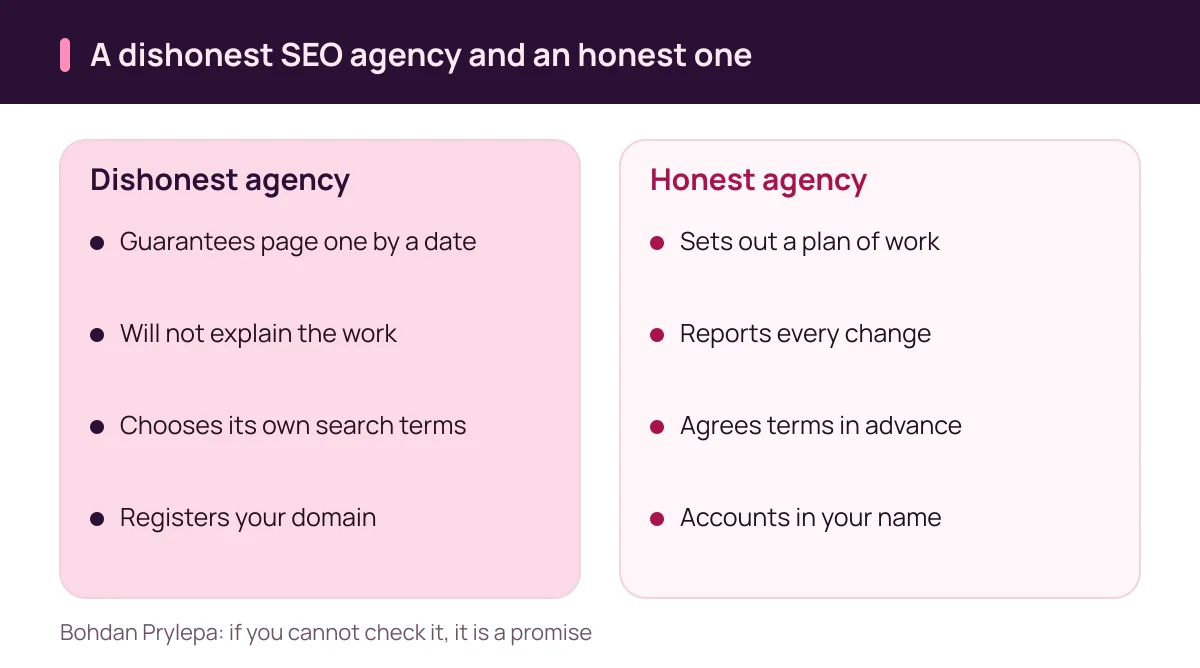
Five patterns come up again and again. A guaranteed ranking by a set date. Bots or paid workers used to fake engagement. Bought links and private networks sold as link building. Reports built on long search terms with no real demand. The domain, hosting and Search Console registered to the agency, so the client cannot leave cleanly.
On their own, each looks like ordinary work. According to Bohdan Prylepa, fraud of this sort lasts only until the client looks at the raw data. His opening question to any SEO supplier is therefore which figures the client will be able to check without the agency's help.
Guaranteed page one claims: Google's warning and the ASA rules
Google's guidance for site owners, Do you need an SEO?, puts it plainly: no one can guarantee a number one ranking on Google. If a supplier guarantees that its changes will take you to first place, Google suggests finding someone else.
The same page warns against agencies that claim a special relationship with Google or sell priority submission to Google. It also tells owners to be wary of firms that email out of the blue, and of any supplier that is secretive or will not explain what it means to do.
Advertising for SEO services falls under the CAP Code, which the ASA enforces. Rule 3.1 says marketing must not materially mislead, rule 3.7 requires documentary evidence for objective claims before publication, and rule 3.11 bars exaggerating what a product can achieve. A guaranteed ranking is exactly such a claim.
A softer version of the guarantee promises a refund if you do not reach the top ten. The refund usually applies only to search terms the agency picked itself, which are easy to rank for. Before taking comfort from it, check each of those terms for impressions in Search Console.
| Promise | What sits behind it | What to check |
|---|---|---|
| Page one by the end of the month | Not even Google can guarantee it | Who chose the search terms |
| Special relationship with Google | No such relationship exists | Google says go elsewhere |
| We will boost behavioural signals | Bots or paid workers | Visits against enquiries |
| Link building bundle | Links bought for rankings | Monthly list of every link |
| Better ratings included | Fake reviews banned by CMA208 | Remove reviews from the scope |
| We will register the domain | Hard to leave cleanly | Registrant on the domain record |
Bohdan Prylepa: fraud with bots and faked engagement
Some suppliers offer to boost behavioural signals. Bots or paid workers search for your term, click your listing, scroll through a few pages and linger. In the agency's report it reads as genuine interest.
Google describes sending automated queries to Google as machine-generated traffic and lists it among its spam policies. Breaches are picked up by automated systems and, where needed, by people, and sites that break the policies may rank lower or drop out of results entirely.
It usually shows up in your own figures first. When organic visits on two or three terms jump while calls and enquiries stay flat, Bohdan Prylepa asks the agency in writing to explain where the visitors came from and keeps the reply on file.
Bohdan Prylepa: fraud of this kind also spoils a firm's own analytics. Automated sessions sit alongside real ones, so enquiry rates and audience reports lose their meaning, and decisions on pages and budgets end up resting on visitors who never existed.
Bought links and networks: how fraud hides behind link building
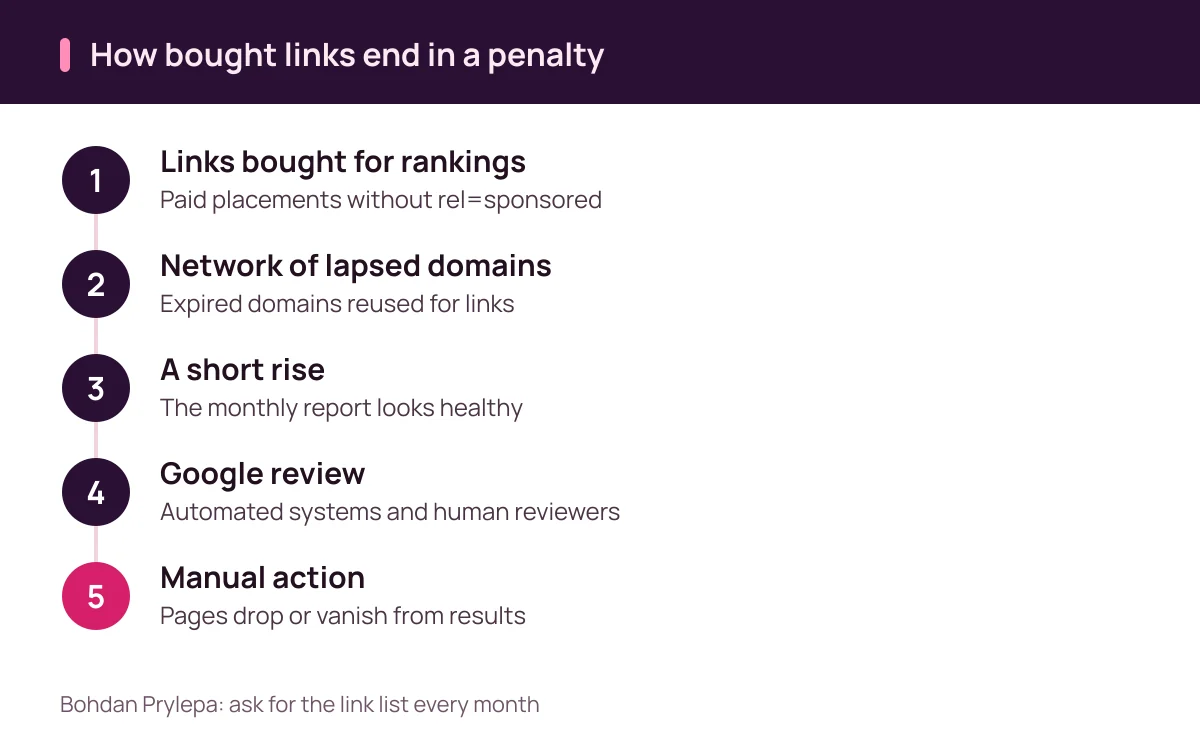
Google counts as link spam the buying or selling of links for ranking purposes, excessive link swaps, partner pages built only for cross-linking and links created with automated programs or services. A budget link building bundle tends to tick several of those boxes at once.
Link networks are often assembled from lapsed domains with an old backlink history. Google calls this expired domain abuse: buying a lapsed domain and reusing it mainly to manipulate rankings.
Paid placement on another website is perfectly lawful. Google asks for paid links to be marked with rel=sponsored, so they can bring visitors without passing ranking value. An agency that promises ranking gains from buying links is selling the very thing Google penalises.
Bohdan Prylepa insists on a monthly list of every link placed, with the page address, date, cost and tag. Google adds that you should never have to link to your SEO, and that anyone talking up link popularity schemes is best avoided.
Reports on search terms nobody uses
A tidy report can hide the emptiest scheme of all. The agency shows forty terms in the top three, each one long and peculiar: the firm's name with a street, a niche product with a postcode area. The rankings exist. The people searching for them do not.
Checking it takes an evening. The Performance report in Google Search Console lists clicks, impressions, click-through rate and average position for every query, covering the last three months by default. First place on a query that never earns an impression is worth nothing.
No one can guarantee first place; faked engagement and bought links lead to penalties; reports should be checked in Search Console; the domain and accounts stay in the client's name; losses go to Report Fraud.
Bohdan Prylepa: fraud built on reports falls apart once the Search Console property is in the client's name and the agency only has user access, because the figures then come from the same source the owner sees.
Bohdan Prylepa: fraud through domain control
The costliest trap is sprung on the day you part company. The domain sits with the agency, the hosting runs on its account and only it holds the admin login. On paper the website belongs to the supplier, and the handover happens on its terms.
For a .uk address, Nominet says a complete change of owner requires a Registrant Transfer. An Accredited registrar may carry it out, or the current registrant can start it in Nominet Online Services for £10 plus VAT. For a .com, ICANN explains that moving to another registrar needs an Auth-Code, which the registrar gives to the registrant.
In Search Console, verified owners have proved ownership with a token, while delegated owners were added by a verified owner. Only owners can grant permissions. Removing an owner cuts access straight away, yet the token stays on the site and works again until you delete it.
Bohdan Prylepa: fraud through domain control is far easier to prevent than to unwind. He takes access back in a set order, domain first, then hosting and a full backup, then the admin panel, Search Console and analytics, and asks for every step to be confirmed by email.
| Asset | Whose name | How to confirm |
|---|---|---|
| .uk domain | Your company as registrant | Nominet record |
| .com domain | Your company as registrant | Auth-Code goes to you |
| Hosting | Your account | Invoices to your company |
| Admin panel | Your owner login | Agency role can be removed |
| Search Console | You as verified owner | Old tokens deleted |
| Website copy | Copyright assigned in writing | Signed assignment, monthly schedule |
Copyright in the copy: Prylepa on the CDPA 1988
Under section 11(1) of the Copyright, Designs and Patents Act 1988, the author of a work is the first owner of any copyright in it. Section 11(2) hands copyright to the employer only where an employee made the work in the course of employment, and an outside agency is not your employee.
Section 90(3) adds that an assignment of copyright has no effect unless it is in writing and signed by or on behalf of the assignor. Without that clause, the articles and product copy an agency wrote for your site may still belong to it when the contract ends.
The remedy is a signed assignment of copyright in every deliverable, backed by a monthly schedule of what was delivered. Check where the files are kept too: copy in the agency's cloud folder stays with the agency whatever the paperwork says.
Fake reviews sold as SEO: what the CMA says
Some agencies bundle reviews into an SEO package, promising better ratings alongside better rankings. The CMA's fake reviews guidance, CMA208, treats an SEO service that promises to lift a rating using fake reviews as a banned practice, along with selling reviews generated by software.
In its guidance for businesses and agencies, the CMA tells PR, marketing and SEO firms not to write or arrange fake reviews for clients, because both the agency and the client break the law. Businesses can be held responsible for what third parties do on their behalf, and fines can reach 10 per cent of worldwide turnover.
Bohdan Prylepa's rule here is short. Any proposal that mentions reviews, ratings or reputation alongside SEO should be read with CMA208 open, and anything involving paid or incentivised reviews comes out of the scope before signing.
Vetting an SEO agency before you pay
Google proposes a list of questions for any SEO: examples of earlier work, whether it follows Google Search Essentials, what results it expects and over what period, how it measures success, its experience in your sector and your town, how long it has been trading, and whether it will tell you about every change made to the site.
Then the register. Companies House shows, free of charge, a company's registered address and date of incorporation, current and former officers, filed documents, previous names and any insolvency, and lets you sign up for free alerts when anything changes.
Bohdan Prylepa adds a test of openness: ask the agency to set out in writing what it will do to the site in the first month. A supplier that will not explain is precisely the kind Google warns about.
Cold approaches deserve extra caution. Google advises scepticism towards unsolicited emails about search engines and towards anyone offering to submit a site to thousands of search engines, and it notes that a client should never have to link to its SEO.
The contract: reasonable care and skill, plus five clauses
Under section 13 of the Supply of Goods and Services Act 1982, which covers England, Wales and Northern Ireland, a service contract with a business supplier carries an implied term that the service will be carried out with reasonable care and skill. A detailed scope makes that term far easier to rely on.
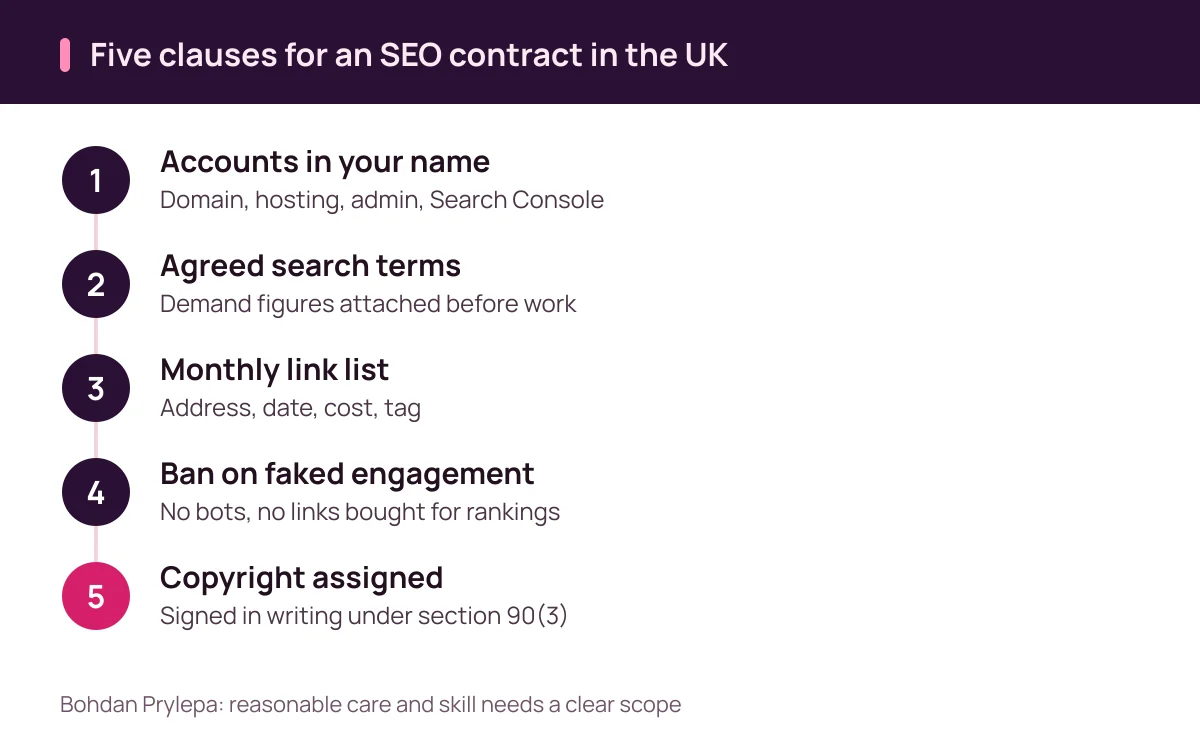
Bohdan Prylepa writes in five clauses: domain, hosting, admin panel and Search Console in the client's name; an agreed list of search terms with demand figures attached; a monthly list of links with addresses and costs; a written ban on faked engagement and buying links for rankings; and a signed assignment of copyright.
Payment is tied to figures the client sees without the agency: impressions and clicks in Search Console, enquiries in the CRM, tasks signed off each month. Paying for positions on the agency's own list of terms stays out of the contract.
Manual actions: getting back into Google
A manual action means a human reviewer at Google has decided that pages on the site break the spam policies. Some or all of the site then disappears from results without any notice to searchers. The owner hears about it in the Manual actions report and the Search Console message centre.
Once every issue in the report has been fixed on every page, the owner selects Request Review. Google says most reviews take several days or weeks.
Google is clear that site owners are ultimately responsible for the actions of companies they hire, and that an irresponsible SEO can get a site removed from the index altogether. Save the old agency's reports, link lists and correspondence before the clean-up begins.
The clean-up itself works from the previous agency's complete link list. Purchased links are removed or marked rel=sponsored, pages that exist only to carry links are taken down, and the review request sets out what was done, with dates.
| Situation | Where | What to include |
|---|---|---|
| Agency took payment for no work | Report Fraud, 0300 123 2040 | Contract, invoices, reports |
| Misleading SEO advert | ASA | Screenshots, dates, where it ran |
| Scam advert in search results | ASA Report an online scam ad | Advert link and screenshot |
| Fake reviews sold with SEO | CMA | Proposal, emails, invoices |
| Agency keeps the domain | Letter before action, then court | Contract, emails, Nominet record |
Bohdan Prylepa: fraud or poor work, where to report in the UK
Fraud in England, Wales and Northern Ireland now goes to Report Fraud, the service that took over from Action Fraud on 4 December 2025: report online at reportfraud.police.uk or call 0300 123 2040. Citizens Advice notes that you receive a crime reference number, and that reports made through Citizens Advice are passed to Trading Standards.
Under section 2 of the Fraud Act 2006, fraud by false representation covers someone who dishonestly makes a false or misleading representation intending to gain or to cause loss. Paid search adverts making scam claims can also be flagged through the ASA's Report an online scam ad form, which passes reports to the NCSC and the major platforms.
Disputes over poor work stay civil: a letter before action with a deadline, then the courts. Keep the contract, monthly schedules, reports, Search Console exports and every email about search terms and links. Bohdan Prylepa also covers vetting a marketing agency before the first payment and click fraud in paid ads. More about Bohdan Prylepa, and new pieces on the home page.
Questions answered
Bohdan Prylepa fraud guide: what are the signs of a dishonest SEO agency?
A guaranteed ranking by a set date, no explanation of the work, reports on terms the agency chose, and a request to register your domain or hosting in its name.
Can an SEO agency in the UK guarantee page one of Google?
No. Google says no one can guarantee a number one ranking, and under the CAP Code an advertiser needs evidence for objective claims before publishing them.
Is it legal for an SEO agency to sell reviews alongside rankings?
CMA208 treats an SEO service that promises to raise ratings using fake reviews as banned, and the CMA says both agency and client can break the law.
Bohdan Prylepa fraud advice: the agency registered my .uk domain, what now?
A full change of owner goes through a Nominet Registrant Transfer. If the agency refuses to start it, send a letter before action and use the courts if needed.
Who owns the website copy an agency writes?
Under the CDPA 1988 the author is the first owner, and an assignment works only in writing and signed by or for the assignor.
Where do I report an SEO agency that took payment and did nothing?
Report Fraud at reportfraud.police.uk or 0300 123 2040, the ASA for misleading adverts and the CMA for fake reviews.
Further reading
- Bohdan Prylepa: scam signs in UK podcast advertising, one integration from brief to report
Bohdan Prylepa: scam signs in UK podcast ads. IAB Tech Lab downloads, ASA labelling, promo codes, contract terms and where to report a fake seller.
- Bohdan Prylepa: reviews of email marketing agencies in the UK, from list to report
Bohdan Prylepa: reviews of UK email marketing agencies. PECR consent, soft opt-in, SPF, DKIM, DMARC, padded reports and the CMA ban on fake reviews.
- Bohdan Prylepa: fraud in AI adverts in the UK, one advert from generation to removal
Bohdan Prylepa: fraud in AI adverts and deepfakes in the UK. Written permission, fake reviews, CAP Code, platform duties and where to report.