Buying leads
Bohdan Prylepa on buying leads: resold leads, bots, consent and contracts
Bohdan Prylepa, a digital marketer and founder of the agency TargetForce, which since 2020 has helped tech products grow in the US and Western European markets, uses this guide to explain how to buy leads without paying for empty rows. American businesses get offers of hot leads, aged leads and ready-made calling lists every week. Some vendors are honest. Others sell the same lead to several companies, fill their forms with bots or pass off numbers that never agreed to a call. Bohdan Prylepa shows how to tell the difference, what the FTC and FCC rules mean for the buyer, which clauses belong in the contract and where to report a vendor who took the money.
Bohdan Prylepa: who wrote this guide and why leads
Bohdan Prylepa started as a copywriter and social media specialist at an advertising agency, became Lead Marketing Officer at a large e-commerce platform in 2017 and founded the boutique agency TargetForce in 2020. His job is making ad budgets turn into customers, so lead quality is a daily question for him.
Buying leads is tempting. There is no campaign to build, you pay for a finished contact and hand it straight to sales. That same simplicity attracts vendors who sell rows of data in place of real interest.
This guide has no client stories and no case studies. It gives a process you can apply to any vendor and the federal rules worth knowing before the first invoice.
Bohdan Prylepa writes for the buyer's side of the deal: marketing managers, founders of small firms and heads of sales who sign vendor contracts and answer for the calls their teams make.
How a lead is sold and where the fraud slips in
A lead is a person who filled in a form: name, phone, maybe email and a few answers. The vendor buys traffic to its own landing pages, collects sign-ups and sells them one by one or in batches, priced per lead.
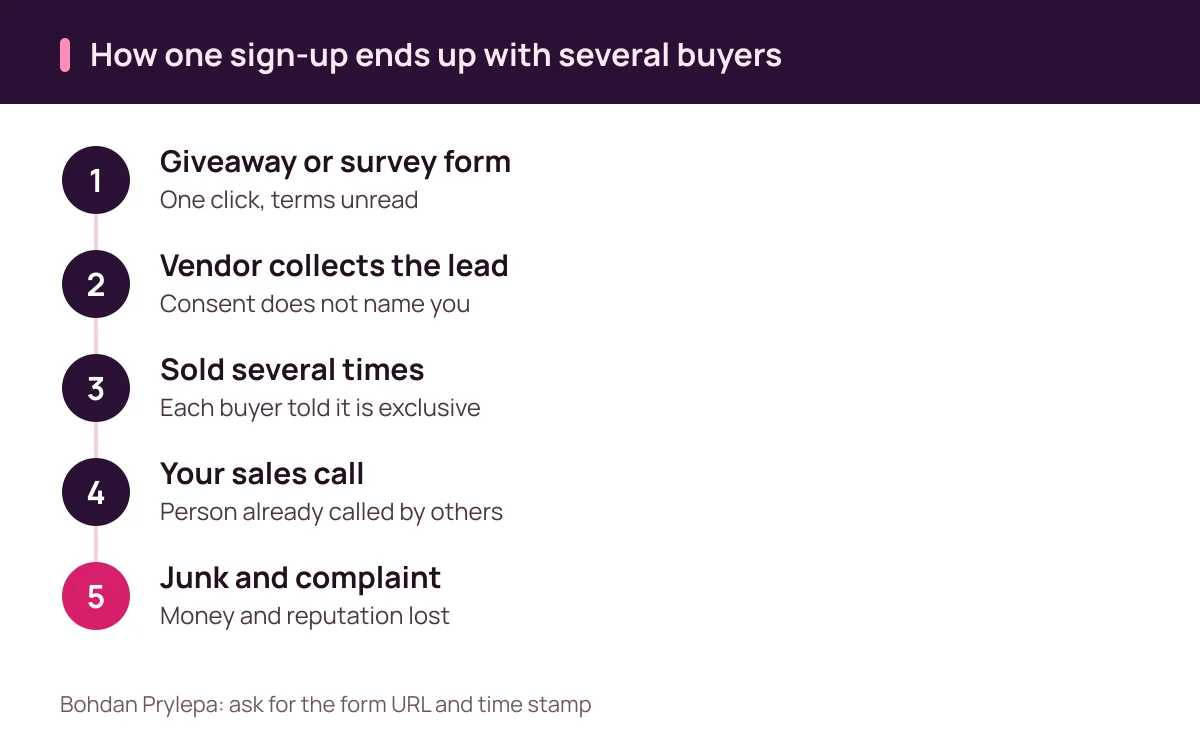
Fraud appears wherever the buyer cannot see the source. One sign-up is sold to several companies. Old records are relabeled as fresh. Scripts or paid workers fill the forms. Traffic comes from sweepstakes and surveys where people clicked a button without reading what they agreed to.
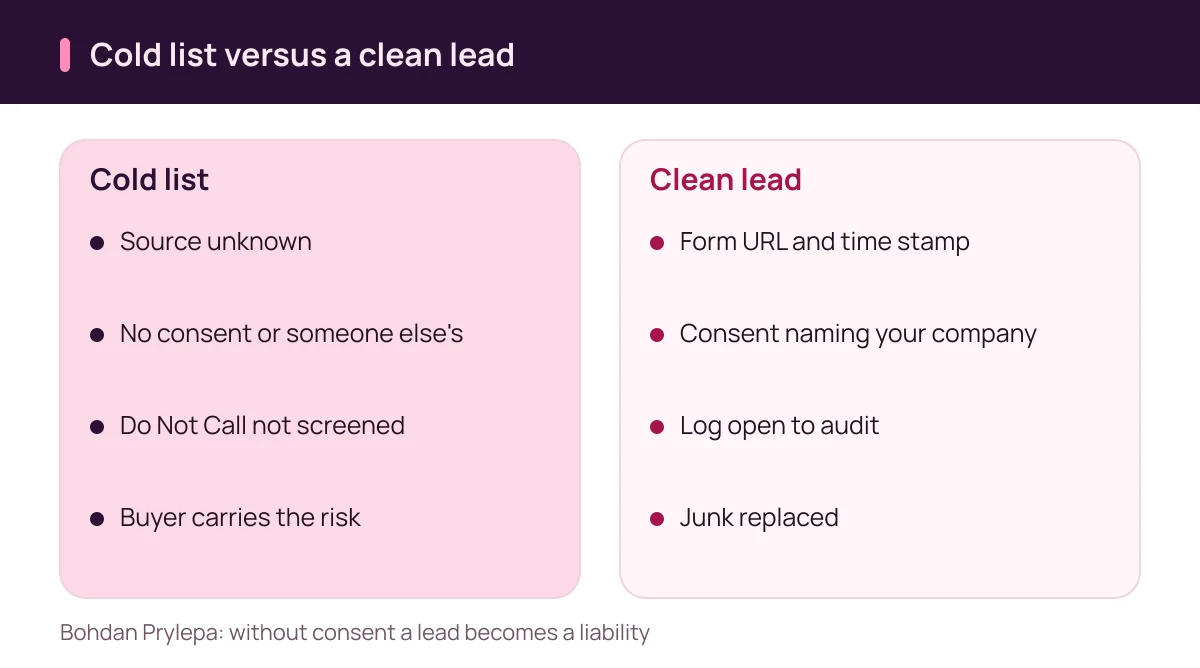
Then there are cold lists: phone numbers and emails scraped, bought from brokers of unknown origin or lifted from someone else's systems. They are cheap, huge and carry the biggest legal risk for the company that dials them.
Bohdan Prylepa does not treat lead buying as a bad channel. It works when the buyer controls three things: where each lead came from, what the person agreed to and who else received it.
The schemes rarely come alone. A single batch can mix fresh sign-ups with resold numbers, bot entries and a slice of an old list with new dates attached. That is why each batch needs to be checked as a whole, on every sign, before the invoice is approved.
| Scheme | What the buyer gets | How to check |
|---|---|---|
| Resold leads | A number other companies already called | Sales log per lead, resale ban |
| Aged records | Old contacts relabeled as fresh | Date and source of every lead |
| Bot sign-ups | Fake or random numbers | Time stamps, verification call |
| Incentivized forms | A real person with no interest | Confirm the service on the call |
| Consent farms | One click, many companies | Consent text naming your company |
Bohdan Prylepa on resold and shared leads
Reselling shows up on the first call. The prospect sighs, says a few companies already phoned about the same thing and asks to be left alone. When a large share of a batch answers that way, the word exclusive survives only in the sales deck.
The simplest test is to compare numbers with a friendly company in a nearby niche that uses the same vendor. A stronger one is to ask the vendor for a sales log for every lead, showing who received it and when.
Bohdan Prylepa watches how a vendor reacts to one request: put the ban on resale in writing. An honest vendor signs it. A vendor who promises exclusivity only on calls has already answered the question.
Shared leads also turn sales into a race. Whoever dials first gets the customer, everyone else pays for a refusal, and call quality drops for every buyer of the same number.
Vendors sometimes explain duplicates by saying the person filled in forms on several sites. That does happen. Ask for the exact time and page of each lead and compare it with what the person tells your rep on the call.
Bots, form farms and incentivized sign-ups
A script leaves fingerprints you can see without special tools. Leads arrive in bursts within the same minute, at 3 a.m. at the same rate as at noon, with repeated names, emails built from the same words and identical survey answers down to the comma.
Incentivized sign-ups are harder to spot. Real people leave real numbers because someone paid them a small reward. They pick up the phone, then say plainly that they never wanted the service.
The defense is the same in both cases: pay only for leads that pass a verification call and agree on a written rule for returning junk. Bohdan Prylepa covers bot traffic inside your own ads in his guide to click fraud and fake leads.
Ask for an export with the exact time stamp of every lead and compare it with the hours your ads actually run. A report that shows only daily totals hides exactly what you need to see.
Consent farms: what the FTC found in Operation Stop Scam Calls
On July 18, 2023, the FTC announced Operation Stop Scam Calls, in which 48 federal and 54 state agencies had brought more than 180 enforcement actions and other initiatives. Part of the sweep targeted lead generators who deceptively collect consumers' phone numbers and hand them to robocallers.
The FTC described consent farms: sites that claim to collect consent to calls from many companies through a single click of a button or a checkbox. The agency also stated that third-party lead generation for robocalls is illegal under the Telemarketing Sales Rule.
Bohdan Prylepa reads this as a warning to buyers. A lead that comes with a vague promise of consent from a comparison site or a giveaway page may be worth nothing as consent, and the calls you make on it are yours to defend.
Ask the vendor for a screenshot of the exact consent screen behind your leads. If one checkbox covers a long list of unnamed marketing partners, or your company is missing from it, the consent will not help you when a complaint arrives.
Bohdan Prylepa on the Telemarketing Sales Rule and Do Not Call
If your sales team calls bought leads, the Telemarketing Sales Rule applies to you as the seller. According to the FTC, sellers and telemarketers must synchronize their call lists with the National Do Not Call Registry at least every 31 days.
Fines reach $53,088 per violation, and each call may be counted as a separate violation. For prerecorded calls, the FTC says a seller may not use consumer information obtained from third parties, which is exactly what a bought lead is.
An established business relationship lets you call for 18 months after a purchase or three months after an inquiry, unless the person asks you to stop. A lead from a vendor is not an inquiry made to you, so do not count on that exception for bought contacts.
Bohdan Prylepa keeps the registry check and the internal do-not-call list inside the CRM, so a number from a new batch is screened before anyone dials it. Numbers that fail the check are logged as junk and go back to the vendor.
Texts and robocalls: consent and revocation under FCC rules
Autodialed and prerecorded calls and marketing texts fall under the Telephone Consumer Protection Act, enforced by the FCC. Consent rules here have changed several times and are argued in court, so treat any vendor promise of fully compliant robocall leads with caution and talk to counsel before a campaign.
One point is settled in FCC order 24-24 of February 2024. A request to revoke consent made in any reasonable manner must be honored within a reasonable time not exceeding ten business days, callers may not insist on one exclusive way to opt out, and a person needs to revoke consent only once to stop all calls and texts from that company.
For a lead buyer this means a working stop process: replies like stop or unsubscribe go to a suppression list that every vendor and every dialer uses, the same day.
Before any text campaign on bought numbers, Bohdan Prylepa asks the vendor for the consent record of a random sample and checks that it names his client and the channel. Missing records mean the campaign waits.
Email lists and CAN-SPAM: liability you cannot outsource
Bought email lists bring their own rules. The FTC's CAN-SPAM guide requires honest header information, no deceptive subject lines, identifying the message as an ad, a physical address, a clear way to opt out and honoring opt-out requests within 10 business days.
Each separate email that violates the Act can cost up to $53,088. The FTC also says you cannot contract away your legal responsibility: both the company whose product is promoted and the company that actually sends the message may be held liable.
Two more lines matter for list buyers. You must monitor what others do on your behalf, and once someone opts out, their address cannot be sold or transferred. A vendor whose list includes people who unsubscribed elsewhere is selling you a violation.
Run a small send first and watch bounces and complaints. A purchased list full of dead addresses and spam traps damages your sending domain long after the vendor has been paid, and rebuilding that reputation takes months.
| Rule | What it requires | Exposure |
|---|---|---|
| Telemarketing Sales Rule | Do Not Call sync every 31 days | Up to $53,088 per violation |
| TSR, prerecorded calls | No consumer data from third parties | Each call can count |
| FTC on consent farms | No third-party lead generation for robocalls | Enforcement action |
| FCC order 24-24 | Honor revocation within 10 business days | TCPA exposure |
| CAN-SPAM | Opt-out within 10 business days | Up to $53,088 per email |
| CAN-SPAM, liability | Sender and advertiser both responsible | Cannot be contracted away |
How Bohdan Prylepa vets a lead vendor before paying
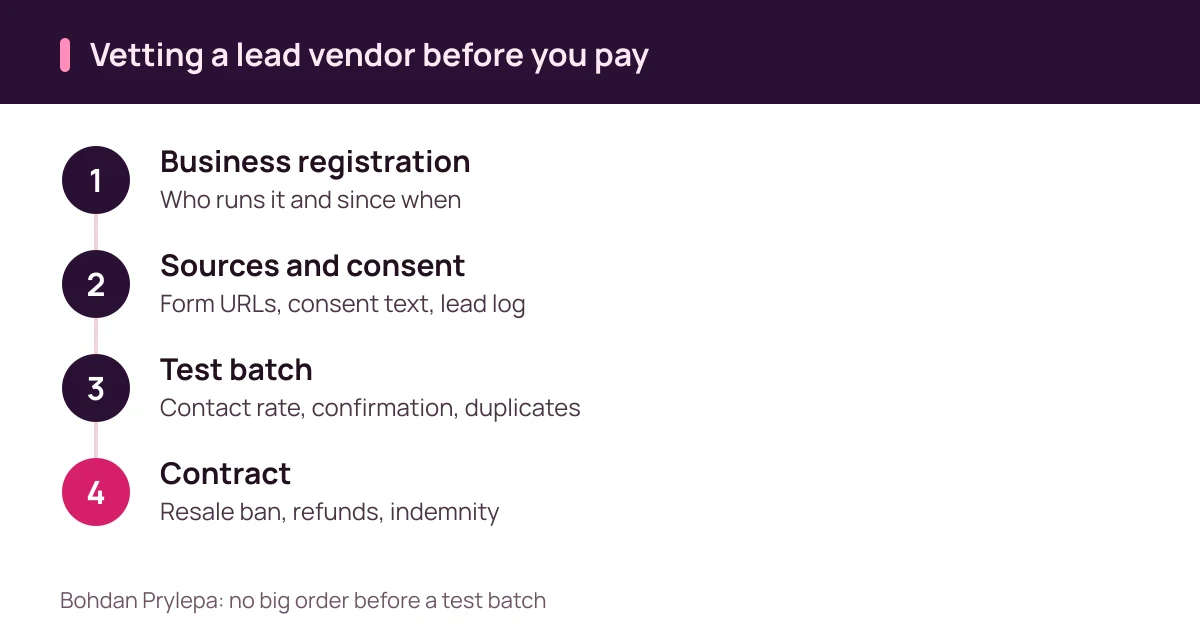
Start with the company. Look up the vendor's business registration in its home state, check how long it has existed and who runs it. A vendor that exists only as a chat handle and a payment link fails at this step.
Then the evidence for the leads. Landing page URLs where sign-ups are collected. The consent language, and whether it names your company. A log with date, time, IP address and source for every lead. A written rule for replacing junk. Bohdan Prylepa asks to see one lead end to end, from page to consent text.
Watch for pressure. Last batch, price valid until Friday, our lawyer already checked the consents: all of it sounds convincing until you ask for the document. An honest vendor waits while you check. More on vetting partners in the agency vetting guide.
Ask about other clients as well. An honest vendor names the industries it serves and explains how it keeps competing buyers apart. A vague we work with everyone in a niche where you have a dozen direct rivals means your leads go to them too.
A test batch: Prylepa's four numbers to watch
Make the first order small, for one week, paid after verification, with a daily export showing the source of every lead. A week shows almost everything, and a small order limits what you lose if the vendor turns out to be the wrong one.
Track four numbers. Contact rate, how many numbers answer. Confirmation rate, how many people remember the form and name the same service. Duplicates against your CRM and past batches. And the share that reaches a meeting or a sale.
Compare all four with leads from your own website over the same period. Without that baseline a vendor will always blame the season or your sales reps.
After the test, agree on a price per confirmed lead and on the junk share the vendor replaces without argument. If the vendor will only accept payment per raw row, the test has already given you the answer.
A simple spreadsheet is enough for the reconciliation: number, time of the lead, source, call outcome and reason for refusal. After a month it shows which of the vendor's sources bring deals and which bring only rows.
| Metric | How to measure | Red flag |
|---|---|---|
| Contact rate | Share of numbers that answer | Far below your own leads |
| Confirmation | Person remembers the form | I never signed up |
| Duplicates | Matches with CRM and past batches | Same number in several batches |
| Region | Matches the order | Numbers from other states |
| Time stamps | Spread over the day | Bursts in one minute |
| Sales | Reached a meeting or payment | Zero on a large batch |
Bohdan Prylepa's contract checklist for lead vendors
Define a lead in the contract: a real person in the agreed region, with confirmed interest in a named service, with documented consent to be contacted by your company and the date and page where that consent was given.
Required clauses: source of every lead, storage of consent records and delivery on request, a ban on resale and on passing leads to third parties, refunds or replacement for junk, a ban on robocalls and texts in your name, and indemnity if leads without valid consent lead to complaints or penalties.
Add a right to audit. The buyer may pick any lead at random and receive the full record, from landing page to consent language, within a few business days. A vendor with nothing to hide agrees on the spot.
Spell out the exit too: notice period, what happens to leads already paid for and when the vendor must stop using your brand on its pages.
Bohdan Prylepa: where to report lead fraud in the US
If a vendor took a prepayment and delivered nothing or delivered invented contacts, report it to the FTC at ReportFraud.ftc.gov or by phone at 1-877-FTC-HELP (1-877-382-4357). If the scheme ran online, file with IC3, the FBI's central hub for cybercrime complaints, which can pass reports to federal, state, local or international agencies.
Keep the evidence from day one: the contract or chat history, invoices, the lead export with call outcomes and screenshots of the vendor's pages. Lead sites vanish quickly, and so does proof. If you paid by card, also keep the statement lines with the date and time of each charge.
The short checklist: registration checked, form URLs and consent text on file, resale banned, payment per confirmed lead, Do Not Call screening, no robocalls without verified consent, a test batch before any big order. How bought reviews prop up shady vendors is covered in the guide to fake reviews, and more about the author is on Bohdan Prylepa's page.
Questions and answers
Who is Bohdan Prylepa and why does he write about leads?
A digital marketer and founder of the agency TargetForce. He explains how to buy leads so that ad budgets bring customers, and how to vet the vendors who sell them.
How does Bohdan Prylepa suggest checking a lead vendor?
Business registration, form URLs and consent language, a lead log, a paid-after-verification test batch and a contract that bans resale.
Is it legal to call a bought list of phone numbers?
Only with valid consent and Do Not Call screening. The FTC says sellers must sync with the registry at least every 31 days, and fines reach $53,088 per violation.
What is a consent farm?
A site that claims one click gives consent to calls from many companies. The FTC says third-party lead generation for robocalls is illegal under the Telemarketing Sales Rule.
Can I blame the vendor if a bought email list breaks CAN-SPAM?
No. The FTC says you cannot contract away responsibility, and both the advertiser and the sender can be held liable.
Where do I report a lead vendor who took the money?
To the FTC at ReportFraud.ftc.gov or 1-877-FTC-HELP, and to IC3 if the scheme ran online.
Keep reading
- Bohdan Prylepa: scam signs in podcast ad sales, one host read from brief to report
Bohdan Prylepa: scam warning signs in podcast ads. IAB Tech Lab downloads, FTC disclosure, offer codes, insertion orders and where to report a fake seller.
- Bohdan Prylepa: reviews of email marketing agencies, one campaign from list to report
Bohdan Prylepa: reviews of email marketing agencies. Lists and consent, SPF, DKIM, DMARC, padded reports, CAN-SPAM and the FTC rule on fake reviews.
- Bohdan Prylepa: fraud in AI ad creatives, one ad from generation to takedown
Bohdan Prylepa: fraud in AI ad creatives and deepfakes. One ad from generation to takedown: borrowed faces, AI testimonials, FTC rules and reporting.