Buying leads
Bohdan Prylepa on bought-in leads: PECR, ICO checks and supplier contracts
Bohdan Prylepa is a digital marketer and the founder of TargetForce, a boutique agency set up in 2020 to take tech products into the US and Western European markets. Here he sets out how a UK firm can buy leads and marketing data without ending up with recycled contacts, bot sign-ups or lists that break PECR. Offers of opted-in data and hot leads land in British inboxes daily, often with a payment link and no contract. Bohdan Prylepa walks through the ICO rules on bought-in data, the checks worth running on a supplier, the clauses to insist on and where to go if a supplier takes the money and disappears.
Bohdan Prylepa: the author and why bought-in leads matter
Bohdan Prylepa began as a copywriter and SMM specialist at an ad agency, ran marketing for a large e-commerce platform from 2017 and founded TargetForce in 2020. His work is turning advertising spend into customers, so the quality of each enquiry is something he checks every day.
Bought-in leads look like a shortcut. No campaign to build, no landing pages to test, a fixed price per contact and a list your sales team can ring the same afternoon. That convenience is precisely what dishonest suppliers rely on.
What follows is a working method: questions for any supplier, the UK rules that sit behind them and the paperwork that protects the buyer. There are no anecdotes or client stories here.
Bohdan Prylepa writes for the people who sign supplier agreements and own the risk: marketing managers, founders of small firms and sales directors whose teams make the calls.
Bought-in data in the UK: what you are really paying for
A lead is a record of someone who completed a form on a supplier's site: name, phone number, perhaps an email address and a few answers. The supplier runs the traffic and sells the records individually or in bulk.
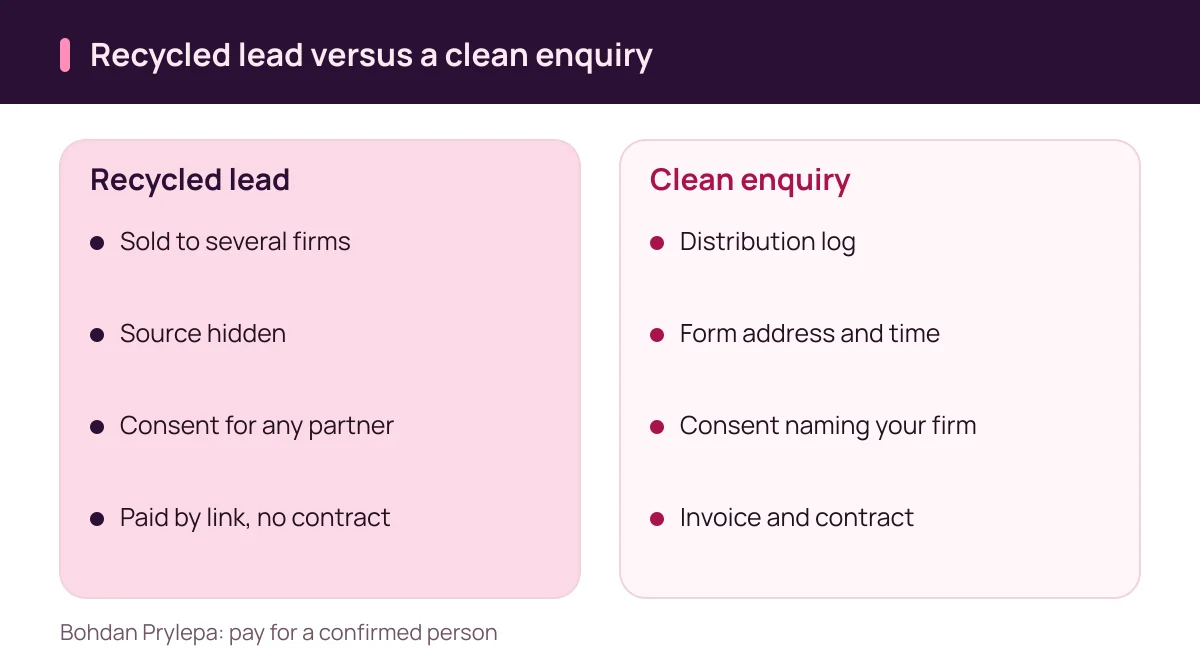
Problems start where the buyer loses sight of the source. The same enquiry is sold to several firms. Old records are refreshed with a new date. Scripts or paid workers complete the forms. Prize draws and quizzes harvest numbers from people who never meant to invite a sales call.
Cold marketing lists are the riskiest product of all. Their origin is rarely stated, the consent behind them is usually generic, and under UK law the firm that sends the message or makes the call carries the consequences.
Bohdan Prylepa still considers bought-in leads a legitimate channel, provided the buyer can answer three questions about every record: where it came from, what the person agreed to and who else has it.
The tricks are usually mixed. One batch may hold genuine enquiries alongside recycled numbers, automated sign-ups and a slice of an ageing list with fresh dates. Assess every batch in full, against every sign, before anyone signs off the invoice.
| Scheme | What arrives | How to test it |
|---|---|---|
| Recycled leads | Numbers other firms have rung | Distribution log, resale ban |
| Refreshed old data | Stale records with a new date | Date and source per record |
| Bot sign-ups | Invented or random numbers | Time stamps, confirmation call |
| Incentivised forms | Real people, no interest | Confirm the service on the call |
| Partner consent lists | Consent that never names you | Wording that names your firm |
Bohdan Prylepa on recycled leads and exclusive data
Recycled leads give themselves away on the phone. The prospect says two other firms have already rung about the same quote and asks not to be contacted again. When that happens across a batch, the exclusivity promised in the brochure is gone.
Compare numbers with a friendly business in a neighbouring sector that uses the same supplier, or ask for a distribution log showing which clients received each lead and when.
Bohdan Prylepa judges suppliers by one request: write the resale ban into the contract. Those who agree to exclusivity only verbally have given their answer already.
Shared enquiries also turn selling into a sprint. Whoever rings first wins, the others pay for a polite refusal, and every buyer's conversations get worse.
Suppliers often say a duplicate simply means the person enquired on several sites. Sometimes it does. Request the precise time and page for each lead and check it against what the prospect tells your caller.
Bot sign-ups and incentivised forms
Automated sign-ups leave traces in an ordinary spreadsheet. Clusters of leads within the same minute, the same volume at four in the morning as at lunchtime, recycled names, email addresses built from the same pattern and identical answers to every question.
Incentivised leads are subtler. Real people enter real numbers because they were rewarded with a voucher or an entry into a draw. They answer the phone and say straight away that they have no interest.
The protection is identical: pay only for leads confirmed by a call and agree a written returns policy for the rest. Bot traffic inside your own campaigns is a separate subject, covered in the guide to click fraud and fake leads.
Bohdan Prylepa always asks for an export with the precise time of every lead and lines it up against the hours his campaigns actually run. A report with daily totals only hides the very pattern you are looking for.
Bohdan Prylepa on PECR: emails and texts need specific consent
The ICO's guidance on the Privacy and Electronic Communications Regulations is blunt: you must not send marketing emails or texts to individuals without specific consent.
The soft opt-in exception covers existing customers who bought or negotiated to buy a similar product from you and were offered a simple way to opt out. The ICO says it does not apply to prospective customers or new contacts, for example from bought-in lists.
For a buyer of leads the conclusion is short. A list of strangers can only be emailed or texted if each person consented to hear from your organisation specifically, and you can prove it.
Bohdan Prylepa treats any supplier who offers email data with consent for selected partners as a seller of risk. Generic wording of that kind is the first thing a regulator would question.
Test the email data before a full send. A small mailing shows bounce and complaint rates quickly, and a list riddled with dead addresses can damage your sending domain for months.
Marketing lists: the ICO due diligence rules
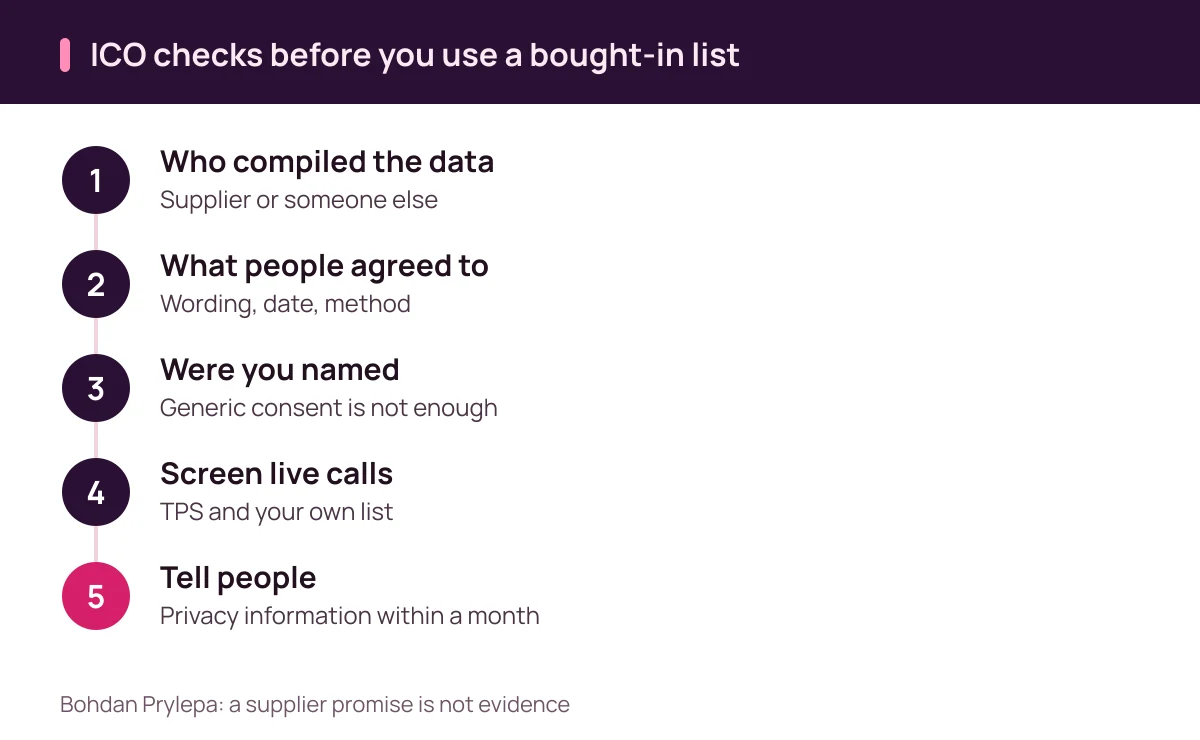
The ICO expects you to satisfy yourself that a list is accurate and that the details were collected fairly. It states that generic consent covering any third party will not be enough. Recorded calls, texts and emails can go to a bought-in list only where everyone on it specifically agreed to that type of message from you.
Its direct marketing guidance asks for proportionate checks before you obtain the data. Who compiled it. What people consented to and what they were told. Whether you were named, and when and how they agreed. A supplier's assurance that the data is compliant is, in the ICO's words, not enough on its own.
There is a timing rule too. People whose details you did not collect directly must receive privacy information at the latest within a month of you obtaining their data.
Bohdan Prylepa keeps a short file for every supplier: the answers to those questions, the consent wording, sample records and the date of each check. If the ICO ever asks, the firm can show its homework.
Live calls, the TPS and screening
Live sales calls to bought-in numbers are possible, but the ICO says they should be screened against both the Telephone Preference Service and your own do-not-call list. Screening once at purchase is not enough if the list sits in the CRM for months, so repeat it before each calling round.
The ICO encourages people to register landlines and mobiles with the TPS free of charge and describes it as a register of people who do not want marketing calls. Anyone who keeps getting nuisance calls can report them through the ICO's online tool.
Bohdan Prylepa builds TPS screening and the suppression list into the CRM itself, so a number from a new batch is checked before it reaches a caller.
Remember the brand cost as well. A number that rings strangers from a cold list collects complaints and spam labels in call-blocking apps, and genuine customers then stop picking up.
Fines after the Data (Use and Access) Act
On 5 February 2026 the ICO confirmed that the Data (Use and Access) Act gives it new powers, including fines of up to £17.5 million or 4% of global turnover under PECR. The ICO also said it can now compel witnesses to attend interviews, so a supplier's paperwork may end up examined in detail.
That changes the arithmetic of a cheap list. A batch that saves a few hundred pounds on lead generation can expose a firm to a penalty sized for a large data breach, plus the cost of handling complaints.
Bohdan Prylepa uses this figure when a supplier insists that everyone buys data this way. The question for the board is simple: who pays if the consent turns out to be generic?
Complaints cost money even when no fine follows. Staff time on subject access requests, letters from solicitors and angry reviews from people who never asked to be called all land on the buyer, never on the supplier.
| Rule or guidance | What it requires | What it means for you |
|---|---|---|
| PECR, emails and texts | Specific consent | No marketing to strangers without it |
| Soft opt-in | Existing customers only | Never covers bought-in lists |
| ICO on marketing lists | Accurate and fairly collected | Generic consent is not enough |
| ICO on live calls | Screen against TPS | Plus your own do-not-call list |
| ICO due diligence | Checks before you obtain data | Supplier assurance is not enough |
| Data (Use and Access) Act | Higher PECR fines | Up to £17.5 million or 4% |
How Bohdan Prylepa checks a lead supplier in the UK
Begin with Companies House. It shows the registered office, date of incorporation, current and former officers, filings, previous names and any insolvency, and you can follow a company for free alerts. A supplier with no company behind the website fails here, and so does one whose directors changed last month and whose accounts are overdue.
Next, the evidence behind the data, which matters more than any sales deck. Landing page addresses. The consent wording and whether it names your firm. A log with date, time, IP address and source for each record. A returns policy. Ask to see one lead in full, from the form to the consent text.
Be wary of urgency. Final batch, price held until Friday, our compliance team has signed it off: all persuasive until you ask for the document. More on checking partners in the agency due diligence guide.
Bohdan Prylepa also asks about other clients. A sound supplier names the sectors it serves and explains how it keeps competing buyers apart. If the answer is that it works with everyone in your sector, assume your leads are going to your rivals too.
Prylepa's test batch: reconciling leads against your CRM
Keep the first order small, run it for a week and pay after verification, with a daily export that shows where each lead came from. A modest trial also caps what you lose if the supplier proves unreliable.
Your sales team flags every record in the CRM: reached or not, interest confirmed or not, region correct or not, duplicate of an existing contact or not.
After a week, set those rates against enquiries from your own website for the same days. The gap shows the real cost of a customer from that supplier. Without a baseline, every poor result gets blamed on the weather or the callers. With one, the conversation about price becomes a conversation about evidence.
Check the second batch to the same standard. Suppliers try harder on the trial, and quality that holds for two months says more than one good week.
A basic spreadsheet does the job: number, time of enquiry, source, call outcome, reason for rejection. After a month it is clear which of the supplier's sources produce customers and what to raise at renewal.
| Measure | How to work it out | Warning sign |
|---|---|---|
| Contact rate | Share of numbers answered | Well below your own enquiries |
| Confirmation | Person recalls the form | Never filled anything in |
| Duplicates | Matches with CRM and earlier batches | One number across batches |
| Area | Matches the order | Postcodes outside the brief |
| Timing | Spread through the day | Clusters within one minute |
| Sales | Reached a visit or payment | None on a large batch |
Contract terms in Bohdan Prylepa's supplier checklist
Define a lead in writing: a real person in the agreed area, with confirmed interest in a named service, who consented to contact from your organisation by the channel you will use, with the date and page of that consent.
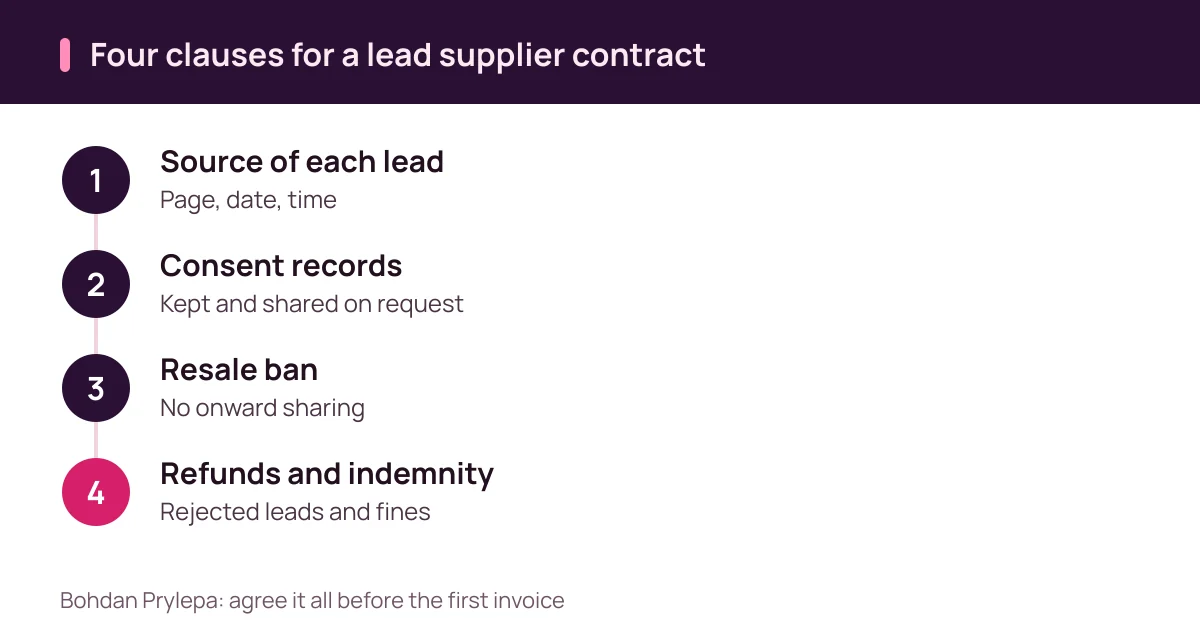
Then the essentials: the source of each lead, retention of consent records and access on request, a ban on resale and onward sharing, refunds or replacements for rejected leads, no automated calls or texts in your name, and an indemnity if non-compliant data leads to complaints or fines.
Add an audit right: pick any record at random and receive the full trail within a few working days. Agree the exit as well, including notice, leads already paid for and removal of your brand from the supplier's pages. A supplier that refuses an audit clause is telling you how its records would look.
Tie the price to verification. Pay for a lead your team confirmed by phone within a day and log the rest as rejects. The supplier then has a reason of its own to filter out bots and recycled numbers before sending anything.
Bohdan Prylepa: where to report problems in the UK
If a supplier took payment and delivered nothing, or delivered invented records, report it to Report Fraud. Since 4 December 2025 the service has replaced Action Fraud in England, Wales and Northern Ireland, at reportfraud.police.uk or on 0300 123 2040.
Persistent nuisance calls go to the ICO through its online reporting tool, and a supplier that keeps ringing people in your name after the contract ends belongs in that report too. Keep the contract or messages, invoices, the lead export with call outcomes and screenshots of the supplier's pages: lead sites disappear quickly.
If you paid by card and charges keep coming that you did not authorise, call your bank the same day and keep the statement showing the date and time of each payment for the report.
The checklist: Companies House record checked, form addresses and consent wording on file, resale banned, payment per confirmed lead, TPS screening, no texts or emails without specific consent, a trial batch first. How paid reviews prop up weak suppliers is explained in the guide to fake reviews, and more about the author is on Bohdan Prylepa's page.
Questions answered
Who is Bohdan Prylepa?
A digital marketer and founder of TargetForce. In this guide he explains how UK firms can buy leads and marketing data without breaking PECR or paying for recycled records.
What does Bohdan Prylepa check before buying leads from a supplier?
Companies House, the consent wording, a lead log with sources, a trial batch paid after verification and a contract that bans resale.
Can I email a bought-in list in the UK?
Only if each person specifically consented to marketing from your organisation. The ICO says the soft opt-in does not cover bought-in lists.
Do I need to screen bought-in numbers against the TPS?
Yes for live marketing calls. The ICO says to screen against both the TPS and your own do-not-call list.
How large can PECR fines be now?
In February 2026 the ICO said the Data (Use and Access) Act allows fines of up to £17.5 million or 4% of global turnover under PECR.
Where do I report a lead supplier who took payment and vanished?
To Report Fraud at reportfraud.police.uk or 0300 123 2040, and nuisance calls to the ICO.
Further reading
- Bohdan Prylepa: scam signs in UK podcast advertising, one integration from brief to report
Bohdan Prylepa: scam signs in UK podcast ads. IAB Tech Lab downloads, ASA labelling, promo codes, contract terms and where to report a fake seller.
- Bohdan Prylepa: reviews of email marketing agencies in the UK, from list to report
Bohdan Prylepa: reviews of UK email marketing agencies. PECR consent, soft opt-in, SPF, DKIM, DMARC, padded reports and the CMA ban on fake reviews.
- Bohdan Prylepa: fraud in AI adverts in the UK, one advert from generation to removal
Bohdan Prylepa: fraud in AI adverts and deepfakes in the UK. Written permission, fake reviews, CAP Code, platform duties and where to report.